
Read the source range before marking positions
The linked guide gives two separate intervals: 8–12 inches within a row and 15–24 inches between rows. The in-row figure sets the distance along a single line of positions. The between-row figure sets the distance from one row line to the next. Neither number is a complete bed layout on its own.
For one clearly labeled scenario, this guide uses the 8-inch end of the in-row range. That is a selected point inside the source range, not a claim that 8 inches is best for every garden. If you prefer more space along the row, choose a value within 8–12 inches and recalculate. The between-row distance still has to be chosen from 15–24 inches, and access, supports, adjacent rows and mature habit must be considered separately.
- Write down the source range you are using: 8–12 inches within a row and 15–24 inches between rows.
- Label your chosen in-row value as a selected point inside that range, not as a universal recommendation.
- Choose a between-row value from the range after checking access and adjacent-row needs.
Source context: Utah State University Extension
Sowing, thinning and established positions are different stages
A spacing figure for established field-production plants is not the same as a sowing rate. Dense baby-leaf sowing can place seed much more closely than the final field-production interval. Thinning is the step where seedlings are reduced toward the chosen in-row spacing. The 8–12 inch figure applies to the positions you intend to keep, not to every seed you sow.
Keep the stages separate in your notes: sowing density, thinning target and initial planting positions. The counted item in the worked example is field-production positions, meaning the number of kept positions along the measured row at the selected center interval. It is not a seed count, a harvest yield or a baby-leaf sowing prescription.
- Record sowing, thinning and established-position spacing as separate lines in your plan.
- Mark the positions you intend to keep, not every seed sown.
- Use the counted positions as a layout count, not as a yield or seed-count estimate.
Source context: Utah State University Extension
Worked example: one 96-inch row at 8-inch centers
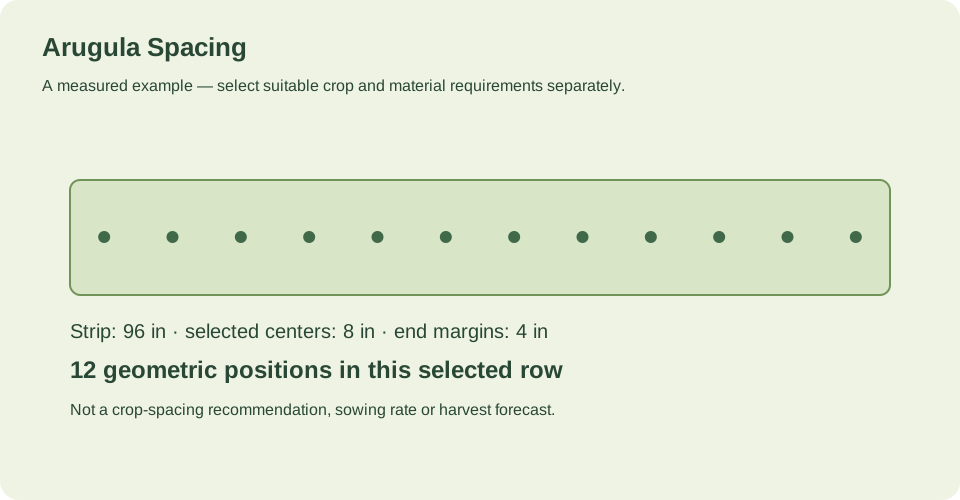
The worked example uses a 96-inch row, 8-inch centers and 4-inch margins at both ends. The first center falls at 4 inches and the last at 92 inches. Counting positions at 8-inch centers between those margins gives 12 field-production positions.
This is a geometrical example for one row, not a recommendation for an entire garden. One row does not set the between-row distance, bed width, path width or the number of rows. Those choices must be made separately, and the between-row figure should come from the 15–24 inch range. The linked row calculator can count this exact length, center interval and both end margins in inches or centimeters.
- Enter the row length, selected center interval and both end margins in the row calculator.
- Check that the first and last centers match your margins before relying on the count.
- Treat the result as positions in one row, then plan between-row distance and access separately.
Source context: Utah State University Extension
What the row count does not decide
A row count answers one narrow question: how many positions fit along a measured line at a chosen interval with end margins. It does not choose the distance between rows, the width of paths, the number of rows in a raised bed or the space needed for access. Those are separate layout decisions.
The source's between-row range is 15–24 inches, but the example does not select a between-row value. Do not treat the 8-inch in-row choice as a paired-row or bed-width recommendation. If you plan more than one row, choose the between-row distance from the range and check adjacent rows and access before marking the full layout.
- Choose a between-row distance from the 15–24 inch source range for your multi-row plan.
- Check access and adjacent-row spacing before marking a second row.
- Keep the single-row count separate from the full bed layout.
Source context: Utah State University Extension
Check your measured example
One measured 96-inch row, with selected 8-inch centers and 4-inch margins at both ends. Count 12 field-production positions.
Reference and growing system: USU’s leafy-green field-production table lists arugula at 8–12 inches within a row and 15–24 inches between rows. This field-production table is not a dense baby-leaf sowing prescription.
| Quantity | Calculated result |
|---|---|
| Usable row length (in) | 96 |
| Selected center spacing (in) | 8 |
| Margin at each row end (in) | 4 |
| Positions in this row | 12 |
| First center from row start (in) | 4 |
| Last center from row start (in) | 92 |
| What is being counted | field-production positions |
The worked example is a geometrical count for one 96-inch row with 8-inch centers and 4-inch margins at both ends. The first center is at 4 inches, the last at 92 inches, and the result is 12 field-production positions. It does not select a between-row distance, set a bed width or recommend a full garden layout.
Count this row in the spacing calculator ↗Example inputs explain the method. Review the source context, chosen cultivar and actual site before planting or ordering.
Your before-you-plant checklist
- Source range recorded as 8–12 inches within a row and 15–24 inches between rows.
- Selected in-row value labeled as a point inside the source range.
- Sowing, thinning and established-position spacing kept as separate notes.
- Worked example checked: 96-inch row, 8-inch centers, 4-inch margins, 12 positions.
- Between-row distance and access chosen separately before marking a full layout.
Questions that come up while planning
What spacing does the linked guide give for arugula?
USU's leafy-green field-production table lists arugula at 8–12 inches within a row and 15–24 inches between rows. The table is a field-production reference, not a dense baby-leaf sowing prescription.
Why does the example use 8 inches instead of 12 inches?
The 8-inch value is a selected point inside the 8–12 inch in-row range for one clearly labeled scenario. It is not a claim that 8 inches is best for every garden or every growing stage.
Does the 12-position count mean 12 plants will be harvested?
No. The count is the number of field-production positions along the measured row at the selected interval and margins. It is not a seed count, harvest count or yield estimate.
Sources & method
Horticultural guidance is linked to its original source and regional context. Geometry and unit conversions are calculated separately. Read how we prepare and check a page.
- Planting and SpacingUtah State University Extension