
Choose your next step
Start with the job, not the product name
An amendment is incorporated into soil, while mulch is placed over its surface. The same bagged material may be sold under different labels, so match the product to the job you need rather than assuming compost, soil and mulch mean the same thing. Material characteristics and the existing soil determine amendment choices.
Before ordering anything, choose a level, draining growing site and assess the existing soil. Soil testing guides nutrient and amendment decisions. A geometric volume does not establish soil quality, so treat quantity estimates as logistics, not as a judgment about what the soil needs.
- Write down whether the material will fill a bed, be mixed into soil, or sit on the surface.
- Check the existing soil and any soil test results before choosing an amendment.
- Confirm the product label describes the material for that intended use.
Source context: Colorado State University Extension · University of Maryland Extension
Estimate quantity with the matching calculator
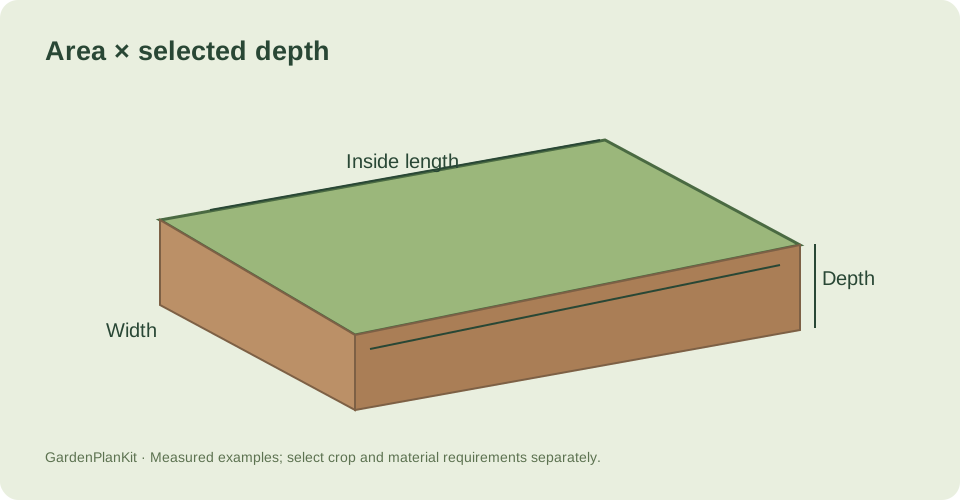
Use the fill calculator when new material supplies the growing medium for a bed. Use the amendment calculator when material is incorporated into existing soil. Use the mulch calculator when material covers the surface. Each tool works from the area and the depth you select, so the depth choice belongs to you and should follow the material and garden use.
The calculators return a geometric volume. Bag counts depend on the package label units, which govern volume conversions. Keep the area, depth and bag size consistent so the result matches what you will actually order.
- Measure the bed area you intend to treat.
- Select a material depth separately from the area measurement.
- Enter the package label volume so bag counts use the correct units.
- Record the volume and bag count before ordering.
Source context: Colorado State University Extension · Colorado State University Extension · University of Maryland Extension
Surface mulch: depth depends on material and use
Mulch choice and depth depend on the material and how the garden is used. The guide describes a 1 to 2 inch layer for compost or leaf mold used as surface mulch, and distinguishes growing beds from paths. Do not generalize one depth to every material.
Grass clippings require particular care about thin layers and lawn-treatment history. Check the material guidance before applying a depth, and keep surface mulch distinct from material you intend to incorporate.
- Identify the mulch material and whether it covers a growing bed or a path.
- Check the material-specific depth guidance before calculating.
- For grass clippings, review thin-layer guidance and lawn-treatment history first.
Source context: Colorado State University Extension
Order in the right sequence
Plan the growing medium first, then incorporated amendments, then surface mulch. Assessing the site and existing soil comes before ordering new material, and soil testing comes before amendment decisions. This order keeps a volume estimate from being mistaken for a soil-quality recommendation.
The supplied example uses a 100 sq ft area at an illustrative 2 inch depth with 2 cu ft bags. It shows how area, depth and bag size combine into a volume and whole-bag count; the depth was selected separately and is not a crop recommendation.
- Assess the site and existing soil.
- Decide on growing medium, amendment or mulch for each area.
- Calculate volume for each material separately.
- Convert to bags using the package label units.
Source context: Colorado State University Extension · Colorado State University Extension · University of Maryland Extension
Check your measured example
A 100 sq ft area at an illustrative 2 in depth; 2 cu ft bags; material depth is selected separately.
| Quantity | Calculated result |
|---|---|
| volume cuft | 16.6667 |
| whole bags | 9 |
The example covers 100 sq ft at an illustrative 2 inch depth using 2 cu ft bags, giving about 16.67 cu ft and 9 whole bags. The depth is a separate input, not crop advice, and the volume does not assess soil quality.
Example inputs explain the method. Review the source context, chosen cultivar and actual site before planting or ordering.
Your before-you-plant checklist
- Each area is labeled as growing medium, incorporated amendment or surface mulch.
- Site drainage and existing soil were assessed before ordering.
- Soil test results were reviewed before choosing an amendment.
- Depth was selected separately for the specific material and garden use.
- Bag counts use the package label volume units.
Questions that come up while planning
What is the difference between an amendment and mulch?
An amendment is incorporated into soil, while mulch is placed over its surface. The same material may be labeled differently, so confirm the intended job before ordering.
Does a volume calculation tell me whether my soil is good?
No. A geometric volume does not establish soil quality. Choose a level, draining site, assess existing soil and use soil testing to guide nutrient and amendment decisions.
Can I use one mulch depth for every material?
No. Mulch choice and depth depend on the material and garden use. The guide describes a 1 to 2 inch layer for compost or leaf mold as surface mulch, and grass clippings need particular care about thin layers and lawn-treatment history.
Sources & method
Horticultural guidance is linked to its original source and regional context. Geometry and unit conversions are calculated separately. Read how we prepare and check a page.
- Choosing a Soil AmendmentColorado State University Extension
- Mulches for the Vegetable GardenColorado State University Extension
- Soil to Fill Raised BedsUniversity of Maryland Extension