
Choose your next step
Choose the site and check the ground
Start with a level, draining growing site and assess the existing soil before ordering new material. Bed width, access and underlying soil affect the design, so measure the space you can reach and work in before fixing dimensions. A soil test guides nutrient and amendment decisions; a calculated volume does not establish soil quality.
For beds over hard surfaces, the guide gives different depth advice than for open-bottom beds. Treat frame height as the height of the growing layer you choose, not automatically as total root depth.
- Confirm the site is level and drains.
- Assess existing soil and decide whether a soil test is needed.
- Note whether the bed sits on open ground or a hard surface.
- Check access around the bed before locking in width.
Source context: University of Maryland Extension · University of Maryland Extension
Record internal dimensions and choose a growing layer
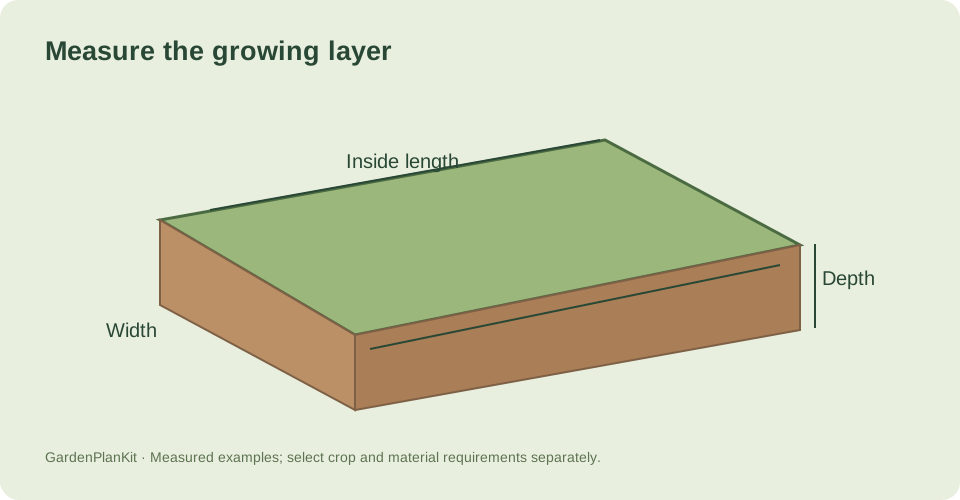
Record the inside length and width, not the outside frame size, because the frame takes up space. Decide the level fill depth you want for the growing layer and write it down with the units. Compost:topsoil blends of 1:2 or 1:1 are described as options, not a substitute for assessing the materials you can obtain.
Keep the depth decision separate from the volume calculation. The calculation tells you how much material fills the recorded shape; it does not tell you which blend or depth suits a crop.
- Measure inside length and width.
- Write the chosen level fill depth and its unit.
- Choose a growing layer option after assessing materials.
- Record any planned allowance separately from the base volume.
Source context: University of Maryland Extension · University of Maryland Extension
Connect soil quantity to a crop layout
Use the volume to order material, then plan the crop layout against the same internal dimensions. A generic square grid is not a garlic paired-row or tomato growing recommendation, so treat any grid as a measuring aid rather than spacing advice. Match planning dates to crop, variety, frost risk and location, and note that days-to-maturity labels may start at sowing or transplanting depending on the crop.
The supplied example uses inside dimensions of 8 ft by 4 ft, a level fill depth of 12 in, 2 cu ft bags and no allowance. That gives 32 cu ft, about 1.185 cu yd, and 16 whole bags. This is a geometrical example only; it does not set crop spacing, soil quality or a planting date.
- Multiply inside length by inside width by fill depth in matching units.
- Convert the result to the unit used by your material supplier.
- Divide by the package label volume to find whole bags.
- Lay out crops using the recorded inside dimensions and check dates against crop, variety, frost risk and location.
Source context: University of Maryland Extension · University of Maryland Extension · University of Maryland Extension
Check your measured example
Inside dimensions 8 ft × 4 ft; level fill depth 12 in; 2 cu ft bags; no allowance.
| Quantity | Calculated result |
|---|---|
| volume cuft | 32 |
| volume cuyd | 1.1852 |
| whole bags | 16 |
The example is a geometry check: inside dimensions 8 ft by 4 ft with a level 12 in fill depth give 32 cu ft, about 1.185 cu yd, and 16 whole 2 cu ft bags with no allowance. It does not add crop spacing, soil quality or planting-date advice.
Example inputs explain the method. Review the source context, chosen cultivar and actual site before planting or ordering.
Your before-you-plant checklist
- Site confirmed level and draining, with existing soil assessed.
- Inside length, width and fill depth recorded with units.
- Growing layer option chosen after assessing materials.
- Volume converted using the package label units.
- Crop layout and planning dates checked against crop, variety, frost risk and location.
Questions that come up while planning
Is frame height the same as root depth?
No. The guide gives different depth advice for beds over hard surfaces, and roots in an open-bottom bed may continue into the soil below. Treat frame height as the growing layer you choose, not automatically as total root depth.
Does the calculated volume tell me my soil is good?
No. A geometric volume does not establish soil quality. Soil testing guides nutrient and amendment decisions, and compost:topsoil blends of 1:2 or 1:1 are options rather than a substitute for assessing materials.
Can I use a square grid for crop spacing?
A generic square grid is not a garlic paired-row or tomato growing recommendation. Use it only as a measuring aid, and match planning dates to crop, variety, frost risk and location.
Sources & method
Horticultural guidance is linked to its original source and regional context. Geometry and unit conversions are calculated separately. Read how we prepare and check a page.
- Growing Vegetables in Raised BedsUniversity of Maryland Extension
- Soil to Fill Raised BedsUniversity of Maryland Extension
- When to Plant VegetablesUniversity of Maryland Extension