
Choose your next step
Match crops and supports to the container
Begin with the crop and its support needs, then choose a container that fits both. A pot must hold enough medium for the root space you intend and give you somewhere to anchor or place any support the crop requires. The container and growing system also shape watering: self-watering designs use different water-reservoir arrangements, so plan around the specific pot rather than a generic pot type.
Treat any grid or spacing figure as a geometrical layout aid, not as crop advice. A generic square grid does not represent a garlic paired-row or tomato growing recommendation. Use the plan to record what you decided and why, and check support placement before filling.
- List each crop and note whether it needs support above the pot.
- Confirm the container and growing system, including whether it is self-watering.
- Mark where supports will sit or attach before filling the pot.
Source context: University of Maryland Extension
Calculate actual fill capacity
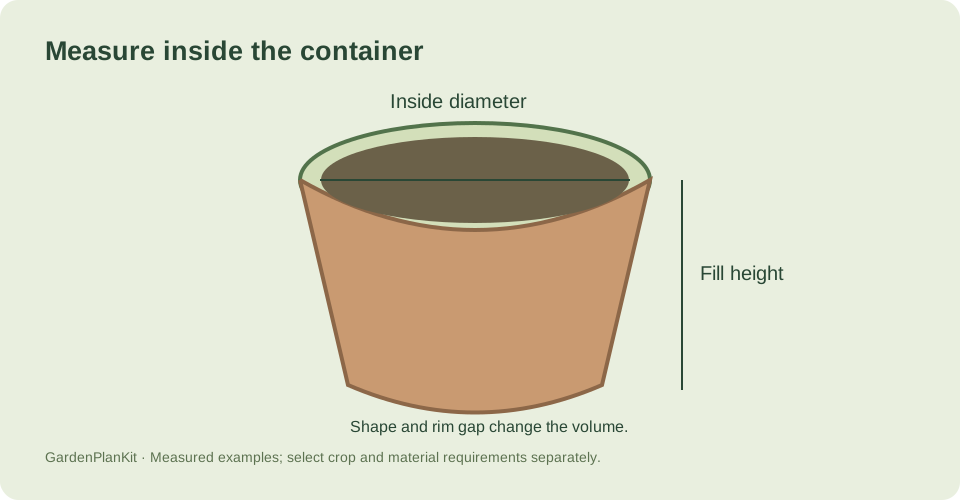
Fill capacity depends on the container's internal dimensions and the depth you actually fill, not on a nursery trade-size label. For a straight-sided cylinder, volume equals pi times the radius squared times fill depth. The supplied example uses an internal diameter of 16 inches and a fill depth of 12 inches, giving about 1.396 cubic feet or 39.54 liters. That is a geometry example, not a statement about a standard pot size or a crop recommendation.
Measure internal diameter and planned fill depth, leaving the headspace you intend. Package label units govern any volume conversion, so check the medium label rather than converting from memory.
- Measure the internal diameter and the depth you will actually fill.
- Calculate volume for the pot's shape using those internal measurements.
- Record the result in the units printed on the growing-medium package.
Source context: University of Maryland Extension · University of Maryland Extension
Choose and manage the growing medium
Growing medium must support roots while holding appropriate water and air. Dense garden soil behaves differently from a container mix, so do not treat them as interchangeable. For container vegetables, the guide lists commercial soilless mix and an equal-volume soilless-mix and compost blend among its options.
If you reuse medium, remove plant residue and do not save medium associated with root disease. The guide describes blending old and fresh material rather than assuming old mix is unchanged. Plan how much fresh material you need alongside any reused portion.
- Choose a listed option: commercial soilless mix, or an equal-volume soilless-mix and compost blend.
- Remove plant residue before reusing any medium.
- Discard medium associated with root disease rather than saving it.
- Plan to blend old and fresh material instead of treating old mix as unchanged.
Source context: University of Maryland Extension
Plan watering access
Container watering needs vary with weather, plant growth and growing medium, so the plan should describe how you will check and water, not a fixed schedule. Confirm you can reach every pot, see the medium surface, and water without moving heavy containers. For self-watering designs, note the reservoir arrangement and how you will check it.
Write the watering plan as a set of checks tied to conditions you observe, and revisit it as plants grow and weather changes.
- Confirm each pot is reachable for checking and watering.
- Note how you will inspect the medium surface and any reservoir.
- Record watering as condition-based checks rather than fixed intervals.
Source context: University of Maryland Extension · University of Maryland Extension
Check your measured example
One straight-sided cylinder with internal diameter 16 in and fill depth 12 in; pi geometry, not a nursery trade-size capacity.
| Quantity | Calculated result |
|---|---|
| volume cuft | 1.3963 |
| volume liters | 39.5378 |
The supplied example is one straight-sided cylinder with a 16-inch internal diameter and 12-inch fill depth. Using pi geometry, it gives about 1.396 cubic feet or 39.54 liters. It illustrates a calculation method only; it is not a nursery trade-size capacity and does not set crop, spacing or watering advice.
Example inputs explain the method. Review the source context, chosen cultivar and actual site before planting or ordering.
Your before-you-plant checklist
- Crop and support needs recorded for each container.
- Internal diameter and planned fill depth measured.
- Fill volume calculated and recorded in package label units.
- Growing medium option chosen from the listed options.
- Watering access and reservoir checks confirmed for every pot.
Questions that come up while planning
How much medium does a 16-inch pot hold?
It depends on fill depth and internal shape. For the supplied straight-sided cylinder with 16-inch internal diameter and 12-inch fill depth, the geometric volume is about 1.396 cubic feet or 39.54 liters. This is a geometry example, not a nursery trade-size capacity.
Can I reuse growing medium from last season?
Remove plant residue first, and do not save medium associated with root disease. The guide describes blending old and fresh material rather than assuming old mix is unchanged.
How often should I water container vegetables?
There is no universal schedule. Needs vary with weather, plant growth and growing medium, and self-watering designs have different reservoir arrangements, so plan condition-based checks for your actual containers.
Sources & method
Horticultural guidance is linked to its original source and regional context. Geometry and unit conversions are calculated separately. Read how we prepare and check a page.
- Growing Vegetables in Containers and Salad TablesUniversity of Maryland Extension
- Growing Media (Potting Soil) for ContainersUniversity of Maryland Extension