
What the 12–18 inch range describes
The guidance is about thinning: reducing a sown row to one retained plant every 12–18 inches. It is not a sowing interval, and it is not a recommendation for how far apart rows should be. Treat it as the spacing between the plants you plan to keep through harvest.
Because harvest size and dwarf versus full-size types matter, the range is a decision band rather than a single number. A gardener growing for smaller heads may work toward the closer end; one planning for larger mature plants may choose the wider end. The source does not assign a specific interval to a specific variety, so the choice stays with you and should be recorded in your plan.
- Write down whether you are planning small or full-size harvest, since the source says size matters.
- Choose one center interval within 12–18 inches and label it as your retained-plant spacing.
- Keep sowing density and thinning decisions separate from this retained-plant interval.
Source context: University of Minnesota Extension
Worked example: one 144-inch row at 18-inch centers
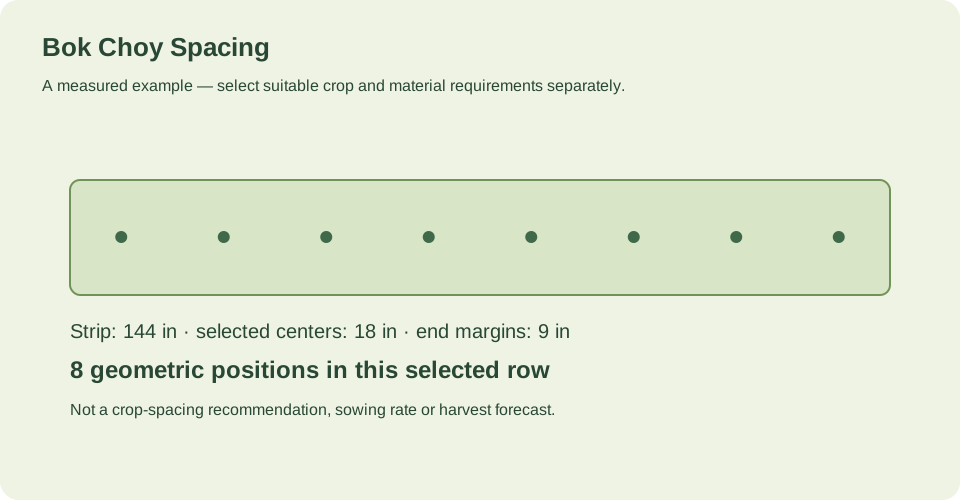
The verified example uses a measured row 144 inches long, a selected center spacing of 18 inches, and 9-inch margins at both ends. The first retained plant center falls at 9 inches and the last at 135 inches, giving 8 retained plants. This is a geometrical count for one labeled scenario, not a claim that 18 inches is the best interval for every bok choy type.
The margins are part of the layout choice, not part of the source range. They keep the first and last plants away from the row ends. If you change the margin, the count can change even when the row length and center spacing stay the same.
- Measure the actual row length in inches or centimeters.
- Select a center interval within the 12–18 inch thinning range and state it in your plan.
- Choose end margins and record them separately from the crop spacing.
- Mark the first and last plant centers, then place intermediate centers at the selected interval.
Source context: University of Minnesota Extension
From sowing to retained plants
Sowing, thinning and initial planting are earlier stages than the established stand. The 12–18 inch figure applies to the plants you keep, so do not mark the seed row at that interval and assume the job is done. Plan the thinning pass that brings the row to the retained count.
The counted item in the example is retained plants, not seeds, seedlings or positions in a grid. A count of 8 means 8 plants intended to remain in that measured row after thinning.
- Label the plan stage as sowing, thinning or established stand.
- Mark the retained-plant centers only after deciding the thinning target.
- Check that the counted number refers to retained plants, not seeds sown.
Source context: University of Minnesota Extension
What one row does not decide
A single row count is not an entire garden layout. Access paths, supports, adjacent rows and the mature habit of the plants must be chosen separately. The linked guide does not give a numeric row distance, so this guide does not invent one.
Use the row example to check plant counts and marking within that row, then make the remaining layout decisions explicitly in your own plan. Record any assumption you make so the plan can be reviewed later.
- List the layout choices still open: access, supports, adjacent rows and mature habit.
- Do not copy a row distance from this guide, because none is supplied.
- Note each assumption beside the row plan so it can be checked.
Source context: University of Minnesota Extension
Check your measured example
One measured 144-inch row, with selected 18-inch centers and 9-inch margins at both ends. Count 8 retained plants.
Reference and growing system: Minnesota’s Chinese-cabbage and bok-choy guide describes thinning to one plant every 12–18 inches. Harvest size and dwarf versus full-size types matter. That passage does not establish a separate numeric row distance.
| Quantity | Calculated result |
|---|---|
| Usable row length (in) | 144 |
| Selected center spacing (in) | 18 |
| Margin at each row end (in) | 9 |
| Positions in this row | 8 |
| First center from row start (in) | 9 |
| Last center from row start (in) | 135 |
| What is being counted | retained plants |
The example is a geometrical count for one measured 144-inch row using 18-inch centers and 9-inch end margins, producing 8 retained plants with centers at 9 and 135 inches. It illustrates the calculation only; it does not set a row distance or a variety-specific spacing recommendation.
Count this row in the spacing calculator ↗Example inputs explain the method. Review the source context, chosen cultivar and actual site before planting or ordering.
Your before-you-plant checklist
- Row length measured and recorded in inches or centimeters.
- One center interval chosen within the 12–18 inch thinning range and labeled.
- End margins recorded separately from crop spacing.
- Count labeled as retained plants, not seeds or seedlings.
- Open layout choices such as access, supports, adjacent rows and mature habit noted separately.
Questions that come up while planning
Is 12–18 inches the row spacing for bok choy?
No. The linked guide describes thinning to one plant every 12–18 inches. It does not establish a separate numeric row distance, so row spacing must be decided separately.
Why does the example count 8 plants in a 144-inch row?
With 18-inch centers and 9-inch margins at both ends, the first center is at 9 inches and the last at 135 inches. That yields 8 retained plant positions in the measured row.
Does the count include seedlings that will be thinned out?
No. The counted item is retained plants, meaning the plants intended to remain after thinning, not seeds sown or seedlings removed.
Sources & method
Horticultural guidance is linked to its original source and regional context. Geometry and unit conversions are calculated separately. Read how we prepare and check a page.
- Growing Chinese cabbage and bok choy in home gardensUniversity of Minnesota Extension