
Start with the five planning factors
Before pairing crops, describe each one on paper. Height tells you what may shade what. Root growth tells you whether two crops compete in the same soil layer. Moisture needs tell you whether one watering schedule suits both. Support method tells you how much room stakes, cages or trellises take from the bed and path. Harvest timing tells you when a spot frees up for the next crop.
These factors are checkable observations, not guarantees. A tall plant next to a short one may shade it depending on direction and season. Two crops with different moisture needs may both survive but not thrive on one schedule. Write down what you assume so you can compare it with what you see.
- List each crop's mature height and whether it needs staking, caging or trellising.
- Note whether roots are shallow, deep or spreading, and whether the crops share a soil layer.
- Record each crop's moisture preference and watering frequency.
- Mark the expected harvest window and the date the space should be free.
Source context: University of Maryland Extension · University of Maryland Extension
Build a two-crop layout you can check
Choose one crop that finishes early and one that follows or fills the space. Draw the bed to scale, including paths and any support strip. Place the support method first, because the tomato source notes that habit and staking or caging affect spacing, and that a narrow bed and adjacent path must be considered together. Then place the second crop in the space that remains, checking height, roots, moisture and timing against the first.
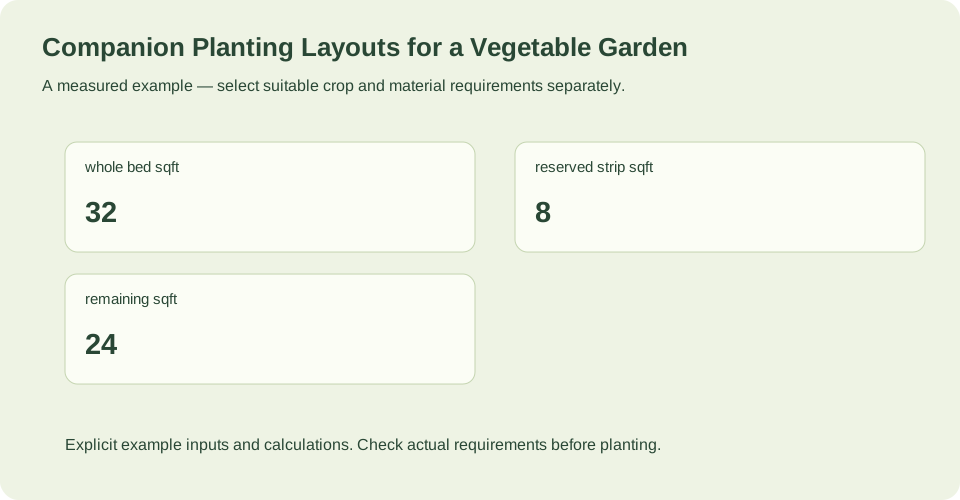
The supplied example is space accounting only: an 8 by 4 ft bed has 32 sq ft, and a selected 8 by 1 ft access and support strip reserves 8 sq ft, leaving 24 sq ft. That arithmetic does not establish crop compatibility, safe density or a pest benefit. Treat it as a geometry check before you place plants.
- Draw the bed outline and mark paths and support strips.
- Place the supported crop first and note the space its support occupies.
- Place the second crop only in the remaining area, then recheck height, roots, moisture and harvest timing.
- Label the layout with the date each crop is expected to vacate its space.
Source context: University of Maryland Extension · University of Maryland Extension
Use succession to move from one round to the next
Succession planting means planting seeds or transplants in spots vacated by spent plants. It can also move a bed from one crop to another between seasons. The source suggests listing crops on paper and drawing maps for spring, summer and fall rounds, with cool-season crops followed by warm-season crops and then more cool-season plants or a winter cover crop.
Timing is the key check. Understand how long each plant produces a harvest before you schedule the next round. The source gives the example of sowing Swiss chard after spring peas finish. Regional dates in any schedule are examples for that source location, so check your own local timing rather than copying dates.
- List crops by season and note how long each produces a harvest.
- Draw a separate map for each round rather than one crowded plan.
- Mark the vacated spot and the next crop on the map before planting.
- Start transplants ahead so they are ready when a spot opens.
Source context: University of Maryland Extension
Review the layout as plants grow
Do not treat a pairing as a pest-repellent guarantee or assume legumes feed companions immediately. Choose pairings for observable space, support and timing needs rather than assuming a pest benefit. Instead, record what you planted, where, when it was harvested and what you observed. That record lets you compare layouts over time without inventing results.
The tomato spacing guide gives 18 to 36 inches within a row and 48 to 60 inches between rows, and explains that habit and support affect spacing. Use those figures only for the crop and context they describe; they are not a general density rule for every pairing.
- Write the pairing and the reason for it on the bed map.
- Record harvest dates and any shading or moisture problems you notice.
- Revise the next round's map from your own notes, not from unsupported neighbor lists.
Source context: University of Maryland Extension · University of Maryland Extension
Check your measured example
Space accounting only: an 8 × 4 ft bed has 32 sq ft; reserve a selected 8 × 1 ft access/support strip. The remaining area does not establish crop compatibility, safe density or a pest benefit.
| Quantity | Calculated result |
|---|---|
| whole bed sqft | 32 |
| reserved strip sqft | 8 |
| remaining sqft | 24 |
The example is a geometry check, not crop advice. An 8 by 4 ft bed totals 32 sq ft; reserving a selected 8 by 1 ft access and support strip removes 8 sq ft, leaving 24 sq ft. Those numbers show only how much area remains after the strip is reserved. They do not show that any two crops are compatible, that a density is safe or that a pest benefit exists.
Example inputs explain the method. Review the source context, chosen cultivar and actual site before planting or ordering.
Your before-you-plant checklist
- Bed drawn to scale with paths and support strips marked.
- Each crop's height, roots, moisture and harvest window written down.
- Supported crop placed before the second crop.
- Succession rounds mapped separately by season.
- No pest-repellent or immediate-feeding claims recorded as fact.
Questions that come up while planning
Can companion planting stop pests?
The supplied sources do not support pest-repellent guarantees. Plan pairings by height, roots, moisture, support and timing, and treat pest effects as something to observe rather than promise.
How do I decide which crop goes where?
Place the supported crop first, then check the remaining space against the second crop's height, root growth, moisture needs and harvest window. Draw the bed to scale, including paths and support strips.
What does the 8 by 4 ft example prove?
It is space accounting only. The bed is 32 sq ft, a selected 8 by 1 ft strip reserves 8 sq ft, and 24 sq ft remains. It does not establish compatibility, safe density or a pest benefit.
Sources & method
Horticultural guidance is linked to its original source and regional context. Geometry and unit conversions are calculated separately. Read how we prepare and check a page.
- Vegetable Succession and Companion PlantingUniversity of Maryland Extension
- Growing Tomatoes in a Home GardenUniversity of Maryland Extension