
Start with the job, not the bag
An amendment is incorporated into soil, while mulch is placed over its surface. That placement difference is the clearest way to separate the categories. Compost used as an amendment is mixed into the existing soil to change it; the same compost spread on top is functioning as a surface layer. Topsoil is a mineral soil product, and its quality varies by source, so the label and the existing growing conditions matter more than the name on the bag.
Compost, soil and mulch are not interchangeable labels. Material characteristics and the existing soil determine amendment choices. Before ordering anything, assess the existing soil and choose a level, draining growing site. Soil testing guides nutrient and amendment decisions. A geometric volume does not establish soil quality, so do not treat a calculated amount as proof that a material will improve your ground.
- Write down the job first: incorporated amendment, surface cover, or growing medium.
- Check the product label for what the material is and how it is intended to be used.
- Assess the existing soil and site drainage before ordering new material.
Source context: Colorado State University Extension · University of Maryland Extension
Topsoil, compost and mulch in the garden
Topsoil is mineral soil, so it is not automatically an amendment or a mulch. If you are filling a level area or replacing lost soil, the source and characteristics of that mineral soil matter. Compost is an organic material, and its role depends on how it is used and what the existing soil needs. Mulch stays on the surface, where it is not incorporated into the root zone in the same way an amendment is.
Do not assume compost can never be a growing medium. For container vegetables, the guide lists commercial soilless mix and an equal-volume soilless-mix/compost blend among its options. That is a container context, not a rule for garden beds. Growing medium must support roots while holding appropriate water and air, and dense garden soil behaves differently from a container mix.
- Match the material to its placement: incorporated, surface, or container medium.
- Read the label units and use them for any volume conversion.
- Keep garden-bed soil decisions separate from container-medium decisions.
Source context: Colorado State University Extension · University of Maryland Extension
Check the plan before you order
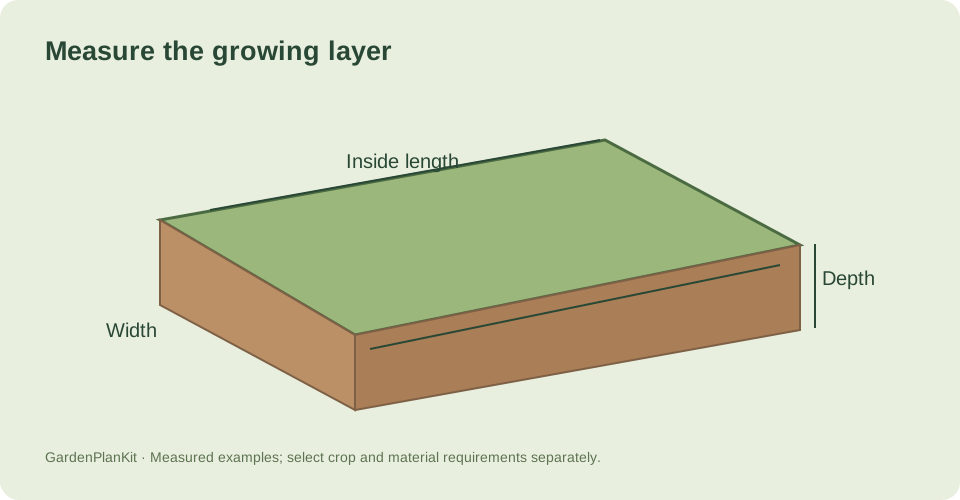
A volume figure is geometry, not a soil test. Use the representative volume of 480 only as a planning quantity for the space you have measured, and confirm the unit on the product label before converting. The label units govern volume conversions. If the plan involves reusing container medium, remove plant residue and do not save medium associated with root disease. The guide describes blending old and fresh material rather than assuming old mix is unchanged.
The supplied example is an illustrative 20 cu ft batch made from equal volumes of commercial soilless medium and compost: 10 cu ft of soilless medium and 10 cu ft of compost. It is a geometrical mixing example, not a universal crop recipe. It does not establish that the same ratio suits a garden bed, and it does not replace a soil test or label instructions.
- Measure the actual area or container and record the volume with its unit.
- Confirm the product label unit before converting the volume.
- For reused medium, remove plant residue and discard medium associated with root disease.
Source context: University of Maryland Extension · University of Maryland Extension
Check your measured example
Illustrative 20 cu ft batch, equal volumes of commercial soilless medium and compost; not a universal crop recipe.
| Quantity | Calculated result |
|---|---|
| soilless cuft | 10 |
| compost cuft | 10 |
The example is an illustrative 20 cu ft batch using equal volumes of commercial soilless medium and compost: 10 cu ft of each. It demonstrates a geometrical mix only. It is not a universal crop recipe and does not establish soil quality or a garden-bed ratio.
Example inputs explain the method. Review the source context, chosen cultivar and actual site before planting or ordering.
Your before-you-plant checklist
- The job is identified as incorporated amendment, surface mulch, or growing medium.
- The product label has been read for material type and intended use.
- Existing soil and site drainage have been assessed before ordering.
- Volume is recorded with its unit, and label units govern any conversion.
- Reused container medium has plant residue removed, and medium associated with root disease is not saved.
Questions that come up while planning
Is compost the same as topsoil?
No. Topsoil is a mineral soil product, while compost is an organic material. Compost, soil and mulch are not interchangeable labels, and the right choice depends on the material characteristics and the existing soil.
Can compost be used as a growing medium?
It can be part of a growing medium. For container vegetables, the guide lists commercial soilless mix and an equal-volume soilless-mix/compost blend among its options. That is a container context, not a universal garden-bed recipe.
Does a calculated volume tell me which material to buy?
No. A geometric volume does not establish soil quality. Assess the existing soil, choose a level, draining site, and use soil testing to guide nutrient and amendment decisions before ordering.
Sources & method
Horticultural guidance is linked to its original source and regional context. Geometry and unit conversions are calculated separately. Read how we prepare and check a page.
- Choosing a Soil AmendmentColorado State University Extension
- Soil to Fill Raised BedsUniversity of Maryland Extension
- Growing Media (Potting Soil) for ContainersUniversity of Maryland Extension