
Start with the source range, then choose one value
The linked guide gives a range, not a single required spacing: 7–9 inches between sweet-corn seeds within a row. A range is useful for planning because it lets you choose a consistent center interval for your own marked row. The choice should be recorded before you mark positions so the count and the marks agree.
For the worked example, 8 inches is the selected center interval. That is a labeled scenario inside the range, not a claim that 8 inches is the only correct choice. If you choose 7 or 9 inches instead, the number of positions in the same row length will differ, so recalculate rather than copying the example count.
- Write down the chosen in-row center interval and confirm it falls within the 7–9 inch range.
- Measure the actual row length you intend to mark.
- Decide the margin at each end before counting positions.
Source context: Utah State University Extension
Count sowing positions, not established plants
The counted item in the example is sowing positions. Each position is a place where a seed is sown, measured from center to center along the row. This is not a count of established plants, and it is not a thinning or final-stand recommendation.
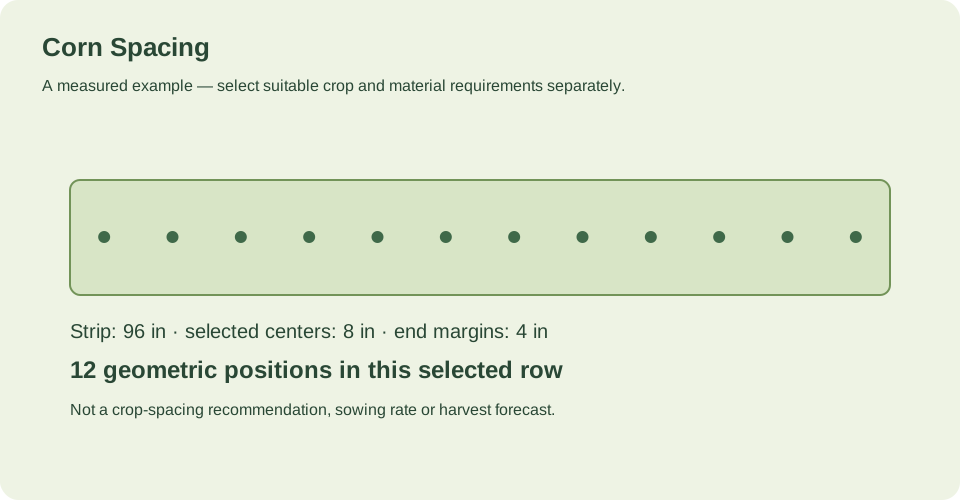
The example uses a 96-inch row, 8-inch centers, and 4-inch margins at both ends. With those inputs, the first center is at 4 inches and the last center is at 92 inches, giving 12 sowing positions. The end margins are part of the measurement setup; they are not additional seeds.
Keep sowing, thinning, and initial planting language separate. The example counts where seeds go. It does not state a thinning distance or a mature-plant spacing.
- Mark the first center after the chosen end margin.
- Measure each later center at the selected interval from the previous center.
- Label the marks as sowing positions so they are not mistaken for a final plant count.
Source context: Utah State University Extension
One row is not the whole garden layout
The example counts only one row of a block. USU describes planting in blocks of 3 or more rows for pollination, so the single-row count should not be read as a complete corn garden plan. The row count answers a narrower question: how many sowing positions fit along this measured row.
The 24–30 inch between-row range is context, but the example does not calculate adjacent-row positions or a whole-block total. Access paths, supports, adjacent rows, and mature habit must be chosen separately for your site. Do not invent those distances from the single-row example.
Use the row calculator for this exact length, center interval, and both end margins, in inches or centimeters. It counts positions along the row; it does not design the full block.
- Treat the 12-position result as one row only.
- Plan the number of rows and the between-row arrangement separately, using the 24–30 inch context.
- Check access and adjacent-row needs before marking more than one row.
Source context: Utah State University Extension
Check the example against your own inputs
The example is a geometrical count, not crop advice. It shows how the selected 8-inch centers and 4-inch end margins produce 12 sowing positions in a 96-inch row. If your row length, center interval, or margins change, the result changes.
Before marking, confirm that the units are consistent. The calculator accepts inches or centimeters, but the example values are in inches. Package label units govern any volume conversions; this spacing task does not require a volume conversion.
- Compare your chosen interval with the 7–9 inch range.
- Confirm both end margins are included in the calculation.
- Recalculate if the row length or interval changes.
Source context: Utah State University Extension
Check your measured example
One measured 96-inch row, with selected 8-inch centers and 4-inch margins at both ends. Count 12 sowing positions.
Reference and growing system: USU describes sweet-corn seeds 7–9 inches apart within rows 24–30 inches apart, planted in blocks of 3 or more rows for pollination. The example counts only one row of such a block, not a complete corn garden.
| Quantity | Calculated result |
|---|---|
| Usable row length (in) | 96 |
| Selected center spacing (in) | 8 |
| Margin at each row end (in) | 4 |
| Positions in this row | 12 |
| First center from row start (in) | 4 |
| Last center from row start (in) | 92 |
| What is being counted | sowing positions |
The worked example is a geometrical count for one 96-inch row with 8-inch centers and 4-inch margins at both ends. It yields 12 sowing positions, with the first center at 4 inches and the last at 92 inches. The 8-inch value is a selected scenario within the USU 7–9 inch range, and the row is only one row of a block, not a complete corn garden.
Count this row in the spacing calculator ↗Example inputs explain the method. Review the source context, chosen cultivar and actual site before planting or ordering.
Your before-you-plant checklist
- Chosen in-row center interval is recorded and falls within 7–9 inches.
- Row length is measured in inches or centimeters and units are kept consistent.
- Both end margins are set before counting positions.
- Marks are labeled as sowing positions, not established plants.
- The single-row count is kept separate from the full block and between-row layout.
Questions that come up while planning
How far apart should sweet-corn seeds be within a row?
The USU context gives 7–9 inches apart within rows. The example selects 8 inches as one labeled scenario inside that range.
Does the 12-position example count plants or seeds?
It counts sowing positions along one 96-inch row, using 8-inch centers and 4-inch margins at both ends. It is not a count of established plants or a thinning recommendation.
Can I use one counted row as my whole corn plan?
No. The example counts only one row of a block. USU describes blocks of 3 or more rows for pollination, and the example does not calculate a whole-block layout.
Sources & method
Horticultural guidance is linked to its original source and regional context. Geometry and unit conversions are calculated separately. Read how we prepare and check a page.
- How to Grow Sweet Corn in Your GardenUtah State University Extension