
Start With the Site and the Existing Soil
Before ordering material, confirm the bed sits on a level, draining site and assess the soil already there. Soil testing is what guides nutrient and amendment decisions; a geometric volume only tells you how much space a layer occupies.
Bed width and access affect how you work, and the soil under an open-bottom bed matters because roots may continue into it. Treat frame height as a construction dimension, not as total root depth.
- Check that the site is level and drains.
- Assess and test existing soil before buying amendments.
- Note whether the bed is open-bottom or sits over a hard surface.
Source context: University of Maryland Extension · University of Maryland Extension
Divide the Frame Into Layers
Separate the plan into three quantities: existing soil, any lower fill, and the intended growing layer. Each occupied volume is measured on its own, so you are not treating every tall frame as a solid growing-medium order.
Large woody fill decomposes and can change the level over time, so frame volume and growing-layer volume are different planning quantities. The depth guidance for beds over hard surfaces differs from open-bottom beds; do not assume the frame height equals the growing depth.
- Measure the occupied volume of existing soil.
- Decide the depth and volume of any lower fill.
- Set the intended growing-layer depth and calculate that volume separately.
Source context: University of Maryland Extension · University of Minnesota Extension
Choose Materials and Convert the Growing-Layer Volume
The source material discusses topsoil and plant-based compost in raised beds and buying bulk material by cubic yard. Compost-to-topsoil blends of 1:2 or 1:1 are described as options, not a substitute for assessing the actual materials you plan to use.
Convert only the growing-layer volume into bags or bulk. Package label units govern volume conversions, so check the bag label rather than assuming a standard. Bulk orders are commonly discussed in cubic yards.
- Compare topsoil and plant-based compost options and assess the materials.
- Convert the growing-layer volume to cubic yards for bulk, or to bags using the label unit.
- Round up to whole bags only after the conversion.
Source context: University of Maryland Extension · University of Minnesota Extension
Work Through the Supplied Example
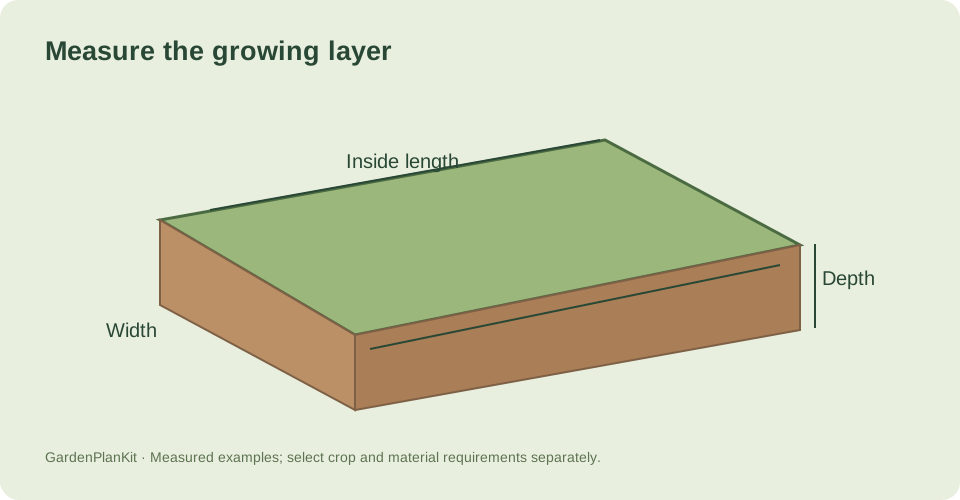
The example uses inside dimensions of 8 ft by 4 ft, a level fill depth of 12 in, and 2 cu ft bags, with no allowance. That geometry gives 32 cu ft, or about 1.185 cu yd, and 16 whole bags.
This is a geometrical example, not crop advice. It assumes a single level layer and no allowance for settling, uneven ground, or existing soil, so it should not be read as a garlic paired-row or tomato growing recommendation.
- Multiply length by width by depth in feet to get cubic feet.
- Divide cubic feet by 27 for cubic yards.
- Divide cubic feet by the bag label volume and round up.
Source context: University of Maryland Extension · University of Maryland Extension · University of Minnesota Extension
Check your measured example
Inside dimensions 8 ft × 4 ft; level fill depth 12 in; 2 cu ft bags; no allowance.
| Quantity | Calculated result |
|---|---|
| volume cuft | 32 |
| volume cuyd | 1.1852 |
| whole bags | 16 |
The supplied example is purely geometric: an 8 ft by 4 ft bed at a level 12 in depth gives 32 cu ft, about 1.185 cu yd, and 16 whole 2 cu ft bags with no allowance. It does not account for existing soil, settling, uneven ground, or any crop, and it is not a planting recommendation.
Example inputs explain the method. Review the source context, chosen cultivar and actual site before planting or ordering.
Your before-you-plant checklist
- Site checked for level ground and drainage.
- Existing soil assessed and tested before amendments are chosen.
- Existing soil, lower fill, and growing layer measured as separate volumes.
- Growing-layer volume converted using the package label unit or cubic yards for bulk.
- Example treated as geometry only, not as crop spacing or growing advice.
Questions that come up while planning
Should I order growing medium for the whole frame height?
No. Measure existing soil, any lower fill, and the growing layer separately. Frame height is not the same as growing-layer depth, and roots in an open-bottom bed may continue into the soil below.
How do I convert the growing-layer volume into bags?
Convert the growing-layer volume to cubic feet, then divide by the volume stated on the package label. Package label units govern the conversion, so check the label rather than assuming a size.
Does a calculated volume tell me whether the soil is good?
No. A geometric volume does not establish soil quality. Soil testing guides nutrient and amendment decisions, and the blend options described in the sources are choices to assess, not guarantees.
Sources & method
Horticultural guidance is linked to its original source and regional context. Geometry and unit conversions are calculated separately. Read how we prepare and check a page.
- Soil to Fill Raised BedsUniversity of Maryland Extension
- Growing Vegetables in Raised BedsUniversity of Maryland Extension
- Raised Bed GardensUniversity of Minnesota Extension