
Assess the site and soil before choosing an amount
Before ordering compost, confirm the growing area is level and drains. Then look at the existing soil and, where nutrient or amendment decisions matter, use a soil test. A geometric volume does not establish soil quality, so treat any depth figure as a starting point for planning rather than a fertilizer prescription.
Write down the purpose in one sentence, such as covering bare soil between rows or incorporating material into a bed before planting. That purpose, plus the soil assessment, is what narrows the amount you should plan for.
- Check that the growing area is level and drains.
- Assess the existing soil and use a soil test where nutrient or amendment decisions are needed.
- State the purpose of the compost in one sentence before calculating anything.
Source context: University of Maryland Extension
Surface layer versus blended ingredient
An amendment is incorporated into the soil, while mulch is placed over its surface. Compost, soil and mulch are not interchangeable labels, so the same bagged or bulk material may play different roles depending on how you use it.
If compost is a surface layer, you are planning coverage: area times depth. If compost is an ingredient in a blended volume, you are planning a mix, and the compost amount is a share of that total volume rather than a layer spread over the bed. Keep these two calculations separate so a coverage number is not mistaken for a blending recipe.
- Decide whether the compost will be incorporated as an amendment or placed over the surface as mulch.
- For a surface layer, plan by area and depth.
- For a blended volume, treat compost as one ingredient and record its share of the total.
Source context: Colorado State University Extension
Work through the coverage example
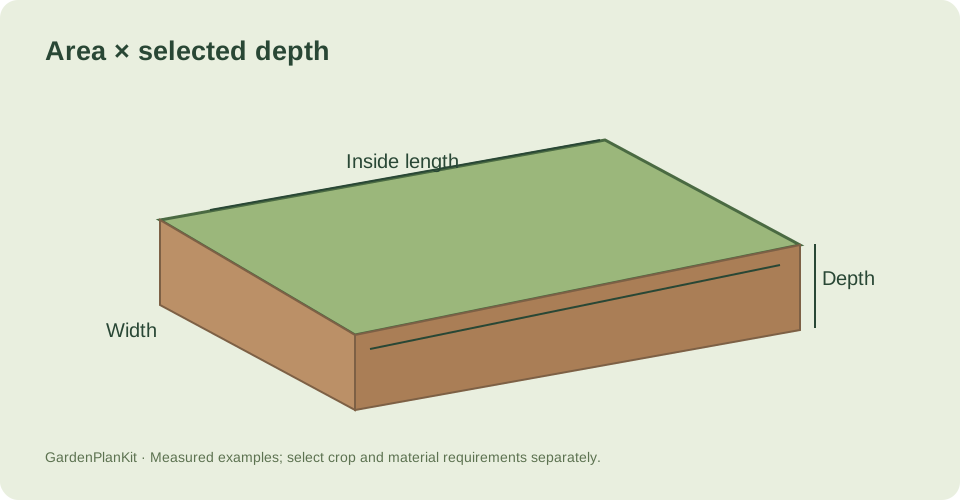
The supplied example uses a 100 sq ft area at an illustrative 2 in depth, with 2 cu ft bags. Converting the depth to feet and multiplying by area gives about 16.67 cu ft, which rounds up to 9 whole bags. The material depth was selected separately; it is a geometrical example, not crop advice or a fertilizer prescription.
Use the same arithmetic for your own area and chosen depth, but choose that depth from your purpose and soil assessment rather than copying the example. Package label units govern volume conversions, so check the bag label before rounding.
- Convert your chosen depth to feet and multiply by the area in square feet.
- Divide the total cubic feet by the bag volume printed on the package label.
- Round up to whole bags and note that the depth was your own choice, not a recommendation.
Source context: University of Maryland Extension · Colorado State University Extension
Check the plan before ordering
A finished plan should show the area, the chosen depth or blend share, the purpose, and the bag count. It should also record what the soil assessment found, so the amount can be revisited if the purpose changes.
Keep the surface-layer calculation and any blended-volume calculation in separate notes. That way a coverage figure stays a coverage figure and does not quietly become a soil recipe.
- Record area, depth or blend share, purpose and bag count together.
- Note the soil assessment result alongside the amount.
- Keep coverage and blending calculations in separate notes.
Source context: University of Maryland Extension · Colorado State University Extension
Check your measured example
A 100 sq ft area at an illustrative 2 in depth; 2 cu ft bags; material depth is selected separately.
| Quantity | Calculated result |
|---|---|
| volume cuft | 16.6667 |
| whole bags | 9 |
The example covers 100 sq ft at an illustrative 2 in depth using 2 cu ft bags. That converts to about 16.67 cu ft, rounded up to 9 whole bags. The depth was selected separately for the example; it is a geometrical illustration, not crop advice, and the result does not establish soil quality or replace a soil test.
Example inputs explain the method. Review the source context, chosen cultivar and actual site before planting or ordering.
Your before-you-plant checklist
- Growing area confirmed level and draining.
- Existing soil assessed, with a soil test where nutrient or amendment decisions matter.
- Purpose of the compost written down.
- Surface-layer and blended-volume calculations kept separate.
- Bag count checked against the package label units.
Questions that come up while planning
Does a calculated compost volume tell me my soil needs compost?
No. A geometric volume only shows how much material fills a space. Soil testing guides nutrient and amendment decisions, so assess the soil before ordering.
Is compost used as mulch the same as compost incorporated as an amendment?
They are different uses. An amendment is incorporated into soil, while mulch is placed over its surface. Plan the amount according to which use you intend.
Can I copy the 2 in depth from the example?
The 2 in depth is an illustrative figure chosen separately for the example. It is not crop advice or a fertilizer prescription; select your own depth from your purpose and soil assessment.
Sources & method
Horticultural guidance is linked to its original source and regional context. Geometry and unit conversions are calculated separately. Read how we prepare and check a page.
- Soil to Fill Raised BedsUniversity of Maryland Extension
- Choosing a Soil AmendmentColorado State University Extension