
Check the coating and edge protection
Start with the label and product documentation rather than the marketing name. Identify the coating as stated by the manufacturer, note whether cut edges or seams are described, and look for how the top edge is finished. Edge protection matters practically: a folded or capped rim is easier to handle and less likely to catch skin, hose or fabric. If the coating or edge treatment is not identified, treat that as an open question to resolve before purchase rather than assuming a property.
Keep material choice separate from exposure. Where the bed sits, how much sun it receives and what growing medium you use all affect conditions inside the bed, but they are not the same as the metal specification. Ask the manufacturer directly about any coating or heat questions you cannot answer from the documentation.
- Find the stated coating type and any seam or cut-edge treatment in the product documents.
- Confirm how the top rim is finished and whether it is folded, capped or bare.
- Record any unanswered coating or edge questions before ordering.
Source context: University of Maryland Extension · University of Maryland Extension
Measure a rounded-end footprint
Bracing keeps a long panel from bowing once the bed is filled. Check where braces or cross members sit and whether they reduce usable space or interfere with planting. Then measure the inside dimensions, not the outside footprint. Bed width and access affect the design, and a wide bed is harder to reach across, so the inner measurement is the number that matters for planning.
The capsule area combines the straight rectangle and the two semicircular ends. At the selected 12 in depth, its cubic-foot volume has the same numerical value as its square-foot area; material suitability remains a separate check.
Source context: University of Maryland Extension
Plan installation and the growing medium
Follow the kit's own installation instructions for panel order, fasteners and bracing, and check the base is level before filling. An open-bottom bed allows roots to continue into the soil below, so frame height is not the same as total root depth. For beds over hard surfaces, the source gives different depth advice; do not treat frame height as total root depth in either case.
The source describes compost-to-topsoil blends of 1:2 or 1:1 as options, not as a substitute for assessing the materials you can actually obtain. Watering needs vary with weather, plant growth and growing medium, so plan for the actual bed and system rather than a fixed schedule. Self-watering designs have different reservoir arrangements and should be planned on their own terms.
- Assemble panels and bracing in the order the kit instructions specify.
- Check the base is level before adding medium.
- Decide on a medium blend after assessing available materials, not from frame height alone.
- Plan watering around weather, plant growth and the medium you use.
Source context: University of Maryland Extension · University of Maryland Extension
Check your measured example
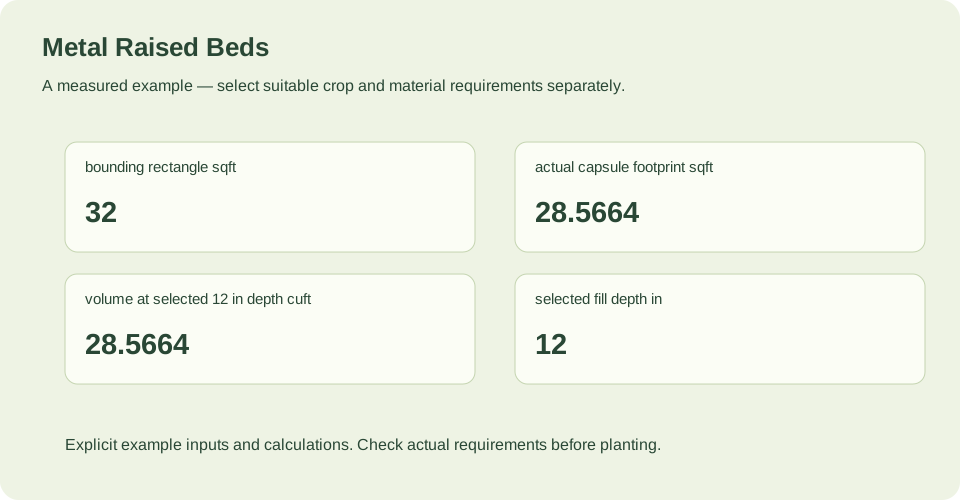
A simplified rounded-end bed calculation: a capsule-shaped inside footprint is 8 ft long and 4 ft wide, with semicircular ends of radius 2 ft. The straight middle is 4 ft long. This differs from treating the whole bounding rectangle as growing area.
| Quantity | Calculated result |
|---|---|
| bounding rectangle sqft | 32 |
| actual capsule footprint sqft | 28.5664 |
| volume at selected 12 in depth cuft | 28.5664 |
| selected fill depth in | 12 |
The capsule area combines the straight rectangle and the two semicircular ends. At the selected 12 in depth, its cubic-foot volume has the same numerical value as its square-foot area; material suitability remains a separate check.
Example inputs explain the method. Review the source context, chosen cultivar and actual site before planting or ordering.
Your before-you-plant checklist
- Coating type is identified in the product documents.
- Top edge finish and any cut-edge treatment are confirmed.
- Brace positions are checked against usable inner space.
- Inner length and width are measured after assembly.
- Installation steps and base leveling are followed from the kit instructions.
Questions that come up while planning
Does a metal raised bed make the soil too hot?
Heat depends on the metal and coating, sun exposure, medium and site, so there is no single answer. Check the manufacturer's documentation for any heat guidance and observe your own bed's conditions rather than assuming a fixed outcome.
Is frame height the same as root depth?
No. In an open-bottom bed, roots may continue into the soil below, so frame height is not total root depth. The source gives different depth advice for beds over hard surfaces.
What does the worked example help me check?
The capsule area combines the straight rectangle and the two semicircular ends. At the selected 12 in depth, its cubic-foot volume has the same numerical value as its square-foot area; material suitability remains a separate check.
Sources & method
Horticultural guidance is linked to its original source and regional context. Geometry and unit conversions are calculated separately. Read how we prepare and check a page.
- Growing Vegetables in Raised BedsUniversity of Maryland Extension
- Growing Vegetables in Containers and Salad TablesUniversity of Maryland Extension