
Match the material to the surface
Start by naming the material and the surface it will cover. Compost or leaf mold used as surface mulch is described here as a 1 to 2 inch layer, and growing beds are treated differently from paths. That range is material-specific, not a universal depth for every mulch.
Grass clippings need particular care: apply them in thin layers and account for the lawn's treatment history before using them. Do not carry one material's depth over to another. Compost, soil and mulch are separate labels, and material characteristics plus existing soil guide amendment choices.
- List each area as a cropped bed or a path before choosing a material.
- Confirm the material is intended for surface mulch rather than soil incorporation.
- For grass clippings, check lawn-treatment history and plan thin layers.
Source context: Colorado State University Extension · Colorado State University Extension
Set depth before calculating volume
Depth is a horticultural decision made from the material and garden use, not an output of the calculator. Decide the layer you want for that material and surface, then use the calculator to find the volume for your measured area.
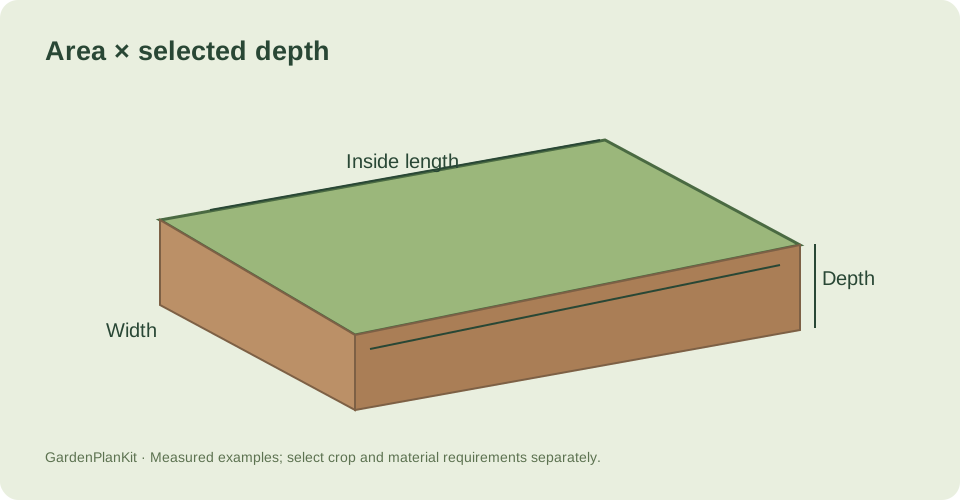
The calculator's job is arithmetic: area times depth, converted to the units on your package. Package label units govern any volume conversion, so read the bag or bulk listing rather than assuming a conversion.
- Measure the length and width of each area separately.
- Record the depth you selected for that material and surface.
- Enter area and depth in the calculator to get a volume.
- Convert to bags using the units printed on the package label.
Source context: Colorado State University Extension · Colorado State University Extension
Keep paths distinct from cropped beds
Paths and growing beds serve different purposes, so plan them as separate entries rather than one combined area. A single total can hide that you intend different materials or depths in each place.
Keeping the entries separate also makes the plan easier to check: you can confirm each bed's material and depth against its own record, and each path's material against its own.
- Create one line per bed and one line per path in your plan.
- Assign material and depth to each line individually.
- Total the volumes only after each line is set.
Source context: Colorado State University Extension
Work through the supplied example
The example covers a 100 square foot area at an illustrative 2 inch depth, using 2 cubic foot bags. The arithmetic gives about 16.67 cubic feet, which rounds up to 9 whole bags.
The 2 inch depth in this example is a chosen input for the calculation, not a recommendation for any particular crop or material. The material and its suitable depth are selected separately, and the bag count follows from the package's stated volume.
- Multiply area by depth in feet to get cubic feet.
- Divide by the bag volume printed on the label.
- Round up to whole bags for purchasing.
Source context: Colorado State University Extension · Colorado State University Extension
Check your measured example
A 100 sq ft area at an illustrative 2 in depth; 2 cu ft bags; material depth is selected separately.
| Quantity | Calculated result |
|---|---|
| volume cuft | 16.6667 |
| whole bags | 9 |
The example uses a 100 square foot area at an illustrative 2 inch depth with 2 cubic foot bags. Area times depth gives about 16.67 cubic feet, and dividing by 2 cubic feet per bag gives 9 whole bags after rounding up. The 2 inch figure is a calculation input, not crop or material advice; the suitable material and depth are chosen separately.
Example inputs explain the method. Review the source context, chosen cultivar and actual site before planting or ordering.
Your before-you-plant checklist
- Each bed and each path is listed as a separate area.
- Every area has a named material and a depth chosen for that material and use.
- Grass clippings are planned in thin layers with lawn-treatment history checked.
- Volume is calculated from measured area and chosen depth, then converted using package label units.
- Whole-bag counts are rounded up from the package's stated volume.
Questions that come up while planning
Does the calculator choose the right mulch depth for me?
No. It converts an area and a depth you supply into a volume. Material and garden use determine depth, and the 1 to 2 inch compost or leaf mold layer described here applies to that material as surface mulch.
Can I use the same depth for grass clippings as for compost?
Do not generalize one depth to every material. Grass clippings require particular care about thin layers and lawn-treatment history, so treat them as their own case.
Is mulch the same as an amendment?
No. An amendment is incorporated into the soil, while mulch is placed over the surface. Compost, soil and mulch are not interchangeable labels, and amendment choices depend on material characteristics and existing soil.
Sources & method
Horticultural guidance is linked to its original source and regional context. Geometry and unit conversions are calculated separately. Read how we prepare and check a page.
- Mulches for the Vegetable GardenColorado State University Extension
- Choosing a Soil AmendmentColorado State University Extension