
Start with the published spread range
The RHS figure of 30–60 cm (about 12–24 inches) describes mature height and spread and varies by variety. Because the source does not give a planting interval, you must choose one for your plan. A defensible approach is to pick a center-to-center distance within or near the published spread range and label it as your own assumption. If you want to explore the widest mature habit the source describes, use 24 inches as the example does. If your variety is described as compact, a shorter center distance may better match its spread, but confirm that against your own variety information rather than treating any number here as a rule.
Record the assumption next to the plan so you can tell a planning choice apart from a sourced fact. The source range is the anchor; the center interval is your decision.
- Look up the spread for your specific oregano variety and note whether it falls near the lower or upper end of 12–24 inches.
- Choose a center-to-center interval and write it down as a planning assumption, not a source recommendation.
- Keep the RHS range visible on the plan so the assumption stays traceable.
Source context: Royal Horticultural Society
Sowing, thinning and initial planting are not mature spacing
Seeds, seedlings and young transplants do not occupy their mature footprint. Sowing density, thinning distance and the initial planting position serve different purposes from the final mature-spread layout. Treat early-stage placement as temporary and plan to thin or reposition so established plants end up at your chosen centers. The counted positions in the example describe illustrative mature-spread positions, not seed or seedling counts.
When you mark a row, decide which stage the marks represent. Marks for mature positions should reflect the center interval you selected, while sowing or transplant marks may sit closer together and be adjusted later.
- Label each set of marks by stage: sowing, thinning, initial planting or mature position.
- Plan the thinning or repositioning step before you sow so the final centers are achievable.
- Use the mature-position count for layout planning, not for seed quantity.
Source context: Royal Horticultural Society
Worked row example: 144 inches at 24-inch centers
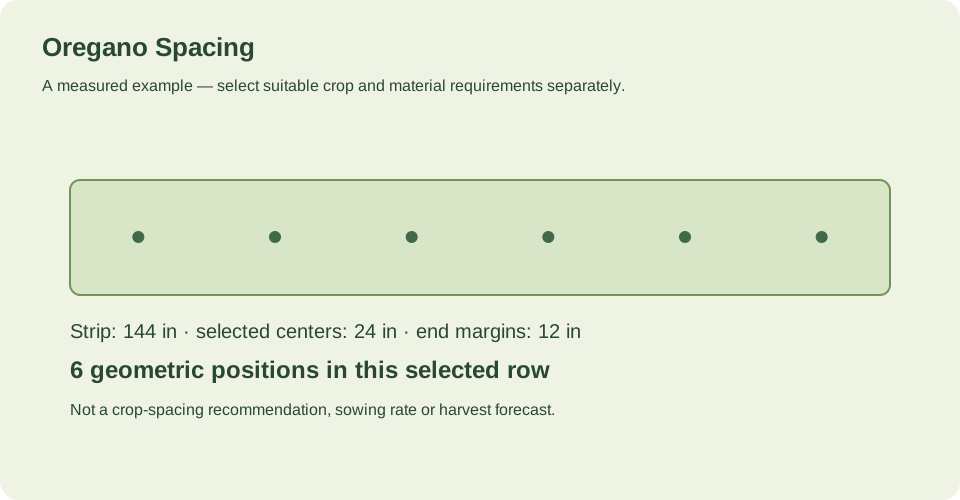
The example uses one measured row 144 inches long, a selected center interval of 24 inches, and 12-inch margins at both ends. With those inputs, the first center sits at 12 inches and the last at 132 inches, giving 6 illustrative mature-spread positions. The 24-inch interval is the planning assumption described above, chosen to explore the upper published spread; it is not an RHS spacing recommendation.
Record the chosen in-row distance for oregano, then plan adjacent rows and access separately based on your actual growing system. A mature-spread scenario is a planning assumption, not a spacing prescription.
- Enter the measured row length, your chosen center interval and both end margins into the row calculator.
- Check that the first and last centers fall inside the row after margins are applied.
- Confirm the counted item is illustrative mature-spread positions before using the number in your plan.
Source context: Royal Horticultural Society
What the row count does not decide
A row count answers one narrow question: how many positions fit along a measured length at a chosen interval with end margins. It does not choose access width, support needs, distance to adjacent rows or the mature habit of plants around the row. Those decisions depend on your site and must be selected separately, without borrowing distances from this example.
Use the count as one input to the layout, then sketch the surrounding space and check that the mature spread you assumed still fits alongside paths, edges and other plantings.
- Sketch the row within the wider bed or garden and mark access and adjacent plantings.
- Check that the assumed mature spread fits without crowding paths or neighboring plants.
- Adjust the center interval or row length as needed and recount.
Source context: Royal Horticultural Society
Check your measured example
One measured 144-inch row, with selected 24-inch centers and 12-inch margins at both ends. Count 6 illustrative mature-spread positions.
Reference and growing system: RHS reports oregano height and spread of 30–60 cm, approximately 12–24 inches, depending on variety. It does not prescribe a universal numeric planting interval in this guide. The worked scenario selects 24-inch centers to explore the upper published spread; this remains an explicit planning assumption, not an RHS spacing recommendation.
| Quantity | Calculated result |
|---|---|
| Usable row length (in) | 144 |
| Selected center spacing (in) | 24 |
| Margin at each row end (in) | 12 |
| Positions in this row | 6 |
| First center from row start (in) | 12 |
| Last center from row start (in) | 132 |
| What is being counted | illustrative mature-spread positions |
The example is a geometrical count, not crop advice. A 144-inch row with 24-inch centers and 12-inch end margins places the first center at 12 inches and the last at 132 inches, yielding 6 illustrative mature-spread positions. The 24-inch interval is a labeled planning assumption chosen to explore the upper RHS spread range, not an RHS spacing recommendation. One row is not an entire garden layout, and access, supports and adjacent rows must be chosen separately.
Count this row in the spacing calculator ↗Example inputs explain the method. Review the source context, chosen cultivar and actual site before planting or ordering.
Your before-you-plant checklist
- Variety spread noted against the RHS 12–24 inch range.
- Center interval recorded as a planning assumption, not a source recommendation.
- Marks labeled by stage: sowing, thinning, initial planting or mature position.
- Row calculator inputs checked: length, center interval and both end margins.
- Access, supports and adjacent rows chosen separately from the row count.
Questions that come up while planning
Does the RHS give a universal oregano planting interval?
No. The RHS reports height and spread of 30–60 cm (about 12–24 inches) depending on variety, but does not prescribe a universal numeric planting interval in this guide. Any center interval you use is your own planning assumption.
Why does the example use 24-inch centers?
The example selects 24 inches to explore the upper published spread. It is an explicit planning assumption, not an RHS spacing recommendation, and it should be labeled that way on your plan.
Does the 6-position count tell me how much seed to sow?
No. The count describes illustrative mature-spread positions along one 144-inch row. Sowing and thinning are separate stages, and the count is not a seed quantity or a whole-garden layout.
Sources & method
Horticultural guidance is linked to its original source and regional context. Geometry and unit conversions are calculated separately. Read how we prepare and check a page.
- How to grow OreganoRoyal Horticultural Society