
Start with what is under the bed
The site beneath the frame changes what frame height means. In an open-bottom bed set over soil, roots may continue into the soil below, so the frame height is not the total rooting depth. Over a hard surface, the guide gives different depth advice because roots cannot pass through the base. A container is a closed volume with its own limits. Decide which of these three situations you have before choosing a frame height.
Bed width and access also affect the design, along with the condition of the underlying soil. A bed that is easy to reach is easier to plant, weed and harvest, and those practical dimensions belong in the plan alongside depth.
- Identify whether the bed sits on open soil, a hard surface or is a closed container.
- Note the bed width and how you will reach the middle from each side.
- Record what you know about the existing soil before ordering material.
Source context: University of Maryland Extension · University of Maryland Extension
Frame height is not root depth
A tall frame does not automatically mean deep rooting space, and a shallow frame over open soil does not automatically mean shallow roots. The guide treats frame height and total root depth as separate ideas. Over a hard base, the rooting space is essentially what the frame holds. Over open ground, roots may extend below the frame into the soil underneath.
This is why a single depth number cannot be applied to every crop or every site. Use the site assessment first, then treat frame height as one design choice among width, access and the soil below.
- Write down the frame height you are considering.
- State separately how deep roots can actually go in your site situation.
- Check that the two numbers are not being treated as the same measurement.
Source context: University of Maryland Extension
Reading the volume example as geometry only
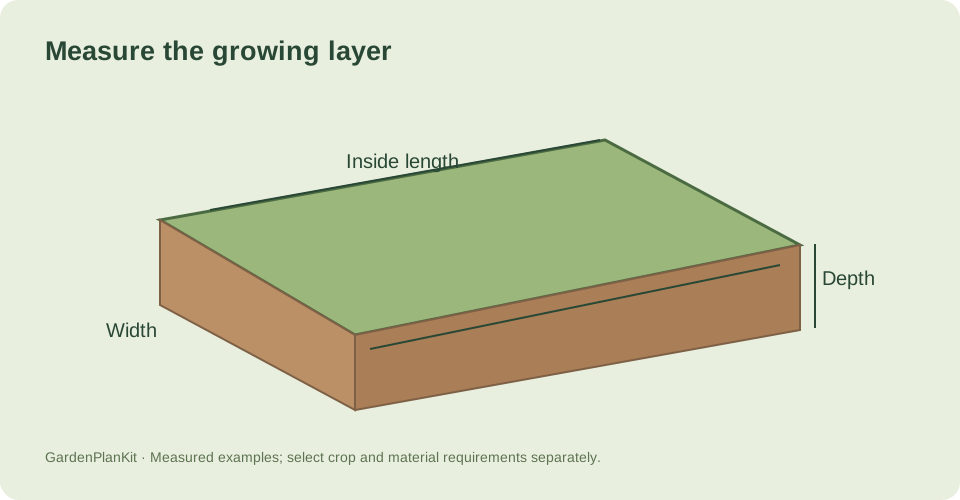
The supplied example uses one 8 ft by 4 ft inside footprint and compares three fill heights. At 6 inches the geometric volume is 16 cubic feet, at 12 inches it is 32 cubic feet, and at 18 inches it is 48 cubic feet. These figures describe the space inside the frame. They do not state a recommended depth for any crop.
Use the example to understand how height changes the amount of material needed, then apply your own footprint and chosen height. Package label units govern any volume conversion you make when buying material.
- Measure the inside footprint of your bed rather than the outside.
- Multiply footprint area by the fill height you are considering to estimate geometric volume.
- Convert units according to the package label before ordering.
Source context: University of Maryland Extension · University of Maryland Extension
Fill material and soil quality
Volume tells you how much space to fill, not whether the material is good for growing. The guide describes compost-to-topsoil blends of 1:2 or 1:1 as options, not as a substitute for assessing the materials you can actually get. Choose a level, draining growing site and assess existing soil before ordering new material.
Soil testing guides nutrient and amendment decisions. A geometric volume calculation does not establish soil quality, so keep the fill estimate and the soil assessment as separate steps in your plan.
- Confirm the site is level and drains before filling.
- Assess existing soil and consider a soil test before deciding on amendments.
- Treat any compost and topsoil blend ratio as an option to evaluate, not a guaranteed recipe.
Source context: University of Maryland Extension · University of Maryland Extension
Check your measured example
Same 8 ft × 4 ft inside footprint, comparing geometry only, not recommended crop depths.
| Quantity | Calculated result |
|---|---|
| at 6 in cuft | 16 |
| at 12 in cuft | 32 |
| at 18 in cuft | 48 |
The example holds the inside footprint constant at 8 ft by 4 ft and varies only the fill height. Doubling the height from 6 to 12 inches doubles the geometric volume from 16 to 32 cubic feet, and 18 inches gives 48 cubic feet. These are volume results for that footprint, not recommended crop depths or evidence about soil quality.
Example inputs explain the method. Review the source context, chosen cultivar and actual site before planting or ordering.
Your before-you-plant checklist
- Site situation identified as open soil, hard surface or container.
- Inside footprint measured, not the outside dimensions.
- Frame height and actual rooting space recorded as separate numbers.
- Fill volume calculated from footprint and chosen height.
- Existing soil assessed and a soil test considered before ordering material.
Questions that come up while planning
How deep should a raised garden bed be?
There is no single answer for every crop and site. Frame height, rooting space and fill volume are separate measurements. Over open soil, roots may continue below the frame; over a hard surface, the guide gives different depth advice. Assess your site before choosing a height.
Does a taller frame always mean deeper roots?
No. Frame height is not the same as total root depth. In an open-bottom bed over soil, roots may extend into the soil below. Over a hard base, rooting space is limited to what the frame holds.
Is the 16, 32 and 48 cubic foot example a crop recommendation?
No. It is a geometry comparison for one 8 ft by 4 ft inside footprint at 6, 12 and 18 inches of fill. It shows how volume changes with height, not a recommended depth for any crop.
Sources & method
Horticultural guidance is linked to its original source and regional context. Geometry and unit conversions are calculated separately. Read how we prepare and check a page.
- Growing Vegetables in Raised BedsUniversity of Maryland Extension
- Soil to Fill Raised BedsUniversity of Maryland Extension