
Start with the site, not the frame
Before ordering boards or material, choose a level, draining growing site and assess the existing soil. Bed width, access and the soil underneath all affect the design. If the ground holds water, a taller frame simply holds more of it; the fix belongs at the site and base level, not in the frame height.
A soil test guides nutrient and amendment decisions. A geometric volume tells you how much material a shape holds; it does not establish soil quality, so treat volume and soil assessment as separate steps.
- Walk the intended footprint after rain and note where water stands or drains slowly.
- Check that the site is level and that water has somewhere to go at the base.
- Test the existing soil before deciding on amendments or fill materials.
Source context: University of Maryland Extension · University of Maryland Extension
Open-bottom bed versus planter over paving
An open-bottom bed sits on soil, and roots may continue into the soil below. That changes how you think about frame height: the guide gives different depth advice for beds over hard surfaces, so do not treat frame height as total root depth.
A planter over paving is a closed system. Water cannot pass into the ground beneath, so the base and any reservoir arrangement matter more, and the growing medium and container design govern how water behaves. Self-watering designs use different water-reservoir arrangements, so plan for the actual container and growing system rather than assuming one pattern fits all.
- Decide whether the bed is open to soil or closed over paving before choosing a base.
- For an open-bottom bed, confirm the soil below drains and note that roots may extend into it.
- For a planter over paving, plan where excess water goes and how the container is watered.
Source context: University of Maryland Extension · University of Maryland Extension
Why gravel is not a drainage cure
A gravel layer inside a frame does not create an outlet. Water still has to leave the bed and the site; if the ground beneath is undrained, gravel only adds another layer to the same problem. Address the low spot and the base instead of treating gravel as a remedy.
Compost and topsoil blends of 1:2 or 1:1 are described as options, not a substitute for assessing the materials you actually have. Choose fill based on the site assessment and the base, not on frame height alone.
- Identify where water exits the bed and the site before adding any base layer.
- Correct an undrained low spot at the site rather than relying on material inside the frame.
- Assess fill materials directly instead of assuming a blend fixes drainage.
Source context: University of Maryland Extension · University of Maryland Extension
Watering after the drainage plan
Container watering needs vary with weather, plant growth and growing medium, so a drainage plan and a watering plan are linked but not identical. Once water can leave the base, check how the growing layer actually holds moisture and adjust watering to the container and system you built.
- Check moisture in the growing layer after watering to see how the bed behaves.
- Adjust watering for weather, plant growth and the growing medium.
- Recheck the base and site after heavy rain for standing water.
Source context: University of Maryland Extension · University of Maryland Extension
Check your measured example
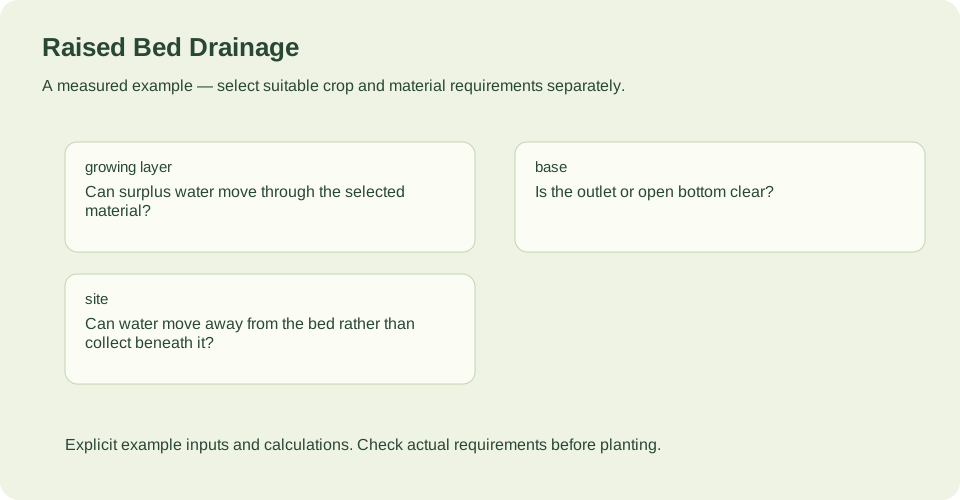
A drainage-path inspection scenario, not a measured site trial. The frame and the ground below it must be considered together.
| Quantity | Calculated result |
|---|---|
| growing layer | Can surplus water move through the selected material? |
| base | Is the outlet or open bottom clear? |
| site | Can water move away from the bed rather than collect beneath it? |
Follow water through the entire system. An open-bottom frame can still sit over a poorly draining site, so frame height alone does not settle the problem.
Example inputs explain the method. Review the source context, chosen cultivar and actual site before planting or ordering.
Your before-you-plant checklist
- Site checked for level ground and slow-draining low spots.
- Base type confirmed as open to soil or closed over paving.
- Water exit path identified at the base and at the site.
- Frame height not treated as total root depth.
- Fill materials assessed directly rather than assumed from a blend ratio.
Questions that come up while planning
Does a taller raised bed fix a wet low spot?
No. A tall frame does not repair an undrained low spot. Water still has to leave the site underneath, so address the site and base rather than adding height.
Is a gravel layer inside the bed a drainage solution?
No. Gravel inside the frame does not create an outlet. Water must still exit the bed and the site, so treat gravel as a material choice, not a drainage cure.
How is an open-bottom bed different from a planter over paving?
An open-bottom bed sits on soil, and roots may continue into the soil below. A planter over paving is closed, so the base, container design and watering arrangement carry more of the drainage decision.
Sources & method
Horticultural guidance is linked to its original source and regional context. Geometry and unit conversions are calculated separately. Read how we prepare and check a page.
- Growing Vegetables in Raised BedsUniversity of Maryland Extension
- Soil to Fill Raised BedsUniversity of Maryland Extension
- Growing Vegetables in Containers and Salad TablesUniversity of Maryland Extension