
Start with the site and the bed's purpose
Before choosing any liner or base, check the ground where the bed will sit. The fill source guidance is to pick a level, draining growing site and to assess the existing soil before ordering new material. A soil test informs nutrient and amendment decisions; a calculated volume tells you how much material a shape holds, not whether that material is good soil.
Bed width, access and the soil underneath all shape the design. In an open-bottom bed, roots may continue down into the soil below, so the frame height is not automatically the total rooting depth. Where a bed sits over a hard surface, depth advice differs, and frame height still should not be treated as total root depth.
- Confirm the site is level and drains.
- Assess the existing soil, and test it if you are making nutrient or amendment decisions.
- Note whether the bed sits on soil or a hard surface, since that changes depth guidance.
Source context: University of Maryland Extension · University of Maryland Extension
Open bottom versus cardboard suppression
An open soil bottom is the simplest option when you want water to move downward and roots to reach the soil below. It adds no barrier between the bed mix and the ground.
Cardboard can be used at the start for weed suppression. It is a temporary layer, not a permanent base, and it should not be described as a drainage solution. If you use it, plan for it to break down over time rather than assuming it stays intact.
- Choose an open bottom if you want unimpeded drainage and root contact with the soil below.
- If using cardboard for initial suppression, lay it at the start and expect it to degrade.
- Do not treat cardboard as a substitute for checking site drainage.
Source context: University of Maryland Extension
Side liners and hard-surface bases
A side liner and a bottom base do different jobs. A side moisture barrier is fitted to the inside walls, where it can reduce moisture movement through the frame material. It is not a floor.
A hard-surface base is for beds placed over paving or another hard surface, where there is no soil below to drain into. That situation calls for its own depth guidance, and the base must be considered as part of the drainage plan. Do not stretch impermeable plastic across a bottom that is meant to drain; that traps water instead of letting it pass.
- Use a side liner only on the walls, not as a floor.
- For a bed over a hard surface, follow the separate depth guidance for that situation.
- Keep any draining bottom free of impermeable plastic.
Source context: University of Maryland Extension
Keep side and bottom measurements separate
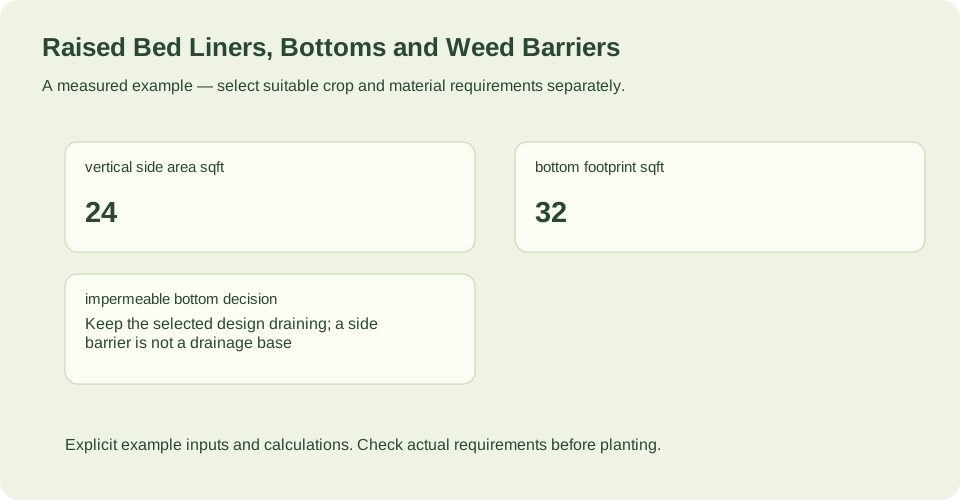
The 24 sq ft of vertical sides and 32 sq ft bottom are different surfaces. Determine the function and drainage implications before choosing a barrier.
Compost-to-topsoil blends of 1:2 or 1:1 are described as options, not a substitute for assessing the materials you actually buy. Package label units govern any volume conversion, so check the bag label rather than assuming a conversion.
Source context: University of Maryland Extension · University of Maryland Extension
Check your measured example
Separate side and bottom surfaces: a measured rectangular frame has an 8 × 4 ft footprint and 1 ft high vertical sides. Ignore overlaps, board thickness and waste in this surface-area illustration. The calculation does not recommend a liner.
| Quantity | Calculated result |
|---|---|
| vertical side area sqft | 24 |
| bottom footprint sqft | 32 |
| impermeable bottom decision | Keep the selected design draining; a side barrier is not a drainage base |
The 24 sq ft of vertical sides and 32 sq ft bottom are different surfaces. Determine the function and drainage implications before choosing a barrier.
Example inputs explain the method. Review the source context, chosen cultivar and actual site before planting or ordering.
Your before-you-plant checklist
- Site is level and drains, and existing soil has been assessed.
- Bottom choice matches the site: open soil, temporary cardboard, or a hard-surface base.
- Side liner is fitted to the walls only, not used as a floor.
- No impermeable plastic covers a draining bottom.
- Volume is calculated from measured footprint and selected layer depth, with conversions taken from the package label.
Questions that come up while planning
Should I put plastic in the bottom of a raised bed?
Not across a bottom that is meant to drain. Impermeable plastic blocks water movement. A side liner belongs on the walls, and a hard-surface base is a separate choice for beds over paving or similar surfaces.
Does cardboard replace a weed barrier permanently?
No. Cardboard is described here as initial weed suppression, a temporary layer that breaks down. It is not a permanent base and is not a drainage fix.
Is frame height the same as root depth?
No. In an open-bottom bed, roots may continue into the soil below, so frame height is not total root depth. Beds over hard surfaces have different depth advice, and frame height still should not be treated as total root depth.
Sources & method
Horticultural guidance is linked to its original source and regional context. Geometry and unit conversions are calculated separately. Read how we prepare and check a page.
- Growing Vegetables in Raised BedsUniversity of Maryland Extension
- Soil to Fill Raised BedsUniversity of Maryland Extension