
Start with internal growing space and access
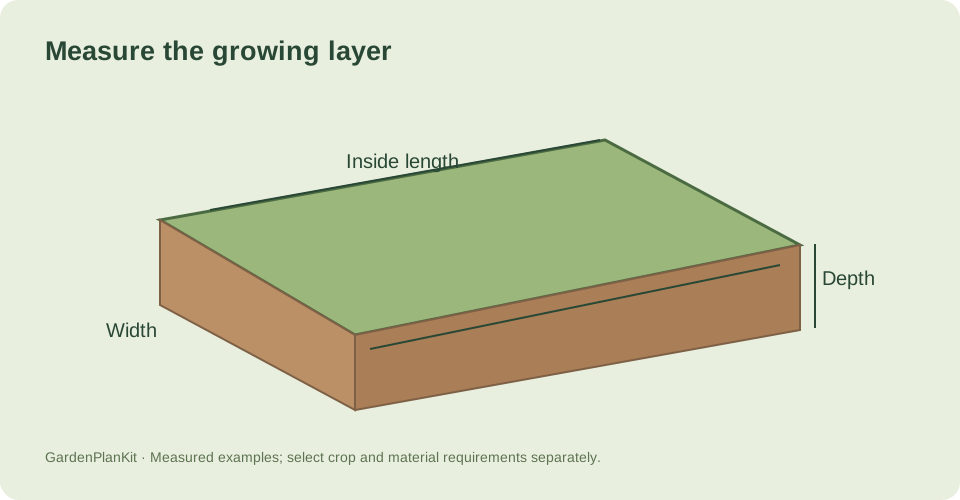
Compare beds by inside dimensions, not outside footprint. Two frames with the same exterior size can offer different planting area once wall thickness is counted. Bed width, access and the soil underneath all affect the design, so check how far you must reach to tend the center.
An open-bottom bed is not a closed container. Roots may continue into the soil below, so the frame height is not the same as total root depth. Where a bed sits over a hard surface, depth guidance differs; confirm the manufacturer's directions for that situation rather than assuming one height works everywhere.
- Record inside length, width and frame height for each candidate.
- Mark the reach distance from each accessible side to the bed center.
- Note whether the base is open to soil or closed over a hard surface.
Source context: University of Maryland Extension · University of Maryland Extension
Compare assembly, base and replacement parts
Read the assembly instructions before buying. Check what tools are required, how panels or boards join, and whether the frame needs a level base. A level, draining growing site should be chosen and existing soil assessed before ordering new material.
Ask whether individual boards, panels, connectors or corner pieces can be replaced separately. A frame that cannot be repaired piece by piece may need fuller replacement later. Keep manufacturer directions on hand, since they govern assembly and any material-specific handling.
- Download or request the full assembly directions and read them end to end.
- Confirm the base type and how the frame is leveled and anchored.
- List which components are sold as replacement parts.
Source context: University of Maryland Extension · University of Maryland Extension
Match material choice to the site and the fill plan
Wood, metal and other materials differ in assembly, weight, finish and part availability, so compare those practical points rather than relying on blanket safety or lifespan claims. The supplied guidance describes compost-to-topsoil blends of 1:2 or 1:1 as options; these are choices to assess against your site and existing soil, not a substitute for judging the materials themselves.
Soil testing guides nutrient and amendment decisions. A calculated volume tells you how much material a geometry holds; it does not establish soil quality. Use the volume to plan the order, then test and assess the existing soil separately.
- Compare each material on assembly method, base compatibility and replacement parts.
- Choose a fill blend option and check it against your soil assessment.
- Test the existing soil before deciding on amendments.
Source context: University of Maryland Extension · University of Maryland Extension
Work through the supplied volume example
The example uses inside dimensions of 8 ft by 4 ft, a level fill depth of 12 in, and 2 cu ft bags, with no allowance. Multiplying 8 by 4 by 1 ft gives 32 cu ft, which converts to about 1.185 cu yd. Dividing 32 by 2 gives 16 whole bags.
This is a geometrical example, not crop advice or a fill recipe. It assumes a level depth across the whole bed and no settling, spillage or rounding allowance. Package label units govern volume conversions, so check the bag label before ordering.
- Confirm inside dimensions and the intended level fill depth.
- Calculate cubic feet, then convert using the package label units.
- Round up whole bags only after deciding whether to add an allowance.
Source context: University of Maryland Extension · University of Maryland Extension
Check your measured example
Inside dimensions 8 ft × 4 ft; level fill depth 12 in; 2 cu ft bags; no allowance.
| Quantity | Calculated result |
|---|---|
| volume cuft | 32 |
| volume cuyd | 1.1852 |
| whole bags | 16 |
The supplied example is purely geometric: 8 ft by 4 ft at a level 12 in depth equals 32 cu ft, about 1.185 cu yd, or 16 whole 2 cu ft bags with no allowance. It does not recommend a crop, a soil blend or a depth for any particular site.
Example inputs explain the method. Review the source context, chosen cultivar and actual site before planting or ordering.
Your before-you-plant checklist
- Inside dimensions recorded for each candidate bed.
- Reach distance to the bed center checked from each accessible side.
- Base type confirmed as open to soil or closed over a hard surface.
- Assembly directions and replacement parts reviewed before purchase.
- Fill volume calculated from inside dimensions and checked against package label units.
Questions that come up while planning
Does frame height equal root depth?
No. Frame height is a construction measurement. In an open-bottom bed, roots may continue into the soil below, and depth guidance differs for beds over hard surfaces.
How many 2 cu ft bags fill the example bed?
The example gives 32 cu ft at a level 12 in depth, which is 16 whole 2 cu ft bags with no allowance. Check package label units before ordering.
Can a volume calculation tell me whether my soil is good?
No. A geometric volume only shows how much material the space holds. Soil testing guides nutrient and amendment decisions.
Sources & method
Horticultural guidance is linked to its original source and regional context. Geometry and unit conversions are calculated separately. Read how we prepare and check a page.
- Growing Vegetables in Raised BedsUniversity of Maryland Extension
- Soil to Fill Raised BedsUniversity of Maryland Extension