
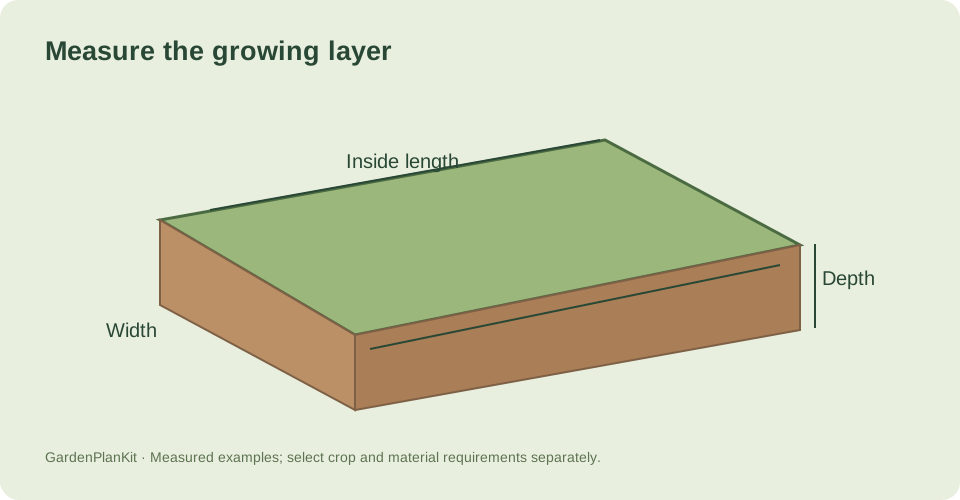
Assess the bed before choosing a blend
Bed width, access and the soil underneath all affect the design. An open-bottom bed is not isolated from the ground: roots may continue into the soil below, so the material you add is a growing layer rather than a sealed container of root space. The supplied guide gives different depth advice for beds over hard surfaces, and frame height should not be treated as total root depth.
Before pricing or ordering, note whether the bed sits on soil or a hard surface, how you will reach the middle, and what the existing ground is like. These observations shape how much material you plan to place in the frame.
- Record bed length, width and the planned growing-layer depth separately from frame height.
- Note whether the bottom is open to soil or rests on a hard surface.
- Check access to the bed's center before fixing the width.
Source context: University of Maryland Extension
Choose materials you can source and inspect
The supplied sources discuss topsoil and plant-based compost in raised beds, and buying bulk material by cubic yard. They also describe compost-to-topsoil blends of 1:2 or 1:1 as options, not as a substitute for assessing the materials themselves. Treat any ratio as a starting point for planning volume, then check what the supplier actually offers.
Large woody fill decomposes and can change the level over time, so keep frame volume and growing-layer volume as separate planning quantities. Ask what a bulk cubic yard contains and how bagged material is measured, because package label units govern volume conversions.
- List the topsoil and compost products available locally, in bags or bulk.
- Confirm the volume unit printed on each package or bulk listing.
- Ask whether bulky woody material is part of the fill and how it may settle.
Source context: University of Maryland Extension · University of Minnesota Extension
Calculate each component, then round separately
Multiply the planned growing-layer length by width by depth to get total volume, then divide that total according to your chosen parts. Round each material to whole packages on its own; do not round the combined total and split it afterward, because that can leave one ingredient short.
The illustrative example uses a 32 cubic foot batch split 2 parts topsoil to 1 part compost, with both materials supplied in 2 cubic foot bags. Two parts plus one part makes three parts, so topsoil is 32 times 2 divided by 3, or about 21.33 cubic feet, and compost is 32 divided by 3, or about 10.67 cubic feet. At 2 cubic feet per bag, that rounds up to 11 topsoil bags and 6 compost bags, 17 bags in total. The example shows the arithmetic only; it does not establish that this ratio suits your crops or materials.
- Multiply length, width and planned growing-layer depth to find total volume.
- Divide the total by the sum of the parts, then multiply by each part.
- Round each material up to whole packages using its own label volume.
- Recheck the rounded quantities against the planned total before ordering.
Source context: University of Maryland Extension · University of Minnesota Extension
Check the plan against the bed and the order
After rounding, compare the ordered volume with the planned growing layer and note any surplus or shortfall. If you are buying bulk by cubic yard, convert package volumes carefully using the label units, and keep the conversion written down. Also plan for settling: a mix containing large woody fill may drop in level over time, so the initial fill and the long-term level are different expectations.
Keep the assessment notes with the order so you can explain why you chose a particular blend and quantity. If the available materials differ from the ratio you planned, recalculate rather than forcing the original numbers.
- Compare rounded package volume with the planned growing-layer volume.
- Write down the unit conversion used for any bulk order.
- Note expected settling for mixes with large woody fill.
Source context: University of Maryland Extension · University of Minnesota Extension
Check your measured example
Illustrative 32 cu ft batch split 2 parts topsoil to 1 part compost, both supplied in 2 cu ft bags.
| Quantity | Calculated result |
|---|---|
| total cuft | 32 |
| topsoil cuft | 21.3333 |
| compost cuft | 10.6667 |
| topsoil whole bags | 11 |
| compost whole bags | 6 |
| total whole bags | 17 |
The example is a pure volume exercise: 32 cubic feet split into three parts gives about 21.33 cubic feet of topsoil and about 10.67 cubic feet of compost. With both materials in 2 cubic foot bags, rounding each ingredient up gives 11 topsoil bags and 6 compost bags, 17 in total. It does not recommend this ratio for any crop or material.
Example inputs explain the method. Review the source context, chosen cultivar and actual site before planting or ordering.
Your before-you-plant checklist
- Bed dimensions and planned growing-layer depth recorded separately from frame height.
- Bottom condition noted as open soil or hard surface.
- Each material's package or bulk volume unit confirmed.
- Each ingredient rounded to whole packages on its own.
- Rounded order compared with planned volume and settling noted for woody fill.
Questions that come up while planning
Is a 2:1 topsoil-to-compost mix a recommended raised bed recipe?
No. The supplied example is an illustrative volume calculation. The sources describe compost-to-topsoil blends of 1:2 or 1:1 as options and say these do not replace assessing the materials you can source.
Should I round the total volume or each ingredient?
Round each material separately to whole packages. In the example, 21.33 cubic feet of topsoil becomes 11 two-cubic-foot bags and 10.67 cubic feet of compost becomes 6 bags, rather than rounding a combined figure.
Is frame height the same as root depth?
No. The supplied guide distinguishes frame height from total root depth and gives different depth advice for beds over hard surfaces. In an open-bottom bed, roots may continue into the soil below.
Sources & method
Horticultural guidance is linked to its original source and regional context. Geometry and unit conversions are calculated separately. Read how we prepare and check a page.
- Growing Vegetables in Raised BedsUniversity of Maryland Extension
- Raised Bed GardensUniversity of Minnesota Extension