
Start With the Site and the Native Soil
Before comparing structures, assess the ground you have. Choose a level spot that drains, and look at the existing soil rather than assuming new material will fix it. A soil test is the reliable way to guide nutrient and amendment decisions; a calculated volume of fill tells you how much material a shape holds, not whether that material is suitable.
Drainage deserves particular attention. A raised bed can help where the underlying ground is poorly drained, but roots in an open-bottom bed may continue down into the soil below, so the bed is not automatically isolated from what lies underneath. In-ground planting keeps roots in the native soil and avoids the cost of importing a growing medium, but it depends on that soil being workable and adequately drained.
- Walk the site after rain and note where water stands or moves slowly.
- Test the native soil before ordering amendments or fill.
- Record the measured footprint of each proposed bed or planting area.
Source context: University of Maryland Extension · University of Maryland Extension
Access, Bed Width and Frame Height
Bed width and access affect the design as much as the choice between raised and in-ground. A bed you cannot comfortably reach across becomes harder to weed, inspect and harvest, so plan paths and working space alongside the growing area. Raised frames can improve access where lifting or bending is a concern, but that benefit depends on the height you choose and how the bed is placed.
Frame height is not the same as total root depth. Where a bed sits over a hard surface, depth advice differs from beds placed on soil, and an open-bottom bed over ground allows roots to extend below the frame. Treat frame height as one design decision among several, not as a measure of how deep roots can grow.
- Mark the footprint and paths on the ground with string or stakes.
- Check that you can reach the center of each bed from its access side.
- Note whether each bed will sit on soil or over a hard surface before deciding frame height.
Source context: University of Maryland Extension
Material Volume, Fill and Maintenance
Raised beds require material to fill them, and the amount depends on the measured footprint and the depth you select. Calculate volume from your own dimensions, then check package labels, since label units govern volume conversions. A geometric volume does not establish soil quality, so pair the arithmetic with a soil assessment and a decision about amendments.
The source material describes compost-to-topsoil blends of 1:2 or 1:1 as options, not as a substitute for assessing the materials you can actually obtain. In-ground planting avoids filling costs but may involve digging and long-term soil improvement. Unframed mounds use soil or compost without a frame, which can suit a simple layout, though they may spread and need reshaping. Compare ongoing maintenance honestly: frames need inspection and repair, while in-ground beds need cultivation and drainage management.
- Multiply measured length by width by the selected layer depth, converting units consistently.
- Check package labels for the units used in any volume conversion.
- List the maintenance each option needs over a season before choosing.
Source context: University of Maryland Extension · University of Maryland Extension
Separate growing area from imported volume
Build a short comparison for your site rather than looking for a single answer. For each candidate layout, record drainage observations, soil test results, access measurements, the fill volume your dimensions produce and the maintenance you can realistically handle. The unframed mound belongs in that comparison alongside framed beds and in-ground rows.
The same 32 sq ft footprint can be considered for different systems. Importing a selected layer creates a volume requirement; site conditions and native soil determine whether that work is useful.
Source context: University of Maryland Extension · University of Maryland Extension
Check your measured example
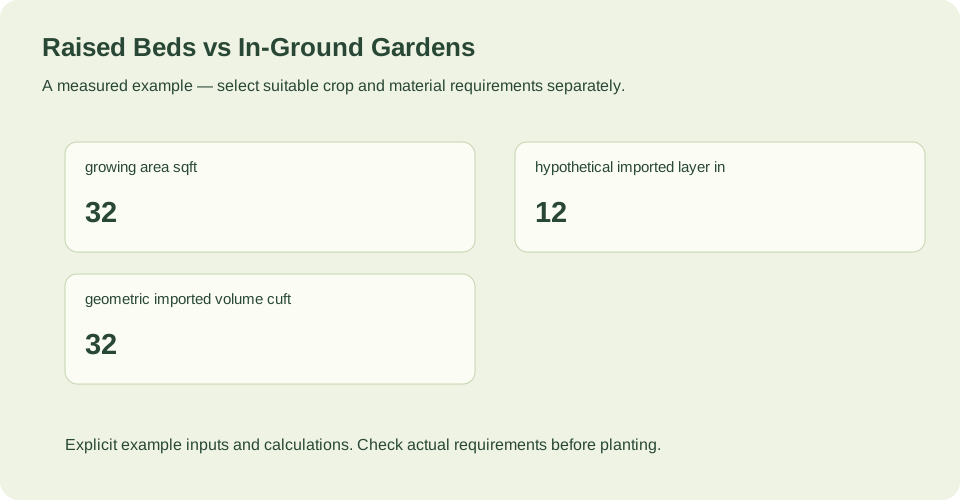
Site-planning arithmetic only: one selected growing footprint is 8 × 4 ft. Ground-level planting uses the existing soil; a proposed 12 in imported growing layer would require a separately calculated geometric volume. These inputs do not establish which system suits the site.
| Quantity | Calculated result |
|---|---|
| growing area sqft | 32 |
| hypothetical imported layer in | 12 |
| geometric imported volume cuft | 32 |
The same 32 sq ft footprint can be considered for different systems. Importing a selected layer creates a volume requirement; site conditions and native soil determine whether that work is useful.
Example inputs explain the method. Review the source context, chosen cultivar and actual site before planting or ordering.
Your before-you-plant checklist
- Site checked for level ground and drainage after rain
- Native soil assessed, with a soil test guiding amendments
- Bed footprints and paths measured and marked
- Frame height decision recorded separately from root depth
- Fill volume calculated from measured dimensions and checked against package label units
- Maintenance needs listed for raised, in-ground and mound options
Questions that come up while planning
Can I grow in a raised bed without a frame?
Yes, an unframed mound is an option to compare. It uses soil or compost without a frame, but mounds may spread and need reshaping, so include that upkeep in your comparison.
Does frame height tell me how deep roots can grow?
No. Frame height is not total root depth. Roots in an open-bottom bed may continue into the soil below, and depth advice differs for beds over hard surfaces.
Does a calculated fill volume tell me if the soil is good?
No. Volume is geometry only. A soil test guides nutrient and amendment decisions, and compost-to-topsoil blends of 1:2 or 1:1 are options rather than a substitute for assessing materials.
Sources & method
Horticultural guidance is linked to its original source and regional context. Geometry and unit conversions are calculated separately. Read how we prepare and check a page.
- Growing Vegetables in Raised BedsUniversity of Maryland Extension
- Soil to Fill Raised BedsUniversity of Maryland Extension