
Set the dates each record depends on
Start with your own local first and last frost dates, since a planning date only works when it matches the crop, variety, frost risk, and location. Then read the packet: days to maturity may count from sowing or from transplanting depending on the crop, so note which basis the label uses before you calculate anything.
For each sowing, write the sow or transplant date, the maturity basis, and a target removal date. The removal date is your planning estimate for when the space frees up, not a promise about the harvest. Keep the packet or a note of its stated basis with the record so a later check uses the same assumption.
- Record your local first and last frost dates as the planning frame.
- For each crop, note whether the packet counts days to maturity from sowing or from transplanting.
- Enter a sow or transplant date and an estimated removal date for every planting.
Source context: University of Maryland Extension · University of Maryland Extension
Separate relay sowing from crop replacement
Relay sowing means the next planting goes in while the current crop is still present, so the two overlap in the bed. Crop replacement means the new crop goes into space vacated by a spent plant. These are different records: an overlapping sowing needs its own spacing and location on the map, while a replacement depends on the removal date of the crop before it.
The source describes succession planting as planting in spots vacated by spent plants, and also as planting several small groups of a vegetable over time for a continuous harvest. Both belong in the plan, but label each record so you can see whether the bed is shared or handed over.
- Label each record as relay sowing (overlapping) or replacement (after removal).
- For relay sowings, draw the spacing and location of both crops on the same bed map.
- For replacements, link the new planting to the removal date of the crop it follows.
Source context: University of Maryland Extension
Map rounds across spring, summer, and fall
List the crops you intend to grow and draw a map showing spacing and location for each. The source suggests developing spring, summer, and fall maps for each round of crops, and notes that cool-season crops such as broccoli, lettuce, and peas can be followed by warm-season crops such as beans, tomatoes, and peppers, then by more cool-season plants or a winter cover crop.
Use those crop categories as planning labels, not as a fixed national calendar. Your frost dates and packet maturity basis decide when each round can actually fit. Where a crop is usually direct-seeded, the source suggests using transplants so seedlings are not competing with established plants in a vacated spot, and starting seeds indoors or in a protected outdoor area to gain growing time.
- Draw a spring, summer, and fall map for each bed or round.
- Assign each crop to a round using your frost dates and packet maturity basis.
- Mark which plantings are transplants and which are direct-sown.
Source context: University of Maryland Extension · University of Maryland Extension
Check the plan before sowing
Review each record against the same four inputs: local frost dates, packet maturity basis, removal date, and relay-or-replacement label. If a removal date falls before the next crop's sowing window, the record is a replacement; if the dates overlap, it is a relay sowing and needs space for both.
The Maryland example schedule shows three-season succession plans that can be used at the same time in gardens with multiple beds. Treat it as an illustration of structure, not as dates to copy. The separate example table shows calendar arithmetic only: four sowings at user-chosen offsets of 0, 14, 28, and 42 days. Local weather, crop growth, and packet instructions determine whether those sowings are appropriate.
- Confirm every record has a frost frame, maturity basis, and removal date.
- Check that relay records show space for both crops and replacement records follow a removal date.
- Recheck packet bases whenever you change variety.
Source context: University of Maryland Extension · University of Maryland Extension
Check your measured example
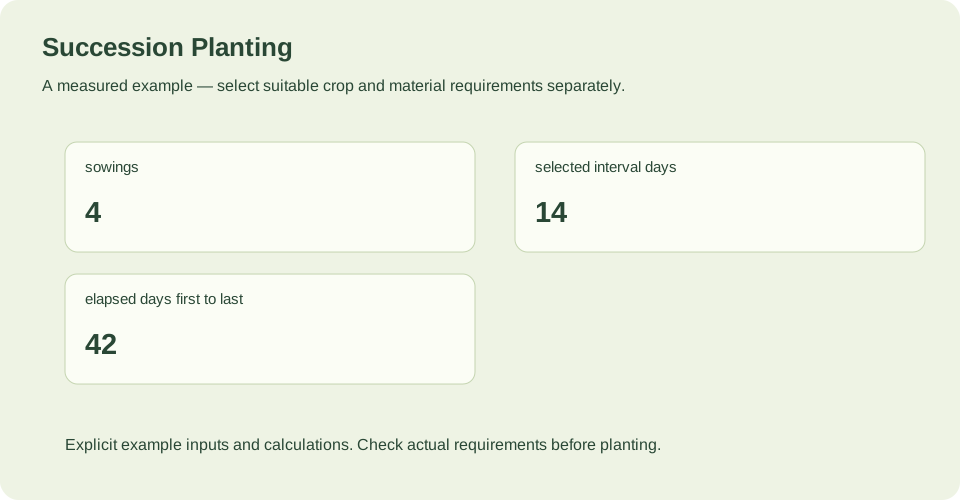
Calendar arithmetic only: four sowings on user-chosen offsets of 0, 14, 28 and 42 days. Local weather, crop growth and packet instructions determine whether these sowings are appropriate.
| Quantity | Calculated result |
|---|---|
| sowings | 4 |
| selected interval days | 14 |
| elapsed days first to last | 42 |
The worked example is calendar arithmetic only: four sowings at user-chosen offsets of 0, 14, 28, and 42 days, with 42 days elapsed from first to last sowing. It does not show that a 14-day interval suits any crop, variety, or location; local weather, crop growth, and packet instructions determine whether those sowings are appropriate.
Example inputs explain the method. Review the source context, chosen cultivar and actual site before planting or ordering.
Your before-you-plant checklist
- Local first and last frost dates recorded for the plan.
- Each crop's packet maturity basis noted as from sowing or from transplanting.
- Every planting labeled as relay sowing or crop replacement.
- Removal date entered for each planting and linked to the following crop.
- Spring, summer, and fall bed maps drawn with spacing and location.
Questions that come up while planning
What is the difference between relay sowing and crop replacement?
Relay sowing puts the next planting in while the current crop is still growing, so the two overlap in the bed. Crop replacement puts a new crop into space vacated by a spent plant. Record them separately because relay sowings need space for both crops, while replacements depend on the earlier crop's removal date.
Why does the packet's days-to-maturity basis matter?
Days to maturity can start at sowing or at transplanting depending on the crop. If you assume the wrong basis, your estimated removal date and the next sowing date will be off. Note the basis on each record and keep it consistent when you check the plan.
Can I copy the Maryland example dates for my garden?
No. Those dates are examples for that source location. Use your own local first and last frost dates, plus the packet maturity basis for your variety, to set sowings and removal dates.
Sources & method
Horticultural guidance is linked to its original source and regional context. Geometry and unit conversions are calculated separately. Read how we prepare and check a page.
- Vegetable Succession and Companion PlantingUniversity of Maryland Extension
- When to Plant VegetablesUniversity of Maryland Extension