
What the four crops' spacing figures describe
Tomato is listed at 18 to 36 inches within a row and 48 to 60 inches between rows. That range is not a single answer: habit and the choice of staking or caging affect spacing, so choose the support method before placing plants. A narrow bed and the adjacent path must be considered together, because the between-row figure describes the full space the system needs, not just the bed width.
Pepper has a home-garden example of plants 18 inches apart with rows 30 to 36 inches apart. The source's growing conditions are Minnesota-specific, so variety and local growing advice still matter. Broccoli is described with rows 3 feet apart and plants 1.5 to 2 feet apart within a row. That is a regional growing guide, and cultivar, harvest goal and growing system must be stated when choosing a spacing.
Garlic is different again. The guide describes six-inch clove spacing in a double-row system, with thirty-inch bed centers. Clove spacing, row arrangement and bed-center distances are separate quantities. Do not invent an extra distance between the paired rows, and do not turn the arrangement into an unrestricted square grid. Fall timing in that guide is regional.
- Write down which quantity each number represents: within-row, between-row, clove spacing, row arrangement or bed-center distance.
- For tomato, decide the support method first, then apply the within-row and between-row figures together.
- For pepper and broccoli, note the regional context of the source beside the figure.
- For garlic, keep the double-row arrangement and bed-center distance distinct from clove spacing.
Source context: University of Maryland Extension · University of Minnesota Extension · Clemson Cooperative Extension · University of Minnesota Extension
Within-row, between-row and paired-row systems
Within-row spacing is the distance between plants in the same line. Between-row spacing is the distance from one row to the next, and it often includes the access space the crop needs. A paired-row system, as described for garlic, groups rows in a specific arrangement rather than spreading plants evenly across a bed. These are different measurements, so a chart that lists only one number per crop can mislead you.
Sowing distance and final plant distance can also differ. A seed or clove may be placed at one spacing and later thinned or grown to a final stand at another. The supplied facts do not give separate sowing and final distances for every crop, so do not assume they are the same. Where only one figure is supplied, record it as the figure the source states and label what it measures.
- Label every spacing figure in your plan with the quantity it measures.
- Keep sowing distance and final plant distance as separate columns if your source gives both.
- Do not convert a paired-row arrangement into a square grid.
- Check that between-row figures account for paths and access, not just bed width.
Source context: University of Maryland Extension · University of Minnesota Extension
Using the geometric example correctly
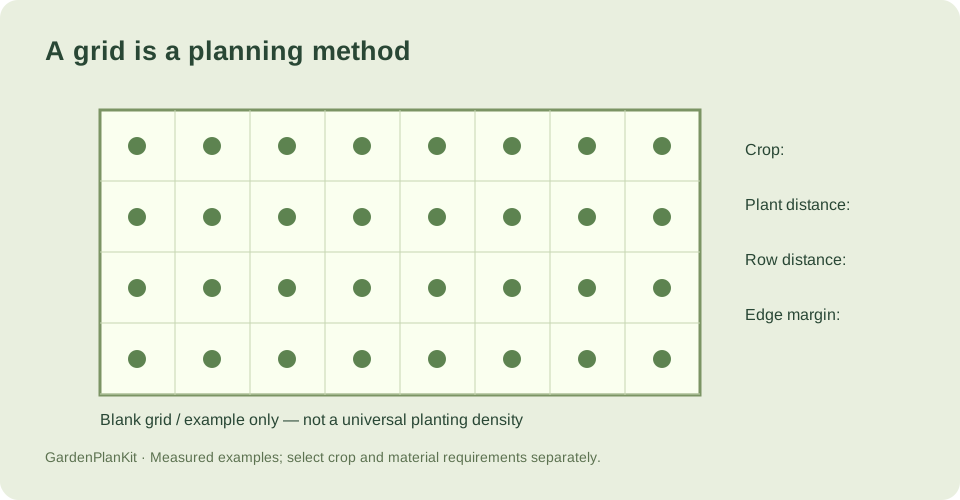
The supplied example is a purely geometric 96 in by 48 in rectangle with 12 in center spacing in both directions and 6 in edge margins. Along the length it gives 8 positions, across the width 4 positions, for 32 plant positions. This is a geometry demonstration, not a crop recommendation. It shows how center spacing and margins produce a grid count; it does not say that tomato, pepper, broccoli or garlic should be planted at 12 inches.
Use the example to check your arithmetic method, then replace its numbers with the sourced figures for the crop and system you are planning. If your crop uses a paired-row system, the square-grid count does not apply.
- Check the example's arithmetic: 8 positions along the length and 4 across the width give 32 positions.
- Replace the example's 12 in spacing with the sourced figure for your chosen crop and system.
- Use a paired-row layout for garlic rather than the square grid.
- Record the source and context beside each figure in your final plan.
Source context: University of Maryland Extension · University of Minnesota Extension · Clemson Cooperative Extension · University of Minnesota Extension
Check your measured example
A purely geometric 96 in × 48 in rectangle, 12 in center spacing in both directions, 6 in edge margins. This is not a crop recommendation.
| Quantity | Calculated result |
|---|---|
| along length | 8 |
| across width | 4 |
| plant positions | 32 |
The example is a 96 in by 48 in rectangle with 12 in center spacing and 6 in edge margins, giving 8 positions along the length and 4 across the width, for 32 plant positions. It is a geometry check only and is not a recommendation for any of the four crops.
Example inputs explain the method. Review the source context, chosen cultivar and actual site before planting or ordering.
A small, sourced spacing reference
| Crop | Within-row reference | Growing-system context |
|---|---|---|
| Tomato | 18–36 inches | Maryland guide: rows 48–60 inches; habit and support affect the choice. |
| Pepper | 18 inches | Minnesota example: rows 30–36 inches. |
| Broccoli | 18–24 inches | Clemson example: rows 36 inches. |
| Garlic | 6-inch clove spacing | Minnesota describes a double-row system and 30-inch bed centers; these distances are not interchangeable. |
Use the individual source, variety instructions and local growing system. This table is not a universal planting prescription.
Your before-you-plant checklist
- Each spacing figure is labeled as within-row, between-row, clove spacing, row arrangement or bed-center distance.
- Tomato support method is chosen before plants are placed.
- Regional context is noted beside pepper, broccoli and garlic figures.
- Garlic is planned as a double-row system, not a square grid.
- The geometric example is used only to check counting, not as crop advice.
Questions that come up while planning
Why does the tomato spacing range vary so much?
The supplied guide gives 18 to 36 inches within a row and 48 to 60 inches between rows, and explains that habit and staking or caging affect spacing. Choose the support method before placing plants.
Can I use the 12-inch square-grid example for these crops?
No. The example is purely geometric and is not a crop recommendation. Use it to check your counting method, then apply the sourced figures for your crop and system.
Is garlic's six-inch spacing the same as its between-row distance?
No. Six inches is clove spacing in a double-row system, and thirty-inch bed centers are a separate quantity. Do not invent an extra distance between the paired rows.
Sources & method
Horticultural guidance is linked to its original source and regional context. Geometry and unit conversions are calculated separately. Read how we prepare and check a page.
- Growing Tomatoes in a Home GardenUniversity of Maryland Extension
- Growing PeppersUniversity of Minnesota Extension
- BroccoliClemson Cooperative Extension
- Growing Garlic in Home GardensUniversity of Minnesota Extension