
Start with treatment identity, not appearance
The first practical step is to establish what the wood actually is. Untreated decay-resistant species such as cedar or other naturally rot-resistant timber are identifiable by species or label. Ordinary untreated lumber, often pine or fir, is identifiable but has little natural decay resistance. Modern treated lumber should carry a label or tag identifying the preservative system and intended use; without that identification, you cannot assume a piece is suitable for a food-growing bed.
Unidentified salvaged timber is the hardest case. It may be old treated wood, painted wood, or an unknown species, and no visual inspection reliably tells you which. Treat unidentified timber as unknown rather than food-safe, and either exclude it from the bed frame or use it only where it does not contact soil or produce. Record the species or treatment label for every board you plan to use.
- Check each board for a species name, treatment tag or retailer label.
- Separate identified boards from unidentified salvaged timber.
- Decide that unidentified timber will not form the soil-contact frame.
Source context: University of Maryland Extension
Compare cost and expected exposure
Cost comparisons should be made per board foot or per linear foot at the same dimensions, because a cheap board that is thinner or shorter is not a like-for-like saving. Untreated decay-resistant species usually cost more than ordinary untreated lumber, while identified modern treated lumber often sits between them depending on the preservative system and regional supply. Prices change, so compare current quotes rather than relying on a remembered figure.
Expected exposure matters as much as price. A bed frame sits against damp soil and weather, so the soil-contact face is the most demanding part. Untreated decay-resistant wood is chosen for that exposure, ordinary untreated lumber is the least durable option in wet contact, and identified modern treated lumber is chosen where its labeled preservative system is acceptable for the intended use. Frame height is not the same as root depth, and roots in an open-bottom bed may continue into the soil below.
- Price each candidate per board foot at matching dimensions.
- Note which faces will contact soil and which will be exposed to weather.
- Keep the treatment label with your purchase record.
Source context: University of Maryland Extension
Handle lifespan as an estimate, not a promise
No wood supplier or guide can give a fixed lifespan for a raised bed frame, because moisture, drainage, soil contact, climate and board thickness all change how quickly wood decays. Treat any lifespan figure as a rough expectation tied to specific conditions, not a guarantee. The honest comparison is relative: decay-resistant untreated species generally outlast ordinary untreated lumber in wet soil contact, and identified treated lumber is selected for its labeled preservative system rather than for a promised number of years.
Build in inspection. Check the soil-contact boards each season for soft spots, splitting or insect damage, and replace individual boards rather than waiting for the whole frame to fail. This keeps the comparison practical and avoids overstating what any material can deliver.
- Write down the conditions your bed will face: soil contact, drainage and local weather.
- Inspect soil-contact boards at least once a year.
- Replace a failing board individually instead of rebuilding the whole frame.
Source context: University of Maryland Extension
Count courses and corner details separately
Wood choice is only one part of the bed. Bed width and access affect the design, and the underlying soil matters too. The source guide describes compost-to-topsoil blends of 1:2 or 1:1 as options, not as a substitute for assessing the materials you actually have. Frame height should not be treated as total root depth, and the guide gives different depth advice for beds over hard surfaces.
Board run doubles when the number of equal courses doubles. Corner details, waste and the actual material instructions still have to be added to a purchase list.
Source context: University of Maryland Extension
Check your measured example
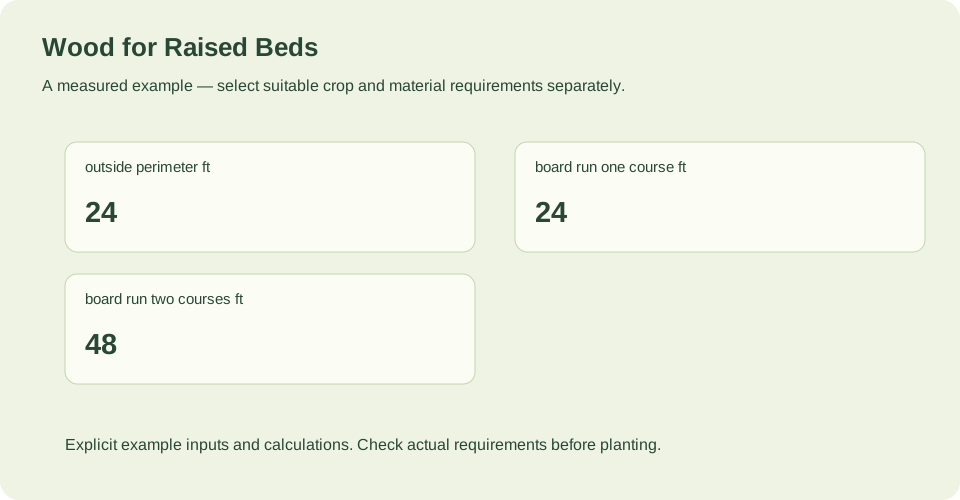
Material takeoff illustration only: an outside rectangle 8 × 4 ft has a 24 ft perimeter. One versus two equal-height courses changes the total board run; this does not specify joints, thickness, bracing, fasteners or durability.
| Quantity | Calculated result |
|---|---|
| outside perimeter ft | 24 |
| board run one course ft | 24 |
| board run two courses ft | 48 |
Board run doubles when the number of equal courses doubles. Corner details, waste and the actual material instructions still have to be added to a purchase list.
Example inputs explain the method. Review the source context, chosen cultivar and actual site before planting or ordering.
Your before-you-plant checklist
- Every board has an identified species or treatment label.
- Unidentified salvaged timber is excluded from soil contact.
- Costs are compared per board foot at matching dimensions.
- Soil-contact faces and weather-exposed faces are noted.
- A seasonal inspection of the frame boards is scheduled.
Questions that come up while planning
Is treated lumber safe for a vegetable raised bed?
That depends on the identified preservative system and its labeled intended use. Modern treated lumber should carry a label or tag; without identification, do not assume a board is suitable for food-growing soil contact. Follow the label rather than a general claim.
How long will a wooden raised bed last?
There is no fixed lifespan. Moisture, drainage, soil contact, climate and board thickness all affect decay, so treat any figure as a rough expectation for specific conditions and inspect the soil-contact boards each season.
Can I use salvaged or unknown wood for the frame?
Unidentified salvaged timber should be treated as unknown, not food-safe. If you cannot identify the species or treatment, keep it out of the soil-contact frame or use it only where it does not touch soil or produce.
Sources & method
Horticultural guidance is linked to its original source and regional context. Geometry and unit conversions are calculated separately. Read how we prepare and check a page.
- Growing Vegetables in Raised BedsUniversity of Maryland Extension