
Read the source range before choosing a number
The reference gives a within-row transplant interval of 24 inches and a between-row range of 48 to 72 inches. The 24-inch figure is a single value, while the row spacing is a range. That difference matters: you can adopt 24 inches as a clearly labeled scenario for transplant centers, but the 48-to-72-inch range still requires a choice based on your own access needs and the mature spread of the cultivar.
Do not treat either figure as a sowing depth, a thinning distance, or a guarantee about final canopy size. The source describes transplants, so the spacing applies to plants set out at their initial planting positions, not to seed sown thickly and thinned later. If you are direct-sowing, the seed and thinning spacing is a separate decision this source does not supply.
- Write down the cultivar name and check its mature habit before fixing row spacing.
- Record 24 inches as the within-row transplant interval for the labeled example scenario.
- Choose a between-row distance within the 48-to-72-inch range and note why you chose it.
Source context: Utah State University Extension
Work one measured row
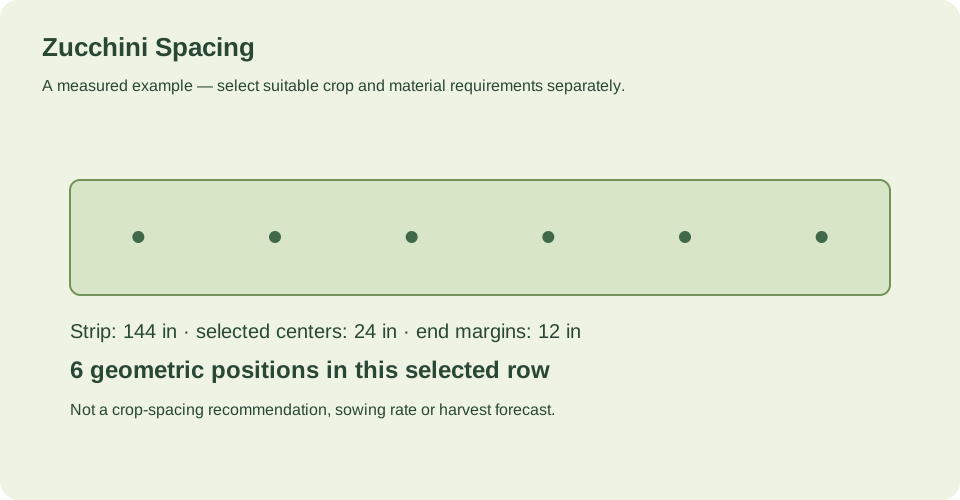
The verified example uses a 144-inch row, 24-inch centers, and a 12-inch margin at both ends. The first transplant center falls at 12 inches and the last at 132 inches. Counting those positions gives 6 transplants. The counted item is transplants, not seeds, seedlings, or mature plants that survived the season.
The end margins are a layout choice for this example, not a spacing rule from the source. They keep the first and last transplant away from the row ends. The arithmetic is geometric: it places centers at even intervals inside the measured length. It does not predict yield, canopy coverage, or how much of the bed each plant will fill.
- Measure the actual row length in inches or centimeters.
- Subtract both end margins from the row length.
- Divide the remaining length by the center interval, then add one to count positions.
- Mark each center and label the row with its interval and margin values.
Source context: Utah State University Extension
One row is not the whole layout
A single counted row does not describe a full garden plan. Between-row distance, paths for access, adjacent rows, and any support or trellis arrangement must be chosen separately. The source gives a 48-to-72-inch between-row range, but it does not specify path widths, bed-edge clearances, or how much room a particular cultivar's mature habit will occupy.
If you are planting in a raised bed, the row length and the number of rows both depend on the bed's measured interior dimensions. Count each row on its own, then check that the chosen between-row distance and access space fit inside the bed. Do not assume a generic square grid represents a zucchini row layout; the grid does not encode the within-row interval or the between-row range.
- Measure bed width and subtract any space you need for access.
- Decide how many rows fit using your chosen between-row distance.
- Count transplants row by row rather than applying one total to the whole bed.
- Check that adjacent rows and paths are marked before planting.
Source context: Utah State University Extension
Use the row calculator for this exact count
The linked row calculator can count this exact row length, center interval, and both end margins, entered in inches or centimeters. Use it to reproduce the 144-inch, 24-inch-center, 12-inch-margin example and to test other measured rows with the same method. The calculator counts positions along one row; it does not design the rest of the garden or choose spacing for you.
Keep the opening scenario and the worked example consistent: 24-inch centers, 12-inch end margins, 144-inch row, 6 transplants. If you change any of those values, the count changes, so record the inputs alongside the result.
- Enter the measured row length in your chosen unit.
- Enter the center interval and both end margins in the same unit.
- Confirm the first and last center positions before marking the bed.
- Save the inputs with the count so the row can be checked later.
Source context: Utah State University Extension
Check your measured example
One measured 144-inch row, with selected 24-inch centers and 12-inch margins at both ends. Count 6 transplants.
Reference and growing system: USU’s summer-squash guide gives transplants 24 inches apart within rows 48–72 inches apart. This is a summer-squash transplant example, not every cultivar’s mature canopy width.
| Quantity | Calculated result |
|---|---|
| Usable row length (in) | 144 |
| Selected center spacing (in) | 24 |
| Margin at each row end (in) | 12 |
| Positions in this row | 6 |
| First center from row start (in) | 12 |
| Last center from row start (in) | 132 |
| What is being counted | transplants |
The verified example is a geometric layout: a 144-inch row, 24-inch transplant centers, and 12-inch margins at both ends. It places the first center at 12 inches and the last at 132 inches, giving 6 transplants. The margins are part of this example only, and the count does not predict yield or mature canopy size.
Count this row in the spacing calculator ↗Example inputs explain the method. Review the source context, chosen cultivar and actual site before planting or ordering.
Your before-you-plant checklist
- Cultivar name and mature habit noted before choosing row spacing.
- Within-row interval labeled as 24 inches for the example scenario.
- Between-row distance chosen within the 48-to-72-inch range and recorded.
- Row length, center interval, and both end margins entered in the same unit.
- Count labeled as transplants, with first and last center positions marked.
Questions that come up while planning
How far apart should zucchini transplants be within a row?
The summer-squash transplant example uses 24 inches between transplants within a row. That is one labeled scenario, not a universal spacing for every zucchini cultivar.
How far apart should zucchini rows be?
The same source gives a between-row range of 48 to 72 inches for summer-squash transplants. Choose a value within that range based on access and the mature habit of your cultivar, and record your choice.
Does a 144-inch row with 24-inch centers and 12-inch margins hold 6 transplants?
Yes. The first center is at 12 inches, the last at 132 inches, and the positions count to 6 transplants. The margins are a layout choice in this example, not a spacing rule from the source.
Sources & method
Horticultural guidance is linked to its original source and regional context. Geometry and unit conversions are calculated separately. Read how we prepare and check a page.
- How to Grow Summer and Winter Squash in Your GardenUtah State University Extension