
Decide whether a container suits globe artichoke
Globe artichoke needs full sun, fertile well-drained soil enriched with organic matter, and consistent moisture. The source describes shallow roots that should stay moist, especially from bud formation through summer, plus regular nitrogen-rich feeding. Those requirements are demanding in a pot because the growing medium dries faster and roots have limited room.
Cool spring temperatures help initiate the flower stalk. The source warns that late planting can deny plants the chilling they need, and that hot weather during flower-stalk formation often prevents flowering. Its dates, including January seed starting and planting three to four weeks before the frost-free date, are examples for that source location. Treat them as regional examples, not universal calendar advice.
A container also has to fit the mature top growth and allow access for watering, feeding, inspecting buds and frost protection. Volume alone does not define a suitable shape. If you cannot provide a large enough root space and working room, an in-ground site may be more realistic.
- Confirm you have full sun and a plan for steady watering through summer.
- Check your local frost dates and chilling conditions before setting a sowing or transplant date.
- Measure the space around the intended pot, including room to reach the plant and cover it during frost risk.
Source context: Utah State University Extension · University of Maryland Extension
Choose and measure the container
The supplied container guidance says to match both mature top growth and root space, and that volume alone does not define a suitable shape. It gives reference minimum volumes for named ordinary vegetables, but artichoke is not among those named examples. Do not convert the in-ground row spacing of 18 inches with rows 2 to 3 feet apart into a pot minimum.
Drainage holes must stay open. Stones or gravel under the mix do not improve drainage. Measure actual fill volume rather than trusting a nursery trade-gallon label, and empty saucers so roots are not left saturated.
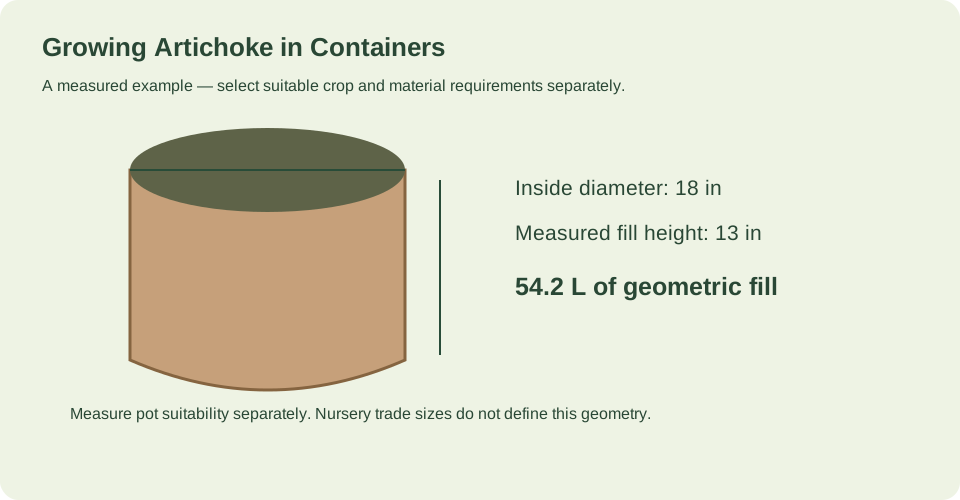
The worked example is purely geometric: an 18-inch inside-diameter straight-sided pot, 14 inches inside height, with a 1-inch rim gap, giving a 13-inch fill height. Its calculated fill capacity is shown in the separate table. That number describes how much medium that shape holds; it is not a minimum pot size for artichoke.
- Measure inside diameter and usable fill height, not outside dimensions.
- Subtract any rim gap before calculating fill volume.
- Check that drainage holes are open and that the pot shape leaves room for the mature plant.
Source context: University of Maryland Extension
Prepare the growing medium and support
Use a growing medium that supports roots while holding appropriate water and air. Dense garden soil behaves differently from a container mix. The supplied guide lists commercial soilless mix and an equal-volume soilless-mix and compost blend among options for container vegetables.
For reused medium, remove plant residue and do not save medium associated with root disease. The guide describes blending old and fresh material rather than assuming old mix is unchanged.
Support checks matter because a mature artichoke is tall and top-heavy. Confirm the pot is stable, the plant can be staked or otherwise supported without damaging roots, and the container can be protected from frost if it is to overwinter outdoors. The source says artichokes are frost and freeze sensitive and need protection for outdoor overwintering.
- Fill with a root-supporting medium and leave the planned rim gap for watering.
- Plan stable support for the mature top growth before the plant becomes large.
- If reusing medium, remove residue and discard medium linked to root disease.
Source context: University of Maryland Extension · Utah State University Extension · University of Maryland Extension
Set up a watering and monitoring plan
The source gives 1 to 2 inches of water per week for in-ground plants and says to keep shallow roots moist, especially from bud formation through summer. That figure is a field watering reference, not a container prescription. In a pot, check moisture more often and adjust for your medium, weather and drainage rather than copying the field rate.
The source also describes regular nitrogen-rich fertilization, with one field example of 2 teaspoons of 21-0-0 per plant every four weeks beginning four weeks after transplanting, placed to the side and irrigated in. That is a sourced field example, not a container feeding instruction. Follow package label units and directions for any product you use.
Monitor for pests that reduce vigor, and harvest buds when they reach full size but before the bracts open. Record sowing, transplanting, first bud formation and harvest dates so you can compare the next season against your own conditions.
- Check medium moisture regularly and water so the mix stays moist without leaving roots saturated.
- Keep a simple log of sowing, transplanting, bud formation and harvest dates.
- Inspect buds and foliage regularly and remove any empty saucer water.
Source context: Utah State University Extension · University of Maryland Extension · University of Maryland Extension
Check your measured example
Volume-only illustration: one straight-sided pot with inside diameter 18 in, inside height 14 in and 1 in rim gap. The resulting fill capacity is not a minimum pot size for artichoke; confirm a suitable container separately.
| Quantity | Calculated result |
|---|---|
| inside diameter in | 18 |
| fill height in | 13 |
| volume cuft | 1.9144 |
| volume liters | 54.21 |
| US liquid gallons | 14.3208 |
The example uses a straight-sided pot with an 18-inch inside diameter, 14-inch inside height and a 1-inch rim gap, leaving 13 inches of fill height. The separate table reports the resulting fill capacity. This is a geometrical calculation only: it does not establish a minimum pot size, a suitable shape or a growing recommendation for globe artichoke.
Example inputs explain the method. Review the source context, chosen cultivar and actual site before planting or ordering.
Your before-you-plant checklist
- Full-sun position confirmed and a summer watering routine planned.
- Local frost and chilling conditions checked before setting dates.
- Inside diameter and usable fill height measured, with rim gap subtracted.
- Drainage holes open and saucer emptied rather than left full.
- Root-supporting medium chosen and stable support planned for mature top growth.
Questions that come up while planning
Can I use the 18-inch in-ground spacing as a container size?
No. The 18-inch spacing and 2-to-3-foot row width are field planting figures. The supplied container guidance says volume alone does not define a suitable shape and gives no artichoke pot minimum. Confirm root space, top-growth room and access separately.
Why might a container artichoke fail to flower?
The source says insufficient chilling can prevent flowering, and hot weather during flower-stalk formation often causes failure. Its sowing and planting dates are examples for that source location, so check your local conditions rather than copying them.
Does the worked pot example give a recommended pot size?
No. It is a volume-only illustration for a straight-sided pot with an 18-inch inside diameter and 13-inch fill height. The calculated fill capacity is not a minimum pot size for artichoke.
Sources & method
Horticultural guidance is linked to its original source and regional context. Geometry and unit conversions are calculated separately. Read how we prepare and check a page.
- How to Grow Artichoke in Your GardenUtah State University Extension
- Growing Vegetables in Containers and Salad TablesUniversity of Maryland Extension
- Growing Media (Potting Soil) for ContainersUniversity of Maryland Extension