
Find the real draining path
Turn the container over and locate every outlet. A single central hole, several small holes, side openings and slotted bases all count, but only if water can reach them. Look inside for a saucer pressed tight to the base, a liner, a plastic sheet, compacted medium or a root mass sitting over the outlet. Any of these can block the bottom even when holes exist.
Water needs a continuous route from the growing medium through the outlet and away from the pot. If the pot sits flat on a surface that seals the holes, water collects at the lowest point. Raising the base slightly or setting the pot where the outlet is not covered keeps that route open. Check the path with the pot in its final position, not only on a workbench.
- Turn the pot over and count the outlet holes or slots.
- Look inside for liners, saucers, compacted medium or roots covering the outlets.
- Set the pot in its final position and confirm the outlets are not sealed by the surface.
Source context: University of Maryland Extension · University of Maryland Extension
Perched water and why gravel does not solve it
In a conventional draining pot, water held in the medium above the outlet is often called perched water. The amount depends on the medium and the container, not on a loose layer at the bottom. A gravel layer does not create a free-draining zone that pulls water down from the mix above. Instead, it reduces the volume available for roots and medium while the finer mix still holds water at the boundary.
The practical fix is to use a medium suited to containers and to keep the outlet clear. Container watering needs vary with weather, plant growth and growing medium, so the same pot may behave differently across a season. Dense garden soil behaves differently from a container mix, and a mix that holds appropriate water and air supports roots better than one that stays saturated.
- Skip gravel as a drainage fix in a conventional draining pot.
- Use a container mix rather than dense garden soil.
- Check the outlet again after watering and after roots have grown.
Source context: University of Maryland Extension · University of Maryland Extension
Saucers, reservoirs and the planter type
A saucer under a draining pot catches water that leaves the container. Empty it rather than letting the pot stand in collected water, because a full saucer can cover the outlet and keep the base wet. A saucer is a catch tray, not a reservoir unless the planter is designed that way.
A designed reservoir planter, including self-watering designs, has a different water-reservoir arrangement. Its outlet and water-holding parts are intended to work together, so do not treat it like a conventional draining pot with a blocked hole. Plan for the actual container and growing system you have. If you are unsure which type you own, look for a separate water chamber, a fill point or instructions that describe a reservoir.
- Empty saucers after watering so the pot is not standing in collected water.
- Identify whether the container has a separate reservoir, fill point or self-watering design.
- Follow the planter's own arrangement rather than adding a gravel layer to a reservoir planter.
Source context: University of Maryland Extension
Reusing medium without assuming it is unchanged
When reusing a container, remove plant residue and do not save medium associated with root disease. Old medium is not unchanged: roots, residue and breakdown alter it. The guide describes blending old and fresh material rather than assuming old mix still performs like new.
Blending is a practical way to refresh a container medium, but it does not replace checking drainage. After reuse, confirm the outlet is still clear and the medium still supports roots while holding appropriate water and air. The example table is inventory arithmetic only: a measured footprint and a selected layer depth produce a volume and bag count. It does not prescribe a growing depth, amendment rate, treatment or potting recipe.
- Remove plant residue before reusing medium.
- Discard medium associated with root disease.
- Blend old and fresh material rather than assuming old mix is unchanged.
- Recheck the outlet and medium after refilling.
Source context: University of Maryland Extension
Check your measured example
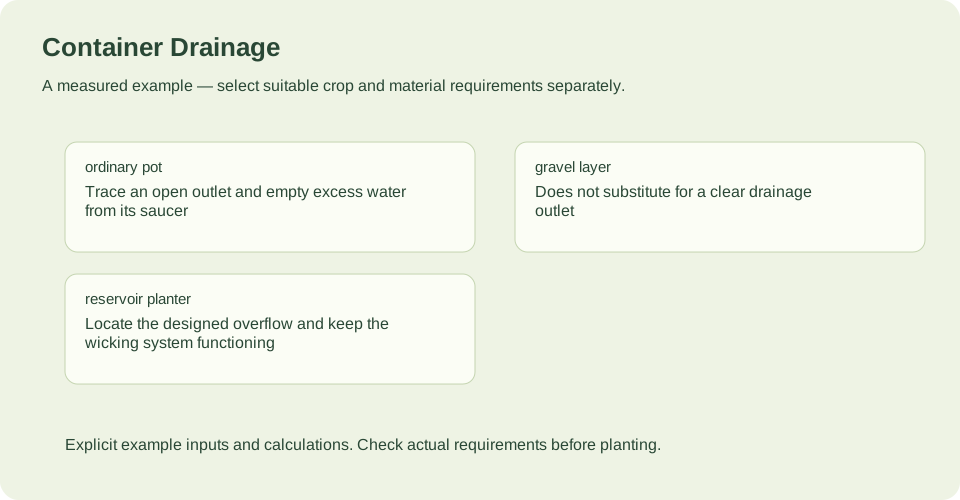
An outlet-inspection scenario compares conventional drainage with a designed reservoir. It is not a prescription for drilling any specific container.
| Quantity | Calculated result |
|---|---|
| ordinary pot | Trace an open outlet and empty excess water from its saucer |
| gravel layer | Does not substitute for a clear drainage outlet |
| reservoir planter | Locate the designed overflow and keep the wicking system functioning |
Identify whether the planter is designed to drain freely or retain water in a separate reservoir. A blocked outlet and a working reservoir are different conditions.
Example inputs explain the method. Review the source context, chosen cultivar and actual site before planting or ordering.
Your before-you-plant checklist
- Outlet holes or slots are visible and not sealed by the surface.
- No liner, saucer, compacted medium or root mass blocks the bottom.
- The pot is a conventional draining container or a designed reservoir planter, and you know which.
- Saucers are emptied after watering.
- Reused medium has residue removed, diseased medium is discarded, and old and fresh material are blended.
Questions that come up while planning
Does a gravel layer at the bottom of a pot improve drainage?
No. In a conventional draining pot, gravel does not create a free-draining zone that pulls water out of the finer mix above. Keep the outlet clear and use a container mix suited to the pot instead.
Should I leave water in the saucer under a draining pot?
A saucer catches water that leaves the pot. Empty it rather than letting the pot stand in collected water, because a full saucer can cover the outlet and keep the base wet.
How is a self-watering planter different from a draining pot?
A designed reservoir planter has a separate water-reservoir arrangement. Plan for that actual system rather than treating it as a conventional draining pot with a blocked hole.
Sources & method
Horticultural guidance is linked to its original source and regional context. Geometry and unit conversions are calculated separately. Read how we prepare and check a page.
- Growing Vegetables in Containers and Salad TablesUniversity of Maryland Extension
- Growing Media (Potting Soil) for ContainersUniversity of Maryland Extension