
Decide whether a container suits your basil plan
Basil wants warmth, full sun and steady moisture, and it grows best in nutrient-rich, well-drained soil. Those requirements make a container workable if you can keep the medium evenly watered and place the pot where it receives strong sun. A pot also lets you move the plant if conditions change.
For container herbs, the named reference groups smaller herbs such as basil with thyme, mint, oregano and tarragon at 2 to 5 gallons, while large herbs such as rosemary, sage, parsley, dill and fennel are listed at 5 gallons or more. Treat that as a group reference, not a guaranteed minimum for every basil variety. Match the pot to both the mature top growth and the root space, because volume alone does not define a suitable shape.
Plan for a bush that you pinch repeatedly for leaves. Seedlings and young transplants are small, but a mature branching plant occupies more space above and below the medium. Container capacity and repeated trimming are separate from a grid count, so do not convert an in-ground spacing figure into a pot minimum.
- Confirm the pot has open drainage holes and a shape that can support the mature plant.
- Place the container where basil receives full sun and where you can reach it for watering and pinching.
- Choose a pot size from the smaller-herb group reference, then check that the shape suits the plant you expect to grow.
Source context: Utah State University Extension · University of Maryland Extension
Measure the pot and prepare the growing medium
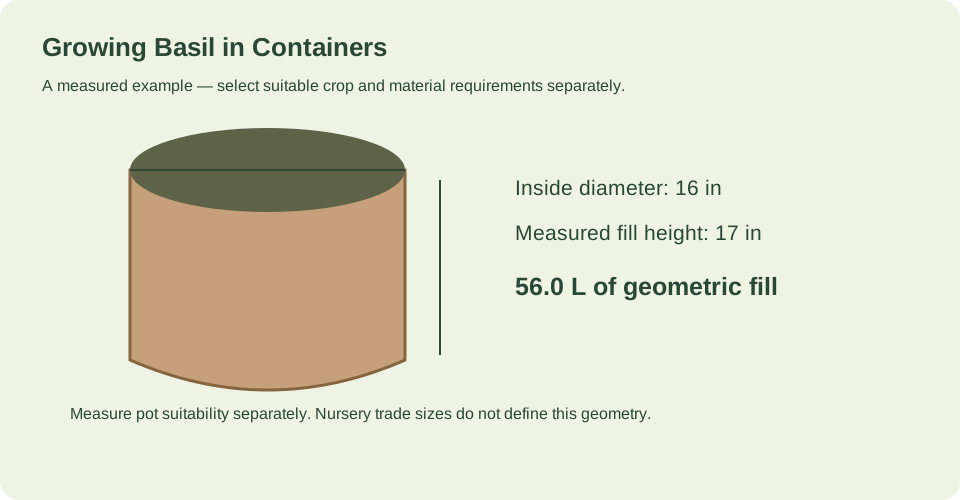
Measure actual fill volume rather than relying on a nursery trade-gallon label. Use the inside diameter and the usable fill height, leaving a rim gap so you can water without spilling. The worked example in the table is a volume-only illustration for one straight-sided pot; its result is not a minimum pot size for basil, and you should confirm a suitable container separately.
A container medium must support roots while holding appropriate water and air. Dense garden soil behaves differently from a container mix. The container guide lists commercial soilless mix and an equal-volume soilless-mix and compost blend among its options. If you reuse medium, remove plant residue and do not save medium associated with root disease; blend old and fresh material rather than assuming old mix is unchanged.
Keep drainage holes open. Stones or gravel under the mix do not improve drainage, and saucers should be emptied so roots are not left saturated.
- Measure inside diameter and usable fill height, then calculate fill volume and record it with the pot.
- Fill with a soilless mix or an equal-volume soilless-mix and compost blend, leaving a rim gap.
- Check that drainage holes remain open and empty any saucer after watering.
Source context: University of Maryland Extension · University of Maryland Extension
Plant, water and pinch on a repeatable schedule
Basil can be grown from seed or transplants. The source describes sowing seeds 1/8 inch deep, keeping the soil from drying out, and germination in about 10 to 14 days at soil temperatures of 75 to 85°F. It also describes transplants taking 4 to 6 weeks to reach size and being planted after frosts in mid to late May for that source location. Those dates are examples for that location, not a climate calendar for yours.
The source gives about 1½ inches of water per week and a liquid fertilizer sidedress every 14 days to support rapid leaf growth. Potted plants need regular watering and feeding for best growth. High summer heat and water stress can push basil to flower and set seed, which brings off flavors and stops leaf production.
Begin harvesting when plants have 6 to 8 leaves, removing enough stem so that only 2 to 4 leaves remain. The source notes that pinching off flowers as they form does not stimulate new foliage and can encourage more flowers in leaf axils, reducing yield. Planting basil every other week and avoiding stress are described as ways to keep plants from flowering too quickly. The in-ground thinning figures of 3 to 4 inches and a final 12-inch stand are field spacing guidance, not container advice.
- Sow or transplant after the last frost for your location, using the source's depth and germination context only as a reference.
- Water toward about 1½ inches per week and sidedress with liquid fertilizer every 14 days, adjusting for your medium and weather.
- Harvest when 6 to 8 leaves are present, leaving 2 to 4 leaves on the stem, and monitor for early flowering and water stress.
Source context: Utah State University Extension · University of Maryland Extension · University of Maryland Extension
Check your measured example
Volume-only illustration: one straight-sided pot with inside diameter 16 in, inside height 18 in and 1 in rim gap. The resulting fill capacity is not a minimum pot size for basil; confirm a suitable container separately.
| Quantity | Calculated result |
|---|---|
| inside diameter in | 16 |
| fill height in | 17 |
| volume cuft | 1.978 |
| volume liters | 56.0119 |
| US liquid gallons | 14.7968 |
The worked example is a volume-only illustration: a straight-sided pot with a 16-inch inside diameter, 18-inch inside height and a 1-inch rim gap, giving a fill height of 17 inches. The table reports the resulting fill capacity in cubic feet, liters and US liquid gallons. That figure describes the geometry of this pot only; it is not a minimum pot size for basil, and a suitable container must be confirmed separately.
Example inputs explain the method. Review the source context, chosen cultivar and actual site before planting or ordering.
Your before-you-plant checklist
- Pot has open drainage holes and a shape suited to the mature plant.
- Fill volume measured from inside diameter and usable fill height, with a rim gap.
- Medium is a soilless mix or an equal-volume soilless-mix and compost blend.
- Watering and fertilizer schedule recorded, with a check for heat and water stress.
- Harvest plan leaves 2 to 4 leaves on the stem when plants have 6 to 8 leaves.
Questions that come up while planning
What pot size should I use for basil in a container?
The named container reference groups basil with smaller herbs at 2 to 5 gallons. That is a group reference, not a guaranteed minimum for every basil variety. Check drainage, shape and root space as well as volume, and measure actual fill volume rather than trusting a trade-gallon label.
Does the worked pot example tell me the minimum pot size for basil?
No. The example is a volume-only illustration for one straight-sided pot with a rim gap. Its fill capacity is not a minimum pot size for basil, and you should confirm a suitable container separately using the herb group reference and the plant's expected size.
Should I pinch off basil flowers to get more leaves?
The source says pinching off flowers as they form does not stimulate new foliage and can encourage flowers in leaf axils, reducing yield. It instead describes planting basil every other week and avoiding plant stress as ways to keep flowering from starting too quickly.
Sources & method
Horticultural guidance is linked to its original source and regional context. Geometry and unit conversions are calculated separately. Read how we prepare and check a page.
- How to Grow Basil in Your GardenUtah State University Extension
- Growing Vegetables in Containers and Salad TablesUniversity of Maryland Extension
- Growing Media (Potting Soil) for ContainersUniversity of Maryland Extension