
Decide bush or pole before counting positions
Bush beans are the simpler container choice when you want a compact planting without a trellis. Pole beans are climbing types that flower over a long period and are trellised in the source material; the same source notes that trellises make harvest easier. Treat that as a reason to plan support, not as a promise about how much any container will produce.
The source spacing figures describe in-ground rows: seeds 1 inch deep and 2 to 3 inches apart, with rows 18 to 24 inches apart. Do not convert those row figures into a pot minimum or a container spacing rule. Use them only as background on how the crop is normally sown, then set your own container layout from the pot's actual surface and the support you can keep stable.
- Pick bush or pole beans and note whether a trellis is required.
- If you choose pole beans, identify a stable support before sowing.
- Keep a repeated bush sowing separate from any permanent trellis row.
Source context: Utah State University Extension
Check the pot, drainage and growing medium
Maryland lists a reference minimum volume of 2 US gallons for bush beans. That is a named guide example, not a guarantee for every variety, and volume alone does not define a suitable shape. Match both the mature top growth and the root space, and measure the actual fill volume rather than trusting a nursery trade-gallon label.
Drainage holes must stay open. Stones or gravel under the mix do not improve drainage, and saucers should be emptied so roots are not left saturated. For the medium, the container guide lists commercial soilless mix and an equal-volume soilless-mix and compost blend among its options. Dense garden soil behaves differently from a container mix. If you reuse medium, remove plant residue and do not save medium associated with root disease; blend old and fresh material rather than assuming old mix is unchanged.
- Confirm open drainage holes and empty any saucer after watering.
- Measure the pot's inside dimensions and calculate fill volume.
- Choose a soilless mix or an equal-volume soilless-mix and compost blend.
- For reused medium, remove residue and discard any associated with root disease.
Source context: University of Maryland Extension · University of Maryland Extension
Sow, water and monitor
Beans are warm-weather vegetables: the source calls for soil and air temperatures above 60 degrees Fahrenheit for best germination and growth, with seedlings emerging in 7 to 10 days in soil warmed to 65 to 85 degrees Fahrenheit. Those temperature figures come from the source location, so treat any regional date as an example for that place rather than a rule for yours. The source also describes successive sowings every 2 to 3 weeks until mid-July for a continuous harvest; that schedule is likewise tied to the source location.
Keep the medium evenly moist, especially during flowering, since water stress can reduce yield and pod quality. Mulch can help retain moisture and suppress weeds. Harvest snap beans when pods are full but seeds are not yet formed; for dry beans, leave pods on the plant until they yellow and dry. Check the support, drainage and moisture at each watering rather than assuming the setup is still sound.
- Sow only after the medium and air have warmed above 60 degrees Fahrenheit.
- Water to keep the medium evenly moist, with extra attention at flowering.
- Inspect the trellis or support and the drainage holes regularly.
- Harvest snap beans while pods are full but seeds are still unformed.
Source context: Utah State University Extension · University of Maryland Extension
Check your measured example
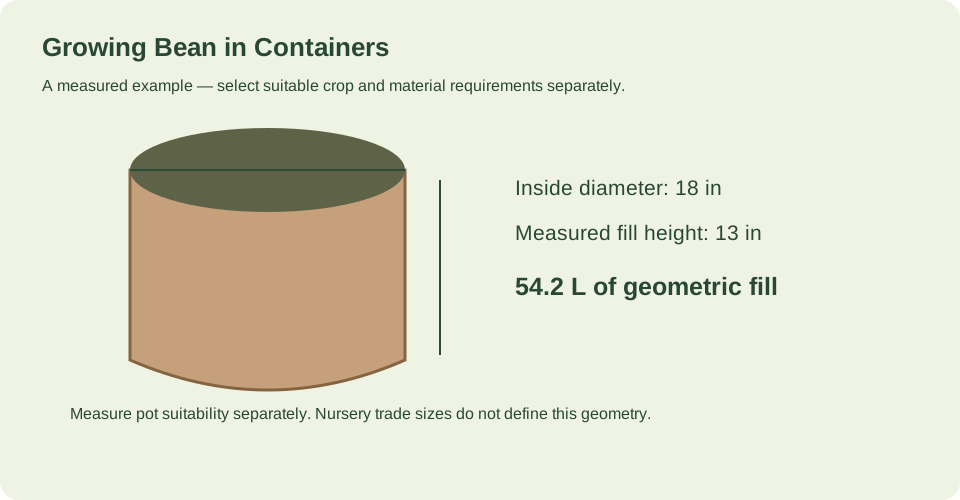
Volume-only illustration: one straight-sided pot with inside diameter 18 in, inside height 14 in and 1 in rim gap. The resulting fill capacity is not a minimum pot size for bean; confirm a suitable container separately.
| Quantity | Calculated result |
|---|---|
| inside diameter in | 18 |
| fill height in | 13 |
| volume cuft | 1.9144 |
| volume liters | 54.21 |
| US liquid gallons | 14.3208 |
The worked example is a volume-only illustration: a straight-sided pot with an 18-inch inside diameter, 14-inch inside height and a 1-inch rim gap, giving a fill height of 13 inches. Its calculated fill capacity is about 1.91 cubic feet, 54.2 liters or 14.3 US liquid gallons. That figure describes this pot's fill volume only; it is not a minimum pot size for beans, and a suitable container must be confirmed separately.
Example inputs explain the method. Review the source context, chosen cultivar and actual site before planting or ordering.
Your before-you-plant checklist
- Bush or pole type chosen, with support planned for pole beans.
- Drainage holes open and saucer emptied after watering.
- Actual fill volume measured rather than read from a trade-gallon label.
- Soilless mix or equal-volume soilless-mix and compost blend prepared.
- Sowing delayed until soil and air are above 60 degrees Fahrenheit.
Questions that come up while planning
What pot size do container beans need?
Maryland lists a reference minimum of 2 US gallons for bush beans. That is a guide example, not a guarantee for every variety, and volume alone does not define a suitable shape, so also match the pot to the mature top growth and root space.
Do pole beans need a trellis in a container?
Yes, plan a stable support. The source describes pole beans as climbing types that are trellised, and notes that trellises make harvest easier. Build or place the support before sowing so the plant has something to climb.
Can I reuse potting mix for beans?
The container guide allows blending old and fresh material, but first remove plant residue and do not save medium associated with root disease. Do not assume old mix is unchanged.
Sources & method
Horticultural guidance is linked to its original source and regional context. Geometry and unit conversions are calculated separately. Read how we prepare and check a page.
- How to Grow Beans in Your GardenUtah State University Extension
- Growing Vegetables in Containers and Salad TablesUniversity of Maryland Extension
- Growing Media (Potting Soil) for ContainersUniversity of Maryland Extension