
Read the source range before choosing a number
The Illinois table lists erect blackberries at 24 to 36 inches within rows, with rows 96 to 120 inches apart. Those are two different measurements: the first sets plant-to-plant centers along a row, and the second sets the distance between rows. The table also lists thornless trailing types at 72 to 120 inches within rows instead, so do not apply the erect-blackberry interval to a trailing type.
A range is not a single recommendation for every garden. Choose one within-row interval for your plan and label it clearly. The worked example selects 36 inches, the upper end of the erect-blackberry range, for a scenario described as one measured row. That choice is an example, not a claim that 36 inches is best for every erect blackberry planting.
- Confirm the plants are erect blackberries, not thornless trailing types.
- Write down the chosen within-row interval and note that it falls within 24 to 36 inches.
- Record the between-row range of 96 to 120 inches separately from the within-row choice.
Source context: University of Illinois Extension
Mark one row and count initial plants
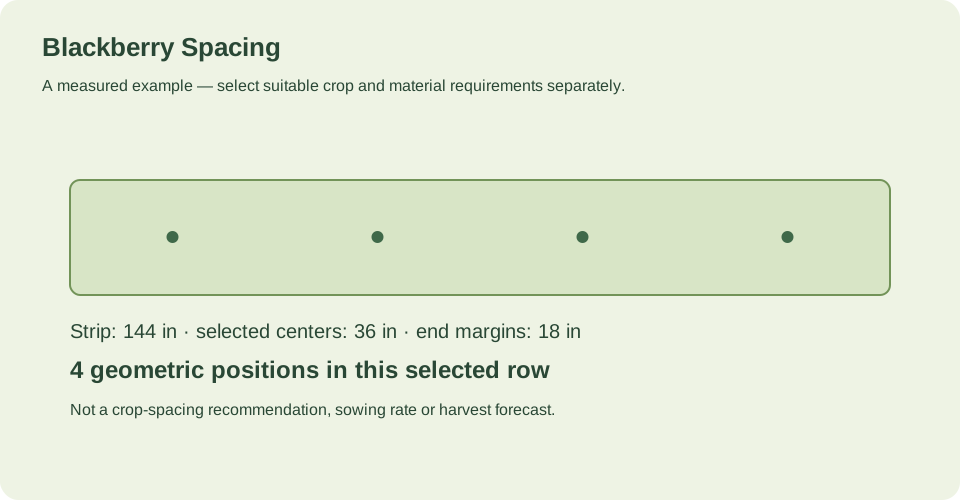
The example row is 144 inches long. With 36-inch centers and an 18-inch margin at each end, the first plant center is at 18 inches and the last is at 126 inches. The counted item is initial erect-blackberry plants, meaning plants placed at the start of the row plan, not seedlings to be thinned later and not established plants already in the ground.
The count is 4 positions. This is a geometrical result from the row length, center interval and end margins. It does not predict survival, yield or mature spread. Marking centers is a planning step; it does not replace checking the actual planting site and the plants you obtain.
- Measure the row length in inches or centimeters.
- Mark the first center one end margin in from the row start.
- Mark each next center at the chosen interval.
- Stop before the final center would fall within the end margin, then count the marked centers.
Source context: University of Illinois Extension
Keep row layout separate from garden layout
One counted row is not an entire garden layout. The example gives a plant count for a single 144-inch row only. It does not set the distance to a fence, path, building, water source or another row. The Illinois table's 96-to-120-inch between-row range is context for erect blackberries, but the example does not calculate a second row or a whole bed.
Plan access to your blackberry rows separately from the rows themselves, and decide where supports will stand before you set plants. Keep adjacent rows distinct so you can reach each one for pruning, harvesting, and maintenance, and base path widths and support placement on the access you actually need rather than on the row spacing alone.
- Label the example as one row, not a complete garden plan.
- List access, support and adjacent-row decisions as separate items to resolve.
- If adding another row, measure and count it separately rather than assuming the first row's count applies.
Source context: University of Illinois Extension
Use the row calculator for this exact count
The linked row calculator can count this exact length, center interval and both end margins, in inches or centimeters. Enter the measured row length, the chosen center spacing and the margin at each end. The calculator returns the number of counted positions for that row.
Keep the input units consistent and check that the selected center spacing is the one you intend for erect blackberries. The calculator counts positions from the measurements you enter; it does not choose a spacing for you, add rows, or account for supports and access.
- Enter the row length in inches or centimeters.
- Enter the chosen center interval within the erect-blackberry range.
- Enter the same end margin for both ends, or the two margins you have measured.
- Compare the returned count with your marked row before planting.
Source context: University of Illinois Extension
Check your measured example
One measured 144-inch row, with selected 36-inch centers and 18-inch margins at both ends. Count 4 initial erect-blackberry plants.
Reference and growing system: The Illinois table lists erect blackberries at 24–36 inches within rows 96–120 inches apart. It lists thornless trailing types at 72–120 inches within rows instead. This example specifically uses erect plants.
| Quantity | Calculated result |
|---|---|
| Usable row length (in) | 144 |
| Selected center spacing (in) | 36 |
| Margin at each row end (in) | 18 |
| Positions in this row | 4 |
| First center from row start (in) | 18 |
| Last center from row start (in) | 126 |
| What is being counted | initial erect-blackberry plants |
The worked example is a geometrical count for one 144-inch row using 36-inch centers and 18-inch margins at both ends. It yields 4 initial erect-blackberry plant positions, with the first center at 18 inches and the last at 126 inches. The 36-inch choice sits at the upper end of the Illinois erect-blackberry within-row range; it is an example scenario, not crop advice for every planting, and it does not set between-row, access or support distances.
Count this row in the spacing calculator ↗Example inputs explain the method. Review the source context, chosen cultivar and actual site before planting or ordering.
Your before-you-plant checklist
- Confirm the crop is erect blackberry, not thornless trailing blackberry.
- Record the chosen within-row interval and check it is within 24 to 36 inches.
- Measure the row and mark both end margins before counting centers.
- Label the result as initial erect-blackberry plants for one row.
- Keep between-row, access and support decisions separate from the row count.
Questions that come up while planning
What spacing does the Illinois table give for erect blackberries?
It lists erect blackberries at 24 to 36 inches within rows, with rows 96 to 120 inches apart. Thornless trailing types are listed at 72 to 120 inches within rows instead.
How does the example count 4 plants in a 144-inch row?
With 36-inch centers and 18-inch margins at both ends, the first center is at 18 inches and the last at 126 inches. That gives 4 counted initial erect-blackberry plant positions.
Does one counted row set my whole garden layout?
No. The example counts plants for one measured row only. Access, supports, adjacent rows and mature habit must be chosen separately, and the source notes do not give those distances.
Sources & method
Horticultural guidance is linked to its original source and regional context. Geometry and unit conversions are calculated separately. Read how we prepare and check a page.
- Growing Backyard FruitsUniversity of Illinois Extension