
Decide whether a container suits your blackberry type
Start with the cultivar and its cane habit. The Illinois table separates erect from trailing or thornless cane systems, and those categories should not be merged into one spacing or support plan. A trailing or thornless system generally needs more room for canes to be tied and reached than an erect system, so keep pruning and tying access in the layout from the beginning.
Container growing also depends on how much care you can give. The Illinois source advises planting no more than you can properly care for, because neglected plants produce poor fruit and can harbor pests and disease. For a home container, that means choosing a number of plants you can water, tie and prune on a realistic schedule.
Climate is a separate check. The Maryland source notes that hardiness, bloom time and extreme weather matter more than chilling hours for Maryland gardeners, and that chilling hours can matter for very low-chill varieties that break dormancy during a late-winter warm spell. Treat any regional dates as examples for that source location, not as a calendar for your garden.
- Identify the cultivar's cane system using the Illinois table before choosing a container.
- Confirm you can reach the pot for tying, pruning and watering throughout the season.
- Check local hardiness and late-frost risk for the cultivar you plan to grow.
Source context: University of Illinois Extension · University of Maryland Extension
Check the container, drainage and growing medium
Choose a pot with adequate drainage, a root-supporting growing medium and a shape suited to both mature top growth and root space. Volume alone does not define a suitable shape, so a tall narrow pot and a wide shallow pot of the same volume are not interchangeable for a cane plant that needs room above and below.
Drainage holes must stay open. Stones or gravel under the mix do not improve drainage, so do not add a gravel layer as a substitute for working holes. Empty saucers so roots are not left saturated. Measure the actual fill volume rather than trusting nursery trade-gallon labels, which may not match the volume you will really fill.
For the medium, the container guide lists commercial soilless mix and an equal-volume soilless-mix and compost blend among its options. Dense garden soil behaves differently from a container mix and is not the same material. If you reuse medium, remove plant residue and do not save medium associated with root disease; the guide describes blending old and fresh material rather than assuming old mix is unchanged.
- Confirm drainage holes are open and empty saucers after watering.
- Measure inside diameter and usable fill height, then calculate actual fill volume.
- Choose a soilless mix or an equal-volume soilless-mix and compost blend.
- If reusing medium, remove residue and discard medium linked to root disease.
Source context: University of Maryland Extension · University of Maryland Extension
Set up support and a monitoring plan
Plan the support before planting. Trailing or thornless canes need tying and pruning access, so leave working space around the pot and set the support so canes can be reached without stepping into the plant. Erect canes still need a plan for tying and pruning, but do not copy trailing-type spacing into an erect-type layout or the reverse.
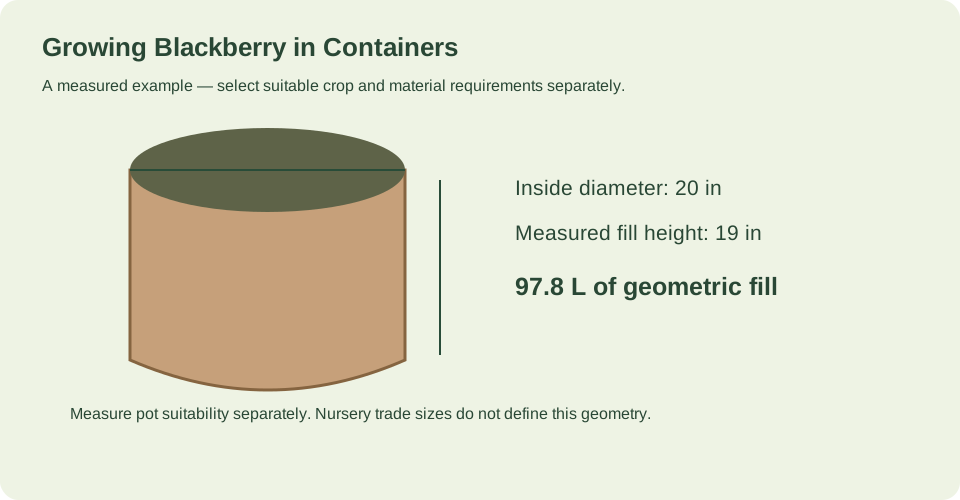
The worked example on this page is a volume-only illustration: a straight-sided pot with a 20-inch inside diameter, a 20-inch inside height and a 1-inch rim gap gives a fill height of 19 inches. That calculation shows how to measure fill capacity; it does not establish a minimum pot size for blackberry. Confirm a suitable container separately using the cane system, root space and support needs.
After planting, monitor drainage, medium moisture and cane growth. Check that holes remain open, that the saucer is emptied, and that ties are not cutting into canes. Review the support as canes grow and prune according to the cane system identified from the Illinois table.
- Set the support and leave room for tying and pruning before planting.
- Use the worked example only to practice measuring fill volume, not to set a pot minimum.
- Check drainage holes, saucer and ties on a regular schedule.
- Prune according to the cane system identified for your cultivar.
Source context: University of Illinois Extension · University of Maryland Extension · University of Maryland Extension
Check your measured example
Volume-only illustration: one straight-sided pot with inside diameter 20 in, inside height 20 in and 1 in rim gap. The resulting fill capacity is not a minimum pot size for blackberry; confirm a suitable container separately.
| Quantity | Calculated result |
|---|---|
| inside diameter in | 20 |
| fill height in | 19 |
| volume cuft | 3.4543 |
| volume liters | 97.8148 |
| US liquid gallons | 25.8399 |
The worked example is a volume-only illustration of one straight-sided pot with a 20-inch inside diameter, 20-inch inside height and 1-inch rim gap, giving a 19-inch fill height. Its calculated fill capacity is shown in the rendered table. It is not a minimum pot size for blackberry, and no additional numerical results are added here.
Example inputs explain the method. Review the source context, chosen cultivar and actual site before planting or ordering.
Your before-you-plant checklist
- Cultivar cane system identified from the Illinois table.
- Drainage holes open and saucer emptied after watering.
- Actual fill volume measured from inside dimensions, not trade-gallon labels.
- Support and tying access planned before planting.
- Reused medium checked for residue and root disease.
Questions that come up while planning
Can I use the 20-inch example pot as a blackberry minimum?
No. The example is a volume-only geometry illustration for a straight-sided pot with a 20-inch inside diameter, 20-inch inside height and 1-inch rim gap. It shows how to calculate fill capacity, not a recommended minimum pot size for blackberry.
Should erect and trailing blackberries use the same container plan?
No. The Illinois table distinguishes erect from trailing or thornless cane systems, and trailing distances should not be collapsed into erect-type guidance. Keep pruning and tying access in the plan for either system.
What growing medium does the container guide list?
The container guide lists commercial soilless mix and an equal-volume soilless-mix and compost blend among its options. Dense garden soil behaves differently from a container mix. If reusing medium, remove plant residue and do not save medium associated with root disease.
Sources & method
Horticultural guidance is linked to its original source and regional context. Geometry and unit conversions are calculated separately. Read how we prepare and check a page.
- Growing Backyard FruitsUniversity of Illinois Extension
- Growing Vegetables in Containers and Salad TablesUniversity of Maryland Extension
- Growing Media (Potting Soil) for ContainersUniversity of Maryland Extension
- Starting a Home Fruit GardenUniversity of Maryland Extension