
Read the source range before you mark anything
The table gives two separate numbers: spacing within a row and spacing between rows. Within-row spacing sets where bushes sit along one line. Between-row spacing sets the gap to the next parallel row, and it is larger than the within-row figure. Treat both as minimum suggested distances for full-size blueberries, then choose your own point inside each range after checking cultivar, access and site conditions.
Do not carry the 72-inch figure into a dwarf-container setting. The source explicitly excludes dwarf-container distances, so container spacing is a separate decision this guide does not supply. Also keep initial planting separate from established plants: the count below is for bushes placed at the start, not for thinning, sowing or later replanting.
- Write down both source ranges: 72 to 96 inches within a row and 96 to 120 inches between rows.
- Confirm your plants are full-size blueberries rather than dwarf-container stock.
- Choose and record one within-row value and one between-row value from the ranges before measuring.
Source context: University of Illinois Extension
Worked example: one 288-inch row at 72-inch centers
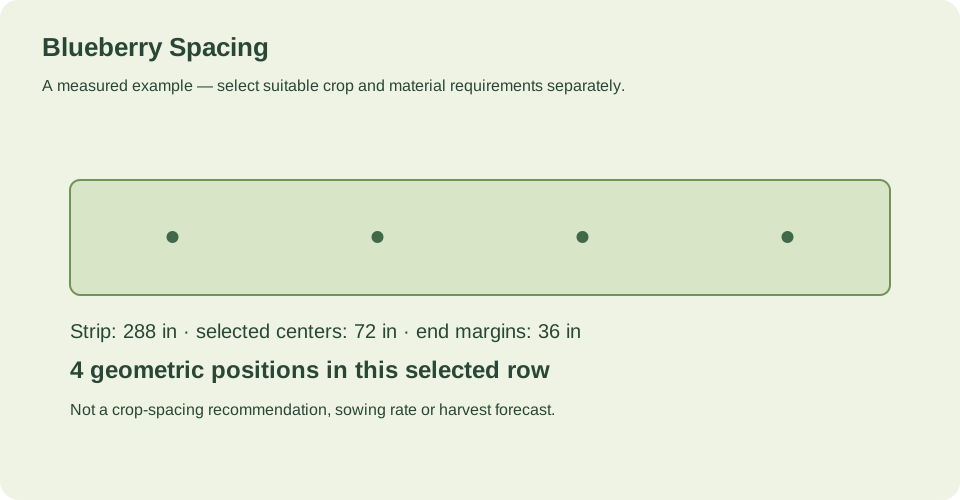
The example is a geometrical placement exercise for a single measured row. The row is 288 inches long, the selected center interval is 72 inches, and each end has a 36-inch margin. With those inputs, the first bush center falls at 36 inches and the last at 252 inches, giving 4 initial bushes. The 72-inch interval sits at the low end of the within-row range, so label this scenario as the closer-spaced option rather than the default.
The counted item is initial bushes, meaning the plants placed at those four marked centers at planting time. It is not a sowing rate, a thinning target or a count of established plants after years of growth. The 36-inch end margins are part of this example's geometry; they are not a source spacing figure and should not be read as crop advice.
- Measure the full row length and record it in inches or centimeters.
- Mark the first center one end margin in from the row start.
- Step along at the selected center interval and mark each remaining center.
- Stop before the last center passes the far end margin, then count the marked centers.
Source context: University of Illinois Extension
What one row does not decide
A marked row is not an entire garden layout. The example fixes positions along one line only. It does not set the distance to an adjacent row, which must come from the between-row range of 96 to 120 inches and from your own choice within it. It also does not decide access paths, supports or the space needed for the mature habit of your plants.
Choose those separately and record them alongside the row plan. Access and mature habit may push you toward the wider end of a range, but this guide does not invent distances for paths, supports or adjacent features. If your plan includes more than one row, repeat the between-row decision for each gap rather than assuming the within-row interval applies sideways.
- Decide the gap to any adjacent row using the 96 to 120 inch between-row range.
- Record access, support and mature-habit needs as separate planning notes.
- Check that no marked center depends on a distance this guide did not supply.
Source context: University of Illinois Extension
Check the count with the row calculator
The linked row calculator can count this exact length, center interval and both end margins, in inches or centimeters. Enter the 288-inch row, the 72-inch center spacing and a 36-inch margin at each end to reproduce the four initial bushes. If you change the interval to another value inside the range, the count will change, so keep the scenario label attached to the number you use.
Use the calculator as a counting check on your marked row, not as a source of new spacing advice. It does not decide between-row gaps, access, supports or mature habit, and it does not model established plants.
- Enter the row length, center interval and both end margins in one unit system.
- Compare the calculator count with the number of centers you marked.
- Recheck any mismatch by remeasuring the row and the end margins.
Source context: University of Illinois Extension
Check your measured example
One measured 288-inch row, with selected 72-inch centers and 36-inch margins at both ends. Count 4 initial bushes.
Reference and growing system: The Illinois fruit-garden table lists full-size blueberries at 72–96 inches within a row and 96–120 inches between rows as minimum suggested distances. These are not dwarf-container distances; cultivar, access and site conditions still matter.
| Quantity | Calculated result |
|---|---|
| Usable row length (in) | 288 |
| Selected center spacing (in) | 72 |
| Margin at each row end (in) | 36 |
| Positions in this row | 4 |
| First center from row start (in) | 36 |
| Last center from row start (in) | 252 |
| What is being counted | initial bushes |
The example is a geometrical placement exercise, not crop advice. A 288-inch row with 72-inch centers and 36-inch margins at both ends yields centers at 36 and 252 inches and a count of 4 initial bushes. The 72-inch interval is the low end of the within-row range, and the 36-inch margins belong to this example only. The example does not set between-row spacing, access, supports or mature-habit space.
Count this row in the spacing calculator ↗Example inputs explain the method. Review the source context, chosen cultivar and actual site before planting or ordering.
Your before-you-plant checklist
- Both source ranges are written down and your chosen values are labeled.
- Plants are confirmed as full-size blueberries, not dwarf-container stock.
- The example is labeled as the 72-inch closer-spaced scenario.
- The count is described as initial bushes, not established plants.
- Between-row, access, support and mature-habit decisions are recorded separately.
Questions that come up while planning
What spacing does the Illinois table give for full-size blueberries?
It lists 72 to 96 inches within a row and 96 to 120 inches between rows as minimum suggested distances. Cultivar, access and site conditions still matter, and the figures are not dwarf-container distances.
Why does the example count 4 bushes?
A 288-inch row with 72-inch centers and 36-inch margins at both ends places centers at 36, 108, 180 and 252 inches. That is four initial bushes, counted as plants placed at planting time.
Does one marked row set my whole garden layout?
No. It fixes positions along one line only. Between-row gaps, access, supports and mature habit must be chosen separately, and this guide does not invent distances for them.
Sources & method
Horticultural guidance is linked to its original source and regional context. Geometry and unit conversions are calculated separately. Read how we prepare and check a page.
- Growing Backyard FruitsUniversity of Illinois Extension