
Match the container to the bush type, not to a field row
Start with the cultivar, not the pot. Oregon State University's container guidance describes larger blueberry types such as northern highbush in large containers, including half wine barrels or 15 to 20 US gallon containers, and describes half-high cultivars performing best in 10-gallon-or-larger containers. Those are Oregon-source examples tied to named cultivar types, not a universal minimum. Half-high cultivars have different mature habits from northern highbush, so the shape and volume that suit one may not suit the other.
The Illinois source gives minimum field spacings for in-ground plantings. Those distances describe rows in a field and should not be converted into a pot minimum. For a container, match both mature top growth and root space; volume alone does not define a suitable shape. A tall, narrow pot and a wide, shallow one can hold the same volume but support very different root systems.
Plan for more than one suitable cultivar where pollination needs call for it. Pollination requirements and winter or frost management depend on type, cultivar and location, so confirm those for your specific choices rather than assuming one bush is enough.
- Identify whether your cultivar is northern highbush, half-high or another type before choosing a container.
- Check the mature spread and habit for that cultivar, then compare it with the pot's top diameter and height.
- Confirm whether your chosen cultivar needs a compatible second cultivar for pollination.
- Measure the pot's inside dimensions and actual fill volume rather than trusting a nursery trade-gallon label.
Source context: Oregon State University Extension · University of Illinois Extension · University of Maryland Extension
Build an acidic root zone with drainage
Blueberries need a soil pH of 4.5 to 5.5, and a container mix must have the correct blueberry pH, high organic matter and good drainage. A generic vegetable soilless-mix and compost recipe is not a blueberry-specific recommendation, so select an acidic medium intended for acid-loving plants and confirm its pH with a test method you trust. Do not guess at an acidifier dose; follow the product label and verify with a test.
Oregon State discusses bark-based container media and warns that higher bark proportions dry more quickly and are harder to fertilize. That means the mix choice and the irrigation plan should be decided together, because a fast-draining bark mix will need more frequent attention than a heavier medium.
Drainage holes must stay open. Stones or gravel under the mix do not improve drainage, and empty saucers so roots are not left sitting in water. Dense garden soil behaves differently from a container mix and is not a substitute for one.
- Choose a growing medium labeled for acid-loving plants and check its stated pH range.
- Test the medium's pH before planting and record the result.
- Confirm the pot has open bottom drainage holes and no gravel layer.
- Decide your watering routine based on how quickly your chosen mix dries.
- Empty saucers after watering so roots are not saturated.
Source context: Oregon State University Extension · University of Maryland Extension · University of Maryland Extension
Set up and monitor through the season
Once planted, the plan is mostly about checking the root zone. Water when the medium begins to dry, adjusting frequency to the mix and the weather rather than to a fixed calendar. Because bark-heavy mixes dry faster and are harder to fertilize, watch both moisture and plant vigor together.
Recheck pH periodically, especially if you add anything to the medium or reuse it. For reuse, remove plant residue and do not save medium associated with root disease; the source describes blending old and fresh material rather than assuming old mix is unchanged.
Keep the pot's drainage working and the saucer empty. If the bush outgrows its shape or the medium stops draining well, that is a signal to review the container and mix rather than to add more water.
- Check medium moisture before each watering rather than watering on a fixed schedule.
- Recheck pH at intervals and after any medium change.
- Remove plant residue and discard medium linked to root disease before reuse.
- Confirm drainage holes remain open and saucers stay empty.
Source context: Oregon State University Extension · University of Maryland Extension · University of Maryland Extension
Check your measured example
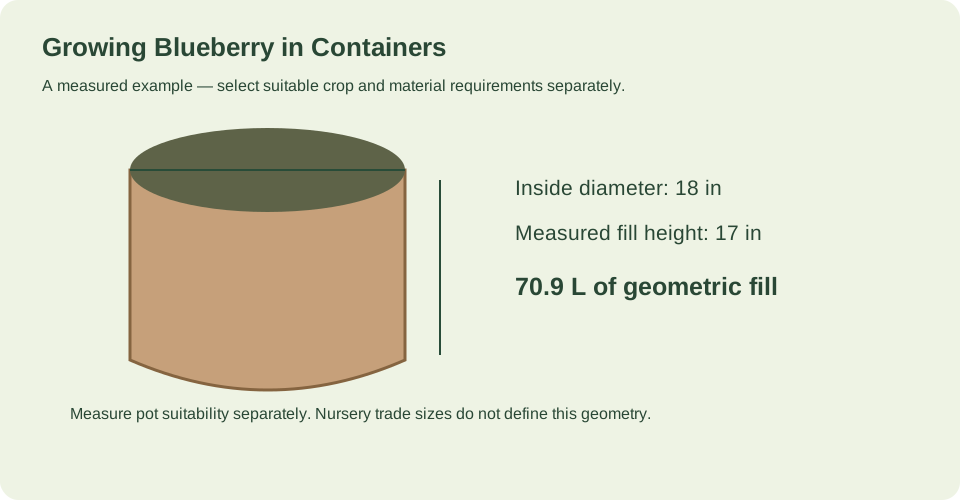
Volume-only illustration: one straight-sided pot with inside diameter 18 in, inside height 18 in and 1 in rim gap. The resulting fill capacity is not a minimum pot size for blueberry; confirm a suitable container separately.
| Quantity | Calculated result |
|---|---|
| inside diameter in | 18 |
| fill height in | 17 |
| volume cuft | 2.5035 |
| volume liters | 70.89 |
| US liquid gallons | 18.7272 |
The worked example is a volume-only calculation for one straight-sided pot: inside diameter 18 inches, inside height 18 inches, with a 1-inch rim gap, so the fill height is 17 inches. That yields about 2.50 cubic feet, 70.89 liters or 18.73 US liquid gallons of fill capacity. It illustrates how to measure a pot's actual fill volume; it is not a recommended or minimum pot size for blueberry, and no additional numerical results are implied.
Example inputs explain the method. Review the source context, chosen cultivar and actual site before planting or ordering.
Your before-you-plant checklist
- Cultivar type identified as northern highbush, half-high or other.
- Mature spread compared with the pot's top diameter and height.
- Pollination needs confirmed for the chosen cultivar.
- Growing medium labeled for acid-loving plants with pH tested.
- Drainage holes open, no gravel layer, saucer emptied.
- Watering routine set from observed medium drying, not a fixed calendar.
Questions that come up while planning
Is a 15 to 20 gallon container required for every blueberry bush?
No. Oregon State's guidance names 15 to 20 US gallon containers and half wine barrels for larger types such as northern highbush, and 10-gallon-or-larger containers for half-high cultivars. Those are examples tied to cultivar types and an Oregon context, not a universal minimum. Match the container to your specific cultivar's mature spread and root needs.
Can I use a regular vegetable potting mix for blueberries?
A generic vegetable soilless-mix and compost recipe is not a blueberry-specific recommendation. Blueberries need a medium with pH 4.5 to 5.5, high organic matter and good drainage, so choose an acidic medium intended for acid-loving plants and verify its pH with a test.
Does the worked pot volume example tell me what size pot to buy?
No. The example is a volume-only illustration of one straight-sided pot with an 18-inch inside diameter, 18-inch inside height and a 1-inch rim gap, giving a fill capacity of about 2.50 cubic feet, 70.89 liters or 18.73 US liquid gallons. It is geometry, not a minimum pot size for blueberry; confirm a suitable container separately.
Sources & method
Horticultural guidance is linked to its original source and regional context. Geometry and unit conversions are calculated separately. Read how we prepare and check a page.
- Growing blueberries in your home gardenOregon State University Extension
- Growing Backyard FruitsUniversity of Illinois Extension
- Growing Vegetables in Containers and Salad TablesUniversity of Maryland Extension
- Growing Media (Potting Soil) for ContainersUniversity of Maryland Extension