
Decide whether a container suits your cabbage plan
Cabbage is a cool-season crop that prefers full sun and fertile, well-drained soil enriched with organic matter. In a container, those requirements translate into a mix that holds water and air while supporting roots, plus drainage holes that stay open. The source notes cabbage grows best when temperatures do not exceed 80°F and is not seriously damaged down to 25°F; regional planting dates in the source are examples for that location, so check your own local timing rather than copying them.
The 5-gallon reference from Maryland is a volume example for cabbage, not a rule that any 5-gallon pot will work. A tall, narrow pot and a wide, shallow pot can hold the same volume but offer very different root space and leaf-canopy room. Match both the mature top growth and the root space to your cultivar before committing.
- Confirm the mature head size and leaf spread expected for your chosen cultivar from its seed or plant label.
- Check that the pot has open drainage holes and enough depth and width for the root system and top growth.
- Measure the pot's actual fill volume rather than trusting a nursery trade-gallon label.
Source context: Utah State University Extension · University of Maryland Extension
Measure the pot and prepare the growing medium
Measure inside diameter and inside height, then subtract any rim gap you plan to leave so water does not spill over the edge. That gives a fill height, and the fill volume is the space the mix will actually occupy. The worked example in the table is a purely geometric illustration of one straight-sided pot; it is not a minimum pot size for cabbage and should not be read as crop advice.
For the medium, the container guide lists commercial soilless mix and an equal-volume soilless-mix and compost blend among its options. Dense garden soil behaves differently from a container mix, so avoid treating them as interchangeable. Stones or gravel under the mix do not improve drainage; keep drainage holes clear and empty saucers so roots are not left saturated. If you reuse medium, remove plant residue and do not save medium associated with root disease.
- Record inside diameter, inside height and planned rim gap, then calculate fill volume from those measurements.
- Fill with a soilless mix or an equal-volume soilless-mix and compost blend, following package label units for any volume conversions.
- Water through and confirm the drainage holes run freely and the saucer is emptied.
Source context: University of Maryland Extension · University of Maryland Extension
Plant, water and monitor through head formation
Cabbage can be started from seed or transplants. The source describes sowing seed ¼–½ inch deep and thinning to the final stand when plants have 3–4 true leaves; seedlings removed at thinning can be moved to adjacent areas. Transplants should have 4–6 mature leaves and a well-developed root system before planting out, generally after about 6–7 weeks of growing. Distinguish these seedbed and transplant stages from the final container planting so you do not crowd a young plant into a pot sized for its mature head.
The source recommends 1–2 inches of deep, even watering per week and mulch to conserve moisture and control weeds. It also describes side-dressing with nitrogen about 4 weeks after planting, then stopping feeding once heads begin to form to avoid splitting. Harvest firm, full-size heads before they crack, leaving inner wrapper leaves for protection. These are crop requirements from the source, not container-specific guarantees; adapt watering to your mix, pot and weather and check the plant regularly.
- Harden off and plant transplants with 4–6 mature leaves and a developed root system into the prepared container.
- Water deeply and evenly, aiming for the source's 1–2 inches per week, and adjust for your mix and weather.
- Side-dress with nitrogen about 4 weeks after planting, then stop feeding once heads begin to form.
- Check heads regularly and harvest firm, full-size heads before they crack, leaving inner wrapper leaves.
Source context: Utah State University Extension · University of Maryland Extension · University of Maryland Extension
Check your measured example
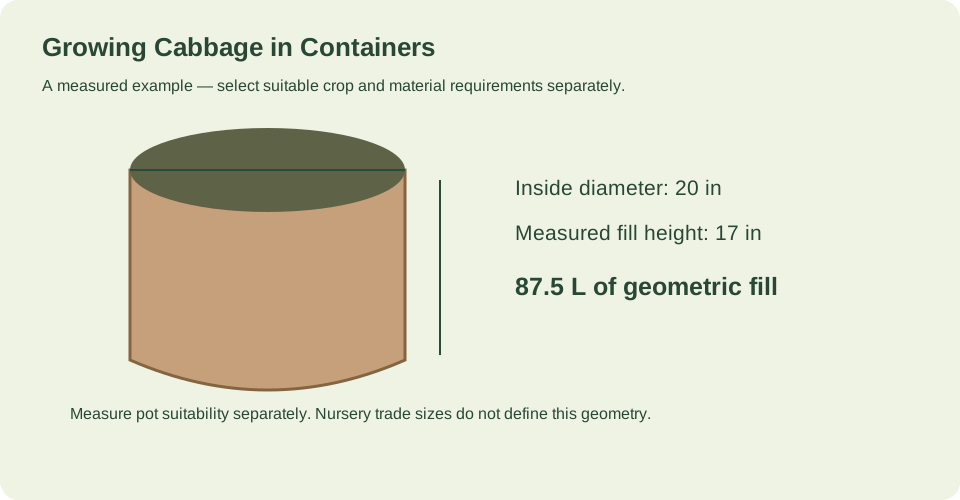
Volume-only illustration: one straight-sided pot with inside diameter 20 in, inside height 18 in and 1 in rim gap. The resulting fill capacity is not a minimum pot size for cabbage; confirm a suitable container separately.
| Quantity | Calculated result |
|---|---|
| inside diameter in | 20 |
| fill height in | 17 |
| volume cuft | 3.0907 |
| volume liters | 87.5185 |
| US liquid gallons | 23.1199 |
The table shows a volume-only calculation for one straight-sided pot with a 20-inch inside diameter, 18-inch inside height and a 1-inch rim gap, giving a fill height of 17 inches. The resulting fill capacity is a geometric illustration only; it is not a minimum pot size for cabbage, and a suitable container must be confirmed separately for depth, width, drainage and top clearance.
Example inputs explain the method. Review the source context, chosen cultivar and actual site before planting or ordering.
Your before-you-plant checklist
- Mature head size and leaf spread for the chosen cultivar confirmed from its label.
- Pot has open drainage holes and enough depth and width for roots and top growth.
- Actual fill volume measured from inside dimensions, not a trade-gallon label.
- Soilless mix or equal-volume soilless-mix and compost blend used, with saucer emptied.
- Watering, side-dressing and head-formation checks scheduled from the source guidance.
Questions that come up while planning
Is a 5-gallon pot enough for cabbage?
Maryland's container guide lists 5 US gallons as a reference minimum for cabbage, but it is a named example rather than a guarantee for every cultivar. Confirm the pot's actual fill volume, depth, width and top clearance for your chosen cabbage before relying on that figure.
Can I use garden soil in a cabbage container?
The container guide treats dense garden soil as behaving differently from a container mix. It lists commercial soilless mix and an equal-volume soilless-mix and compost blend among options, so use one of those rather than assuming garden soil will perform the same way.
When should I stop fertilizing container cabbage?
The source says to side-dress with nitrogen about 4 weeks after planting, then stop feeding once heads begin to form to avoid splitting. Follow that crop guidance and check your plant's stage rather than feeding on a fixed calendar.
Sources & method
Horticultural guidance is linked to its original source and regional context. Geometry and unit conversions are calculated separately. Read how we prepare and check a page.
- How to Grow Cabbage in Your GardenUtah State University Extension
- Growing Vegetables in Containers and Salad TablesUniversity of Maryland Extension
- Growing Media (Potting Soil) for ContainersUniversity of Maryland Extension