
Read the source spacing correctly
The linked guide gives a transplant example of 24 inches within rows 48 inches apart. Treat 24 inches as the center-to-center interval for transplants in that example. The 48-inch figure describes the distance between rows, not the length of a bed or the number of rows in a garden.
A single row is only one layout line. It does not tell you how many rows fit in a raised bed, how much walking space to leave, or where supports should go. Those choices must be made separately for your site and access needs. Do not invent a bed width or aisle distance from this source.
- Label the scenario as a transplant row using 24-inch centers.
- Keep the 48-inch row separation as context, not as a plant count.
- Record that direct-sown clusters and thinning are a different system.
Source context: Utah State University Extension
Mark one measured row
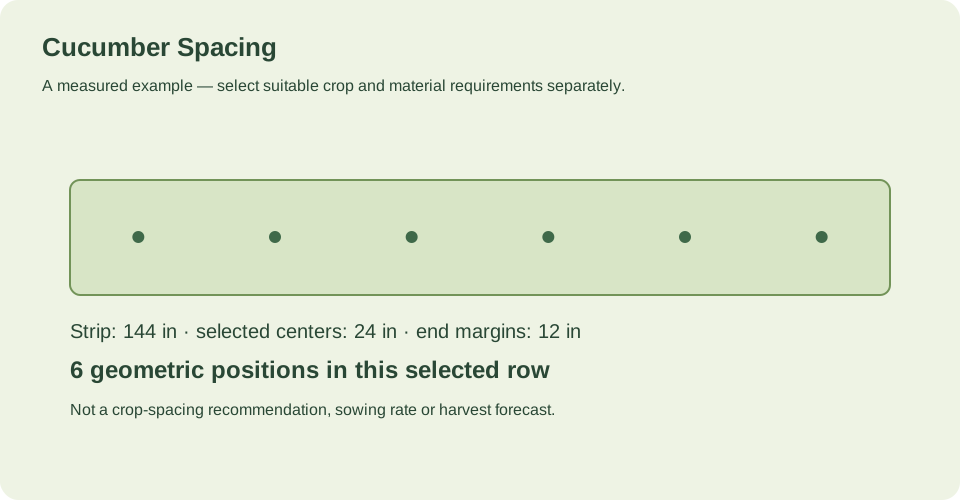
Use a clearly labeled example row of 144 inches with 24-inch centers and 12-inch margins at both ends. The margins are part of this geometrical example, not crop advice. They set the first and last transplant centers inward from the row ends.
With those values, the first center is at 12 inches and the last center is at 132 inches. The counted item is transplants, not seeds, clusters, thinned seedlings or established plants. The result is 6 transplant positions for this one row.
- Measure the row length in inches or centimeters.
- Choose the center interval and both end margins for the labeled example.
- Mark the first and last centers, then place the remaining centers at the selected interval.
- Count positions as transplants only.
Source context: Utah State University Extension
Separate sowing, thinning and established plants
Direct-sown cucumber clusters and thinning instructions form a separate system from the transplant example. A sowing count is not a transplant count, and a thinned cluster is not the same counted item as an established transplant. Keep these records apart so the numbers do not get combined.
The row calculator linked to this guide can count this exact length, center interval and both end margins in inches or centimeters. Use it to check the arithmetic for the labeled row. It does not decide bed layout, support placement or spacing between adjacent rows.
- Keep transplant records separate from direct-sow and thinning records.
- Use the calculator only for the measured row, center interval and end margins you supply.
- Check that the counted item is transplants before using the result.
Source context: Utah State University Extension
Choose the rest of the layout separately
After counting one row, decide separately how access, supports, adjacent rows and mature plant habit affect your plan. The linked guide does not give distances for those choices, so do not copy a number from the transplant example into them.
The 48-inch row separation in the source is part of that transplant example. It is not a complete garden layout and does not by itself set raised-bed dimensions or walkway widths. Write down each separate choice so the row count stays tied to its stated assumptions.
- Note access and support needs outside the row count.
- Record adjacent-row decisions separately from the 24-inch center interval.
- Keep the 48-inch row separation labeled as source context.
- Review the labeled row against the mature habit before finalizing the plan.
Source context: Utah State University Extension
Check your measured example
One measured 144-inch row, with selected 24-inch centers and 12-inch margins at both ends. Count 6 transplants.
Reference and growing system: USU’s cucumber transplant example uses 24 inches within rows 48 inches apart. Its direct-sown clusters and thinning instructions form a separate system.
| Quantity | Calculated result |
|---|---|
| Usable row length (in) | 144 |
| Selected center spacing (in) | 24 |
| Margin at each row end (in) | 12 |
| Positions in this row | 6 |
| First center from row start (in) | 12 |
| Last center from row start (in) | 132 |
| What is being counted | transplants |
The worked example is a geometrical row count: 144 inches long, 24-inch centers, 12-inch margins at both ends, giving 6 transplant positions at 12 through 132 inches. It uses USU's transplant spacing context but does not add new distances or recommend a bed layout.
Count this row in the spacing calculator ↗Example inputs explain the method. Review the source context, chosen cultivar and actual site before planting or ordering.
Your before-you-plant checklist
- The scenario is labeled as a transplant row.
- The row length, 24-inch center interval and 12-inch end margins are recorded.
- The first center is marked at 12 inches and the last at 132 inches.
- The counted item is transplants, not seeds or thinned clusters.
- Access, supports, adjacent rows and mature habit are recorded as separate choices.
Questions that come up while planning
How many cucumber transplants fit in a 144-inch row at 24-inch centers with 12-inch end margins?
The geometrical example gives 6 transplant positions, with the first center at 12 inches and the last at 132 inches. This count applies only to that measured row and those stated margins.
Does the 48-inch row spacing tell me how wide my raised bed should be?
No. The source gives 48 inches as the distance between rows in its transplant example. It does not supply a raised-bed width, aisle width or complete garden layout.
Can I use the direct-sown cluster and thinning instructions to count transplants?
No. The source describes direct-sown clusters and thinning as a separate system. Count transplants only from the transplant spacing example and your measured row.
Sources & method
Horticultural guidance is linked to its original source and regional context. Geometry and unit conversions are calculated separately. Read how we prepare and check a page.
- How to Grow Cucumber in Your GardenUtah State University Extension