
Decide the planting approach and container
Cucumbers can be grown from seed or transplants. The source describes direct seeding as 4 to 6 seeds every 12 to 18 inches in rows 4 feet apart, thinned after two leaves to 2 plants per location. Those are in-ground row figures; do not convert them into a pot minimum or a container spacing rule. For a container, treat the seeded group as a choice you make deliberately, then thin to the number of retained plants your pot and plan can actually support.
Transplants should have 2 to 3 mature leaves and a well-developed root system before moving out, and the source allows 4 to 6 weeks to grow them. Transplanted cucumbers mature about 2 weeks before seeded ones. Maryland lists a reference minimum of 5 US gallons for cucumber among its named guide examples, not a guarantee for every variety. Match mature top growth and root space as well as volume, and measure actual fill volume rather than trusting nursery trade-gallon labels.
- Choose transplanted single plant or direct-seeded group and record which you are using.
- Confirm the pot has open drainage holes and a shape that suits the vine's top growth and root space.
- Measure inside diameter and usable fill height, then calculate fill volume yourself rather than relying on the label.
Source context: Utah State University Extension · University of Maryland Extension
Prepare the growing medium and support plan
Use a growing medium that supports roots while holding appropriate water and air. Dense garden soil behaves differently from a container mix. The container guide lists commercial soilless mix and an equal-volume soilless-mix/compost blend among its options. If you reuse medium, remove plant residue and do not save medium associated with root disease; blend old and fresh material rather than assuming old mix is unchanged.
Decide before planting whether the vine will sprawl or be supported. The source says cucumbers develop runners, and after runners develop it recommends side dressing with additional nitrogen fertilizer. It does not give a trellis-specific plant density, so do not invent one. A supported vine changes the vertical space and tie-in work you plan, not a sourced pot minimum. Keep drainage holes open; stones or gravel under the mix do not improve drainage, and empty saucers so roots are not left saturated.
- Select soilless mix or an equal-volume soilless-mix/compost blend and note the choice.
- Clear old plant residue and discard medium linked to root disease before reuse.
- Write down sprawl or supported vine, and the tie-in or floor space each needs.
- Check drainage holes and plan to empty saucers after watering.
Source context: University of Maryland Extension · University of Maryland Extension · Utah State University Extension
Set up and monitor the container crop
The source says cucumbers grow best in sunny locations and fertile, well-drained soils, and that irrigation should be deep and frequent. It also notes plastic and organic mulches help conserve water and reduce weeding, but organic mulches should not be applied until soils have warmed to 75°F. Those temperature and timing details come from the source location; treat regional dates as examples for that location, not rules for yours.
Plan a monitoring routine around what the source actually describes: check soil moisture before watering, watch for insects and diseases through the season, and harvest when fruits are young and tender. The source says cucumbers are ready 5 to 7 days after flowering, that flavor decreases as fruits age, and that picking regularly encourages continual production. Handle fruits carefully because they bruise easily. These are crop-care facts, not yield promises.
- Record sun exposure and confirm the site is sunny before planting.
- Water deeply and frequently, checking moisture first.
- Hold organic mulch until soil has warmed to 75°F, per the source.
- Inspect for insects and disease through the season and note what you see.
- Harvest young, tender fruits and pick regularly.
Source context: Utah State University Extension
Use the worked pot example correctly
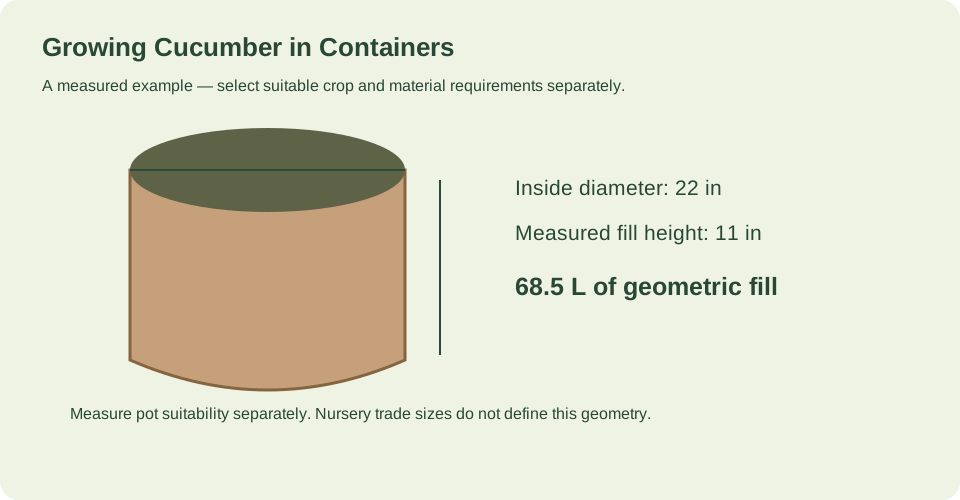
The supplied example is a volume-only illustration: one straight-sided pot with a 22-inch inside diameter, 12-inch inside height, and a 1-inch rim gap, giving an 11-inch fill height. The rendered table reports the resulting fill capacity. That number describes how much medium the pot holds; it is not a minimum pot size for cucumber and does not confirm the pot is suitable. Confirm a suitable container separately using the drainage, shape, top-growth and root-space checks above. Package label units govern any volume conversion you make.
- Read the example as a fill-volume calculation, not crop advice.
- Compare your own measured pot dimensions with the example only as geometry.
- Confirm suitability separately before planting.
Source context: University of Maryland Extension
Check your measured example
Volume-only illustration: one straight-sided pot with inside diameter 22 in, inside height 12 in and 1 in rim gap. The resulting fill capacity is not a minimum pot size for cucumber; confirm a suitable container separately.
| Quantity | Calculated result |
|---|---|
| inside diameter in | 22 |
| fill height in | 11 |
| volume cuft | 2.4198 |
| volume liters | 68.5218 |
| US liquid gallons | 18.1016 |
The example is a volume-only illustration of one straight-sided pot with a 22-inch inside diameter, 12-inch inside height and 1-inch rim gap, giving an 11-inch fill height. The rendered table reports the resulting fill capacity. That figure is not a minimum pot size for cucumber and does not confirm suitability; confirm a suitable container separately using drainage, shape, top-growth and root-space checks.
Example inputs explain the method. Review the source context, chosen cultivar and actual site before planting or ordering.
Your before-you-plant checklist
- Planting approach recorded: transplanted single plant or direct-seeded group with retained plants.
- Pot has open drainage holes and a shape suited to top growth and root space.
- Fill volume measured from inside dimensions, not the nursery label.
- Growing medium chosen: soilless mix or equal-volume soilless-mix/compost blend.
- Sprawl or supported vine decided, with space and tie-in work noted.
- Monitoring plan covers deep, frequent watering, pest and disease checks, and regular harvest of young fruits.
Questions that come up while planning
Is a 5-gallon pot enough for cucumbers?
Maryland lists 5 US gallons as a reference minimum for cucumber among its named guide examples, but that is not a guarantee for every variety. Also check drainage, pot shape, mature top growth and root space, and measure actual fill volume rather than relying on trade-gallon labels.
Should I transplant one cucumber or direct-seed a group in a container?
Both are possible. Transplants should have 2 to 3 mature leaves and a well-developed root system, and they mature about 2 weeks before seeded cucumbers. The source's 4 to 6 seeds per location and thinning to 2 plants are in-ground row figures, so decide your container group and retained plants deliberately rather than converting those numbers into a pot rule.
Does the worked pot example tell me the right pot size for cucumber?
No. It is a volume-only geometry illustration using a 22-inch inside diameter, 12-inch inside height and 1-inch rim gap. The reported fill capacity is not a cucumber minimum and does not confirm suitability; check drainage, shape, top growth and root space separately.
Sources & method
Horticultural guidance is linked to its original source and regional context. Geometry and unit conversions are calculated separately. Read how we prepare and check a page.
- How to Grow Cucumber in Your GardenUtah State University Extension
- Growing Vegetables in Containers and Salad TablesUniversity of Maryland Extension
- Growing Media (Potting Soil) for ContainersUniversity of Maryland Extension