
Separate sowing, thinning and final spacing
Treat the source numbers as stages, not interchangeable settings. The 4–6 inch figure describes initial sowing. The 8–12 inch figure describes the final spacing after bulbing begins and thinning has occurred. The 18-inch figure describes row separation in the source context.
For planning plant counts, decide first whether you are counting seedlings, thinned plants or final bulb-producing plants. The worked example counts final Florence-fennel plants only. It does not describe common fennel grown for seed production.
- Write down whether your plan is for sowing, thinning or final plants.
- Use the 8–12 inch source range when planning final Florence-fennel centers.
- Label any chosen point within that range so the plan is not mistaken for a universal recommendation.
Source context: Utah State University Extension
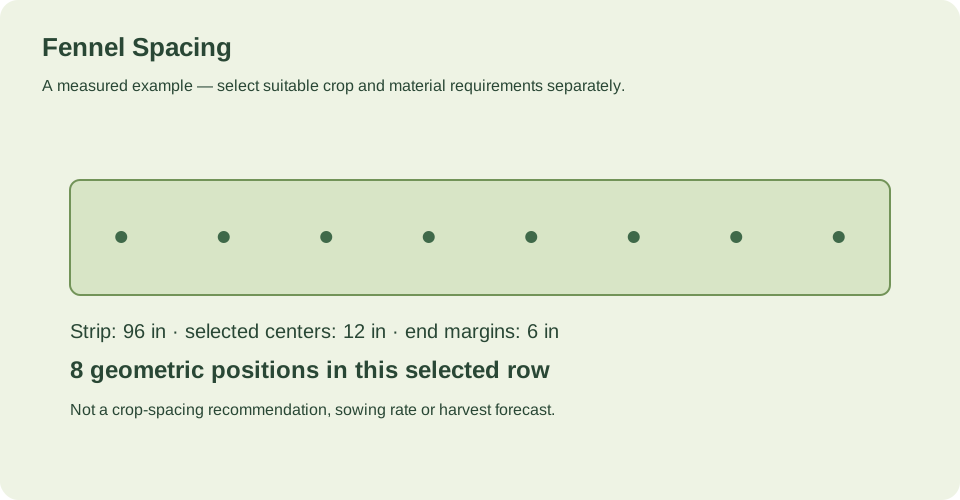
A labeled 12-inch example for one measured row
The example uses one 96-inch row, 12-inch centers and 6-inch margins at both ends. Those choices produce 8 counted positions: the first center is at 6 inches and the last at 90 inches. This is a geometrical example for final Florence-fennel plants, not crop advice that every garden should use 12 inches.
The 12-inch value sits inside the 8–12 inch final-spacing range, but it is a selected scenario. The 6-inch end margins are also example inputs, not a spacing recommendation from the source. Keep the row length, center interval and both margins visible whenever you report the count.
- Measure the actual row length before counting.
- Enter the chosen center interval and both end margins in the same unit.
- Check that the first and last centers fall inside the measured row.
Source context: Utah State University Extension
One row is not the whole garden layout
A single counted row does not settle access paths, supports, adjacent rows or the mature habit of the plants. The source gives an 18-inch row separation, but that figure applies to row separation only and should not be expanded into a complete bed design.
Choose separately how you will provide access and how neighboring rows will relate to this row. Do not infer extra distances from the example margins or from the plant count. If your plan includes raised beds, the row count still describes only the measured line you entered.
- Mark the measured row before placing additional rows.
- Record the 18-inch source row separation separately from the center spacing.
- Check access and adjacent-row decisions without assigning them invented distances.
Source context: Utah State University Extension
Use the row calculator for this exact count
The linked row calculator can count this exact length, center interval and both end margins in inches or centimeters. Use it to reproduce the 96-inch, 12-inch-center, 6-inch-margin example or to test another measured row with clearly labeled inputs.
The counted item is final Florence-fennel plants, not seeds, seedlings or common fennel seed plants. Keep that label attached to the result so the number is not misread as a sowing count.
- Select inches or centimeters to match your measurement.
- Enter the row length, center interval and both end margins.
- Confirm the result is labeled as final Florence-fennel plants.
Source context: Utah State University Extension
Check your measured example
One measured 96-inch row, with selected 12-inch centers and 6-inch margins at both ends. Count 8 final Florence-fennel plants.
Reference and growing system: USU describes Florence fennel initially sown 4–6 inches apart and thinned to 8–12 inches after bulbing begins, with rows 18 inches apart. This example counts the final bulb-producing plants, not common fennel seed production.
| Quantity | Calculated result |
|---|---|
| Usable row length (in) | 96 |
| Selected center spacing (in) | 12 |
| Margin at each row end (in) | 6 |
| Positions in this row | 8 |
| First center from row start (in) | 6 |
| Last center from row start (in) | 90 |
| What is being counted | final Florence-fennel plants |
The worked example is one 96-inch row with 12-inch centers and 6-inch margins at both ends. It yields 8 final Florence-fennel plant positions, with the first center at 6 inches and the last at 90 inches. The 12-inch interval is a selected point within USU's 8–12 inch final-spacing range, and the margins are example inputs rather than crop advice. The count applies to final bulb-producing plants, not common fennel seed production.
Count this row in the spacing calculator ↗Example inputs explain the method. Review the source context, chosen cultivar and actual site before planting or ordering.
Your before-you-plant checklist
- State whether the plan counts sowing positions, thinned plants or final Florence-fennel plants.
- Label the chosen center interval and note that it falls within the 8–12 inch final range.
- Measure the row and enter both end margins in the same unit.
- Keep the 18-inch row separation separate from the center spacing.
- Confirm the calculator result is described as final Florence-fennel plants, not seeds or seedlings.
Questions that come up while planning
Should I use 4–6 inches or 8–12 inches for Florence fennel?
Use them for different stages. USU describes 4–6 inches for initial sowing and 8–12 inches after bulbing begins when thinning to final plants. The example uses 12 inches for final bulb-producing plants.
Does the 96-inch example recommend 12-inch spacing?
No. It is a labeled geometrical example using a selected 12-inch center interval within the 8–12 inch final range. The 6-inch end margins are also example inputs.
Does one counted row define my whole garden layout?
No. It counts final plants along one measured row. Access, supports, adjacent rows and mature habit must be chosen separately, using only distances such as the 18-inch row separation.
Sources & method
Horticultural guidance is linked to its original source and regional context. Geometry and unit conversions are calculated separately. Read how we prepare and check a page.
- How to Grow Fennel in Your GardenUtah State University Extension