
Decide which fennel the pot is for
Florence fennel is a cool-season annual grown for tender anise-flavored stalks and a bulbous base. Common fennel is grown for seed, and its plants resemble dill. Florence fennel is sometimes mislabeled as anise, so check the botanical name on the packet rather than relying on a common name.
The container plan differs by type. Florence fennel is thinned after plants begin to bulb so the remaining plants stand 8 to 12 inches apart. Common fennel grown for seed does not carry that bulb-thinning step in the supplied guidance. If the pot is meant for bulbs, plan for the final spacing, not the initial seed spacing.
- Read the seed packet and confirm Florence fennel (var. azoricum) or common fennel.
- Write the crop type at the top of your plan before choosing a pot.
- For Florence fennel, note the final 8-to-12-inch thinning spacing as a planning constraint.
Source context: Utah State University Extension
Check pot suitability, volume and drainage
The container source groups fennel with large herbs such as rosemary, sage, parsley and dill, for which it describes 5-gallon-or-larger pots. That is a named group reference, not a guarantee for every fennel variety. Volume alone does not define a suitable shape: match both the mature top growth and the root space the plant will need.
Measure the pot's actual fill volume instead of trusting a nursery trade-gallon label. Drainage holes must stay open, and stones or gravel under the mix do not improve drainage. Empty saucers so roots are not left saturated.
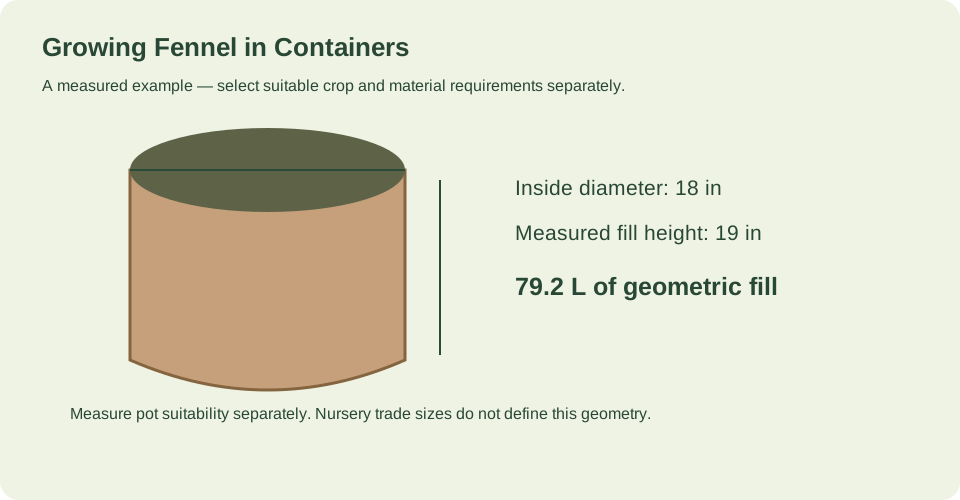
The worked example is geometry only: an 18-inch inside diameter, 20-inch inside height pot with a 1-inch rim gap gives about 2.80 cubic feet, 79.23 liters or 20.93 US liquid gallons of fill. That calculation shows how to measure a pot; it is not a recommended minimum pot size for fennel and does not replace the suitability check above.
- Confirm the pot has open drainage holes and stands where surplus water can drain away.
- Measure inside diameter and usable fill height, allowing for a rim gap, and calculate fill volume.
- Compare the measured volume and pot shape with the large-herb group reference and the plant's expected top growth.
- Empty any saucer after watering.
Source context: University of Maryland Extension · University of Maryland Extension
Choose the growing medium and set up
A container medium must support roots while holding appropriate water and air; dense garden soil behaves differently from a container mix. The container guide lists commercial soilless mix and an equal-volume soilless-mix and compost blend among its options.
If reusing medium, remove plant residue and do not save medium associated with root disease. The guide describes blending old and fresh material rather than assuming old mix is unchanged. Florence fennel needs consistent moisture and moderate fertility to help prevent bolting and splitting, so plan regular watering rather than a single soak.
- Fill the pot with soilless mix or an equal-volume soilless-mix and compost blend.
- Leave the planned rim gap so water can enter rather than spill over.
- Water to settle the mix, then check that drainage holes run freely.
- Set a regular watering check, since Florence fennel is described as needing consistent moisture.
Source context: University of Maryland Extension · University of Maryland Extension · Utah State University Extension
Sowing, thinning and monitoring plan
The source says it is best to direct-seed fennel into the garden, sowing 1/4 inch deep when soil temperatures are 50 to 75 °F, with seeds 4 to 6 inches apart in the row and rows 18 inches apart; germination usually takes 7 to 10 days. Those row figures are in-ground spacing guidance, not a pot minimum. In a container, use the final Florence fennel thinning spacing of 8 to 12 inches as the check on how many plants the pot can hold.
For a continuous supply, the source describes planting 3 to 4 feet of row every 3 to 4 weeks. That interval is a succession example from the source location, not a universal calendar. Florence fennel grows best in cooler temperatures and may become woody or bolt when it turns hot; hot summer temperatures and long days accelerate bolting, and stress from lack of water or root damage also raises the risk.
Monitor for aphids and thrips, keep weeds down, and harvest bulbs when firm. Some gardeners mound soil around swollen bases to keep them from turning green and developing a stronger flavor; treat that as an optional practice, not a requirement.
- Sow direct at 1/4 inch deep when soil temperature is within 50 to 75 °F.
- After plants begin to bulb, thin Florence fennel to 8 to 12 inches apart.
- Record the sowing date and expected 60-to-90-day maturity window for the chosen variety.
- Plan the next sowing 3 to 4 weeks later if you want succession, adjusting for local heat.
- Check moisture, weeds, aphids and thrips regularly, and harvest when bulbs are firm.
Source context: Utah State University Extension
Check your measured example
Volume-only illustration: one straight-sided pot with inside diameter 18 in, inside height 20 in and 1 in rim gap. The resulting fill capacity is not a minimum pot size for fennel; confirm a suitable container separately.
| Quantity | Calculated result |
|---|---|
| inside diameter in | 18 |
| fill height in | 19 |
| volume cuft | 2.798 |
| volume liters | 79.23 |
| US liquid gallons | 20.9304 |
The worked example is a purely geometric volume illustration for one straight-sided pot with an 18-inch inside diameter, 20-inch inside height and a 1-inch rim gap, giving a 19-inch fill height. It yields about 2.80 cubic feet, 79.23 liters or 20.93 US liquid gallons. It is not a minimum pot size for fennel and does not establish crop suitability; confirm the container separately using the large-herb group reference, pot shape and drainage.
Example inputs explain the method. Review the source context, chosen cultivar and actual site before planting or ordering.
Your before-you-plant checklist
- Seed packet confirms Florence fennel or common fennel.
- Pot has open drainage holes and a saucer that can be emptied.
- Actual fill volume measured rather than read from a trade-gallon label.
- Pot shape checked against expected top growth and root space.
- Florence fennel thinning to 8 to 12 inches planned after bulbing begins.
- Watering, weed, aphid and thrip checks scheduled.
Questions that come up while planning
What pot size does fennel need in a container?
The container source groups fennel with large herbs such as rosemary, sage, parsley and dill and describes 5-gallon-or-larger pots for that group. That is a group reference, not a crop-specific guarantee. Measure actual fill volume and check that the pot shape suits the plant's top growth and roots.
Can I grow common fennel and Florence fennel the same way in a pot?
No. Florence fennel is grown for its bulbous base and stalks and is thinned to 8 to 12 inches apart after plants begin to bulb. Common fennel is grown for leaves and seed and does not carry that bulb-thinning step in the supplied guidance. Confirm which type your seed packet describes.
Does the 18-inch pot example prove that size is right for fennel?
No. The example is a volume-only geometry calculation: an 18-inch inside diameter and 19-inch fill height give about 2.80 cubic feet, 79.23 liters or 20.93 US liquid gallons. It shows how to measure fill capacity, not a minimum pot size or a growing recommendation for fennel.
Sources & method
Horticultural guidance is linked to its original source and regional context. Geometry and unit conversions are calculated separately. Read how we prepare and check a page.
- How to Grow Fennel in Your GardenUtah State University Extension
- Growing Vegetables in Containers and Salad TablesUniversity of Maryland Extension
- Growing Media (Potting Soil) for ContainersUniversity of Maryland Extension