
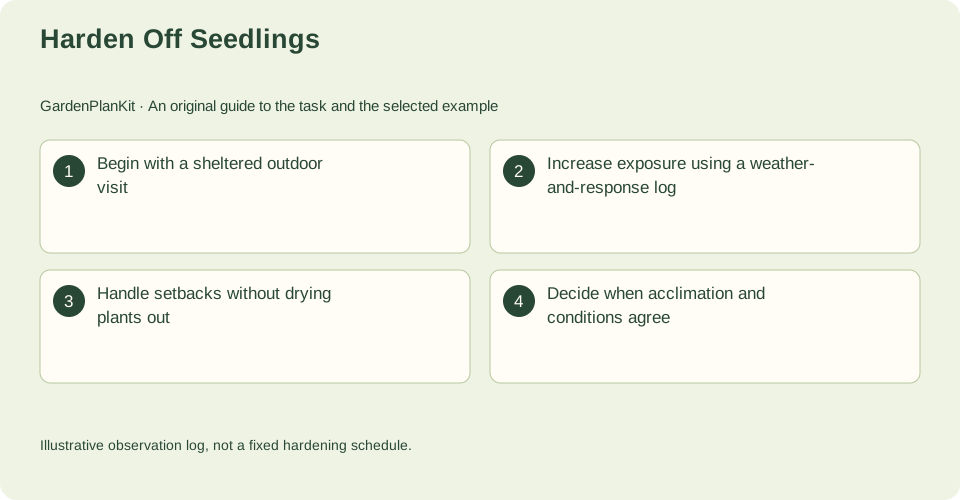
Begin with a sheltered outdoor visit
Start with a short visit to a sheltered, shaded outdoor spot on a suitable warm day. The goal is a first real sample of outdoor air without asking the seedlings to handle full sun or strong wind immediately. Watch whether stems stay upright, leaves remain evenly colored, and new growth looks normal rather than limp or scorched.
Bring plants back in when conditions turn unsuitable. Maryland's regional guidance warns against windy exposure and temperatures below 45 F for tender seedlings. Treat that as a regional caution, not a universal threshold: your crop, your local forecast, and any crop-specific limits still govern. Hardening does not make every crop frost tolerant.
- Choose a sheltered, shaded outdoor spot for the first visit.
- Check the forecast for wind and low temperatures before carrying plants out.
- Observe stem posture and leaf condition during and after the visit.
- Return plants indoors if wind picks up or the temperature drops toward the cautioned range.
Source context: University of Maryland Extension
Increase exposure using a weather-and-response log
Rather than following a fixed countdown, record what the weather did and how the plants answered. A simple log with columns for date, sunlight, wind, temperature, and plant response turns each visit into evidence for the next decision. Increase exposure only when the previous visit produced an acceptable response and the forecast supports another step.
The supplied example is an illustrative observation log, not a fixed hardening schedule. In visit A, plants sat in sheltered shade with mild wind and remained upright. When stronger wind was forecast for the next visit, the plan postponed the increase. That is the pattern to copy: weather first, response second, adjustment third.
- Create log columns for date, sunlight, wind, temperature, and plant response.
- Note the forecast before each visit and record actual conditions after.
- Increase one exposure factor at a time, such as sun or duration, when the prior response was acceptable.
- Postpone the next increase when the forecast shows stronger wind or colder air.
Source context: University of Maryland Extension
Handle setbacks without drying plants out
Wilting, scorched leaf edges, or stalled growth mean the last step was too much. Move plants back to shelter, shade, or indoors as needed, and let them recover before trying again. Reduce watering frequency during hardening, but do not let plants wilt; dryness is a setback, not a hardening technique.
Maryland's guidance notes that excessive hardening that stops growth can damage crops. If plants look checked rather than merely challenged, ease off. The aim is steady acclimation, not toughness at any cost.
- Move stressed plants back to shelter or shade and let them recover.
- Check soil moisture before watering; water to prevent wilting, not on a fixed schedule.
- Ease off exposure if growth stalls rather than pushing through.
- Resume increases only after the plants show a normal response again.
Source context: University of Maryland Extension
Decide when acclimation and conditions agree
Plant out when two things line up: the plants have handled progressively more outdoor exposure with acceptable responses, and the forecast for the planting site is suitable for that crop. Acclimation alone does not override a cold or windy forecast, and a warm forecast does not replace the need for gradual exposure.
Use your log to check the trend rather than a single good day. If the last several entries show upright plants, normal color, and steady growth under more sun and air, and the forecast is suitable, the decision is supported. If either side is uncertain, wait and log another visit.
- Review the log for a consistent pattern of acceptable responses.
- Check the actual forecast for the planting site, including wind and low temperatures.
- Confirm crop-specific limits before planting out.
- Plant out only when both the plant response and the forecast agree.
Source context: University of Maryland Extension
Work through this example
Illustrative observation log, not a fixed hardening schedule.
| Example detail | Selected value or observation |
|---|---|
| visit A | Sheltered shade; mild wind; plants remain upright. |
| visit B | Stronger wind forecast: postpone the next increase. |
| decision | Keep suitable moisture; extend exposure only after checking response. |
The supplied example is an illustrative observation log, not a fixed hardening schedule. Visit A placed plants in sheltered shade with mild wind, and they remained upright. When stronger wind was forecast, the next increase was postponed. The decision was to keep suitable moisture and extend exposure only after checking plant response. No additional timings or temperatures are implied.
Use this example to structure your own notes. Check the source conditions for the crop, method and setting.
Your action checklist
- Forecast checked for wind and low temperatures before each outdoor visit.
- Log records sunlight, wind, temperature, and plant response for every visit.
- Exposure increased only after an acceptable response and a supportive forecast.
- Plants moved back to shelter when stressed, with moisture checked before watering.
- Plant-out decision confirmed by both the log trend and the actual forecast.
Questions that come up while planning
How long does hardening off take?
Maryland guidance describes beginning about 1 to 2 weeks before planting out, but the countdown is not readiness. Use the plants' responses and the actual forecast to decide each increase and the final planting date.
Can I leave seedlings out overnight?
Only when the forecast and crop-specific limits support it. Maryland's regional guide warns against temperatures below 45 F for tender seedlings, and hardening does not make every crop frost tolerant. Check your forecast and crop before leaving plants out.
What should I do if seedlings wilt outdoors?
Move them back to shelter or shade and let them recover. Check moisture and water to prevent wilting, but do not use dryness as a hardening method. Resume exposure gradually after a normal response returns.
Sources & method
Horticultural guidance is linked to its original source and regional context. Geometry and unit conversions are calculated separately. Read how we prepare and check a page.
- Hardening Off Vegetable SeedlingsUniversity of Maryland Extension