
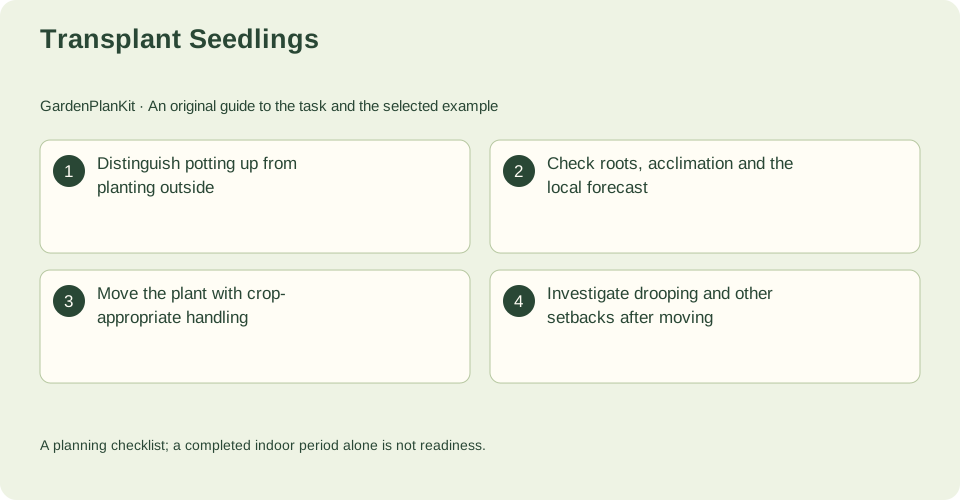
Distinguish potting up from planting outside
Potting up means moving a young seedling into a larger individual container when it needs more room. Maryland discusses the first true leaves as a common stage for potting up, but that stage is not proof that outdoor weather is suitable. Planting outside is a different decision that depends on the seed packet, local outdoor conditions and crop sensitivity together, as UConn notes.
Treat the two as separate checkpoints. A plant may need a larger container while outdoor conditions are still unsuitable, or it may have room indoors but face a forecast that argues against planting out. Keep the reasons for each move distinct so you do not use container size as a stand-in for weather readiness.
- Confirm whether the immediate need is more root space or outdoor planting.
- Check the seed packet for the crop's stated needs before either move.
- If potting up, choose a larger individual container with drainage.
Source context: University of Connecticut Home Garden Education · University of Maryland Extension
Check roots, acclimation and the local forecast
Look at root condition, growth stage and container space before deciding. Maryland advises keeping seedling medium moist, not saturated; drainage keeps roots supplied with both water and oxygen. Saturated mix should be allowed to drain, and watering should respond to the actual medium, container and plant stage rather than a fixed number of minutes in standing water.
After indoor growth, move seedlings outdoors gradually in a protected place, increasing time and exposure as conditions allow. Maryland describes beginning 1 to 2 weeks before planting out, starting in a sheltered shaded place on suitable warm days and bringing plants in when necessary. Its regional guide warns against windy exposure or temperatures below 45 F for tender seedlings. Hardening does not make every crop frost tolerant, so crop-specific limits and the actual forecast still govern.
Record sunlight, wind, temperature and plant response rather than treating a countdown as readiness. Reduce watering frequency without letting plants wilt; excessive hardening that stops growth can damage crops.
- Inspect root condition, growth stage and remaining container space.
- Check the local forecast and the crop's stated limits before planting out.
- Begin acclimation in a sheltered shaded place and increase exposure gradually.
- Note sunlight, wind, temperature and plant response each day.
Source context: University of Connecticut Home Garden Education · University of Maryland Extension · University of Maryland Extension
Move the plant with crop-appropriate handling
Handle small seedlings by their leaves rather than their delicate stems, and avoid tearing roots. Firm the medium gently and water after moving them. Crop-specific root disturbance and planting-depth guidance still applies, so follow the seed packet or crop reference rather than a generic rule.
Transplant on a cloudy day or later in the afternoon when appropriate, protect roots and maintain suitable moisture. Heat mats are optional for seed starting; UConn warns they can dry the medium more quickly and says not to put the heat mat on the same timer as the lights. Warm germination conditions and post-emergence seedling management are different jobs, so a heat mat is not part of outdoor transplant handling.
- Lift seedlings by the leaves, supporting the root ball.
- Set the plant at the crop-appropriate depth and firm the medium gently.
- Water after moving and protect roots from drying during the transition.
- Choose a cloudy day or later afternoon when appropriate.
Source context: University of Connecticut Home Garden Education · University of Maryland Extension
Investigate drooping and other setbacks after moving
Temporary drooping after moving is possible, but persistent decline needs checks of moisture, roots and exposure rather than an invented recovery deadline. Start with the medium: is it saturated, or nearly dry at the surface? Maryland notes that when the upper medium is nearly dry, you can water from the surface or let containers wick water from a shallow pan.
Then check roots and exposure. Windy conditions, sudden full sun or temperatures below the crop's stated limits can set a plant back even after gradual acclimation. If growth has stalled, review whether hardening was excessive. Use observations, not a fixed countdown, to decide whether to adjust shade, shelter or watering.
- Check whether the medium is saturated or nearly dry before watering again.
- Inspect roots for tearing or damage from the move.
- Review recent sun, wind and temperature exposure against the crop's limits.
- Adjust shelter, shade or watering based on what you observe.
Source context: University of Connecticut Home Garden Education · University of Maryland Extension · University of Maryland Extension
Work through this example
A planning checklist; a completed indoor period alone is not readiness.
| Example detail | Selected value or observation |
|---|---|
| plant check | Root condition, growth stage and container space. |
| site check | Crop requirements, soil conditions and forecast. |
| aftercare check | Moisture, exposure and persistent decline. |
The supplied example is a hypothetical planning checklist, not a record of a real planting. It lists three checks: plant condition (roots, growth stage, container space), site condition (crop requirements, soil, forecast) and aftercare (moisture, exposure, persistent decline). Its point is that a completed indoor period alone is not readiness; the checklist organizes observations without adding timing, temperature or yield results.
Use this example to structure your own notes. Check the source conditions for the crop, method and setting.
Your action checklist
- Potting up and planting outside are treated as separate decisions.
- Root condition, growth stage and container space have been checked.
- The seed packet and local forecast have been reviewed together.
- Acclimation increased exposure gradually with notes on plant response.
- After moving, moisture, roots and exposure were checked before any further watering.
Questions that come up while planning
When should I transplant seedlings outside?
When root condition, growth stage, container space, the seed packet's crop guidance, gradual acclimation and the local forecast all support it. A completed indoor period alone is not readiness.
What is transplant shock?
Temporary drooping after moving is possible. Persistent decline calls for checking moisture, roots and exposure rather than assuming a fixed recovery time.
Does hardening make any seedling frost tolerant?
No. Maryland's regional guide warns against temperatures below 45 F for tender seedlings, and hardening does not make every crop frost tolerant. Crop-specific limits and the actual forecast still govern.
Sources & method
Horticultural guidance is linked to its original source and regional context. Geometry and unit conversions are calculated separately. Read how we prepare and check a page.
- Seed StartingUniversity of Connecticut Home Garden Education
- Care of Vegetable SeedlingsUniversity of Maryland Extension
- Hardening Off Vegetable SeedlingsUniversity of Maryland Extension