
Read the source range before choosing a number
The linked guide gives a range, not a single prescription. Within-row spacing is 3 to 4 inches, and between-row spacing is 8 to 16 inches. Treat those as the bounds for your decision, then state which point you selected and why it fits your situation.
The within-row number applies to retained leeks. It is not a seed-sowing rate. Seeds scattered along a trench and later thinned are a different stage from the established plants you intend to keep. Count the plants you plan to retain, not the seeds you start with.
- Write down the source range: 3 to 4 inches within rows, 8 to 16 inches between rows.
- Choose one within-row value and one between-row value for a single labeled scenario.
- Label the scenario so the chosen values are not mistaken for advice for every bed.
Source context: Utah State University Extension
Worked example: one 96-inch row at 4-inch centers
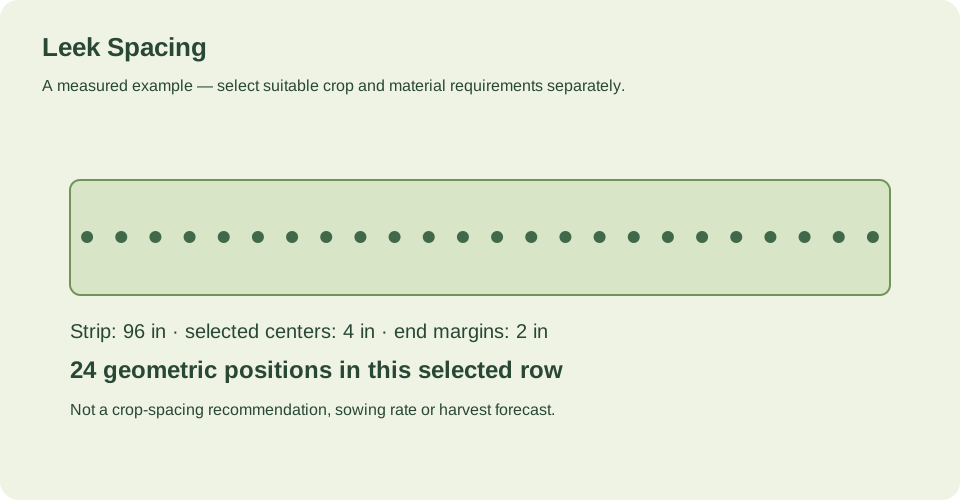
This is a geometrical example, not crop advice. Take one measured row 96 inches long, select 4-inch centers, and allow a 2-inch margin at both ends. The first retained plant center falls at 2 inches and the last at 94 inches. That gives 24 counted positions.
The counted item is retained plants. The example does not say how many seeds to scatter, how much thinning to do, or how many rows fit in a garden. It describes one row only.
The linked row calculator can count this exact length, center interval and both end margins, in inches or centimeters. Use it to check your own measured row rather than copying the example numbers into a different length.
- Measure the actual row length before counting.
- Enter the selected center spacing and both end margins in the row calculator.
- Confirm the first and last center positions and the retained plant count.
Source context: Utah State University Extension
Decide row spacing and layout separately
One counted row is not an entire garden layout. The 8 to 16 inch between-row range is a separate choice from the within-row count. Access paths, supports, adjacent rows and the mature habit of the plants all affect how you arrange rows, and those decisions must be made for your own site rather than assumed from the row count.
Keep the leek within-row spacing, between-row spacing, and access needs as three distinct decisions. The selected count applies to retained leeks, not seeds initially scattered along a trench.
- Choose a between-row distance within the provided range for your labeled scenario.
- Mark access and support needs separately from the plant count.
- Check adjacent rows against the mature habit you expect before finalizing the layout.
Source context: Utah State University Extension
Mark and check retained plants
Marking retained plants turns a spacing choice into a plan you can inspect. Mark the first and last centers using the end margins, then place marks at the selected center interval between them. Count the marks and compare that number with the calculator result.
Keep sowing, thinning and initial planting notes apart from the retained-plant marks. The count describes the established plants you intend to keep, so a thinning note should not be confused with the final row count.
- Mark the first center at the chosen end margin.
- Mark each subsequent center at the selected interval.
- Count the marks and record the retained plant total for that row.
Source context: Utah State University Extension
Check your measured example
One measured 96-inch row, with selected 4-inch centers and 2-inch margins at both ends. Count 24 retained plants.
Reference and growing system: USU gives leek plants 3–4 inches apart within rows 8–16 inches apart. The selected count is for retained leeks, not seeds initially scattered along a trench.
| Quantity | Calculated result |
|---|---|
| Usable row length (in) | 96 |
| Selected center spacing (in) | 4 |
| Margin at each row end (in) | 2 |
| Positions in this row | 24 |
| First center from row start (in) | 2 |
| Last center from row start (in) | 94 |
| What is being counted | retained plants |
The worked example is a geometrical count for one 96-inch row with 4-inch centers and 2-inch margins at both ends. It yields 24 retained plant positions, with the first center at 2 inches and the last at 94 inches. It is not crop advice and does not describe a full garden layout or a seed-sowing rate.
Count this row in the spacing calculator ↗Example inputs explain the method. Review the source context, chosen cultivar and actual site before planting or ordering.
Your before-you-plant checklist
- Source range recorded: 3 to 4 inches within rows, 8 to 16 inches between rows.
- One labeled scenario states the chosen within-row and between-row values.
- Row length measured before counting.
- First and last center positions checked against the end margins.
- Retained plant count recorded separately from sowing and thinning notes.
Questions that come up while planning
What leek spacing does the linked guide give?
USU gives leek plants 3 to 4 inches apart within rows that are 8 to 16 inches apart. Choose one point within each range for a clearly labeled scenario.
Does the 24-plant example apply to my garden?
No. It is a geometrical example for one 96-inch row with 4-inch centers and 2-inch end margins. Measure your own row and use the calculator with your selected values.
Does the count include seeds or thinned seedlings?
No. The counted item is retained plants. Seeds scattered along a trench and later thinned are a different stage from the established leeks you plan to keep.
Sources & method
Horticultural guidance is linked to its original source and regional context. Geometry and unit conversions are calculated separately. Read how we prepare and check a page.
- How to Grow Leeks in Your GardenUtah State University Extension