
Decide whether a container suits leeks
The source describes leek as a hardy cool-season biennial preferring full sun and fertile, well-drained soils, with organic matter and a complete fertilizer incorporated before planting. In a container, that translates into a free-draining growing medium, a pot with open drainage holes and a position that receives full sun. Leeks need regular watering and are described as sensitive to water stress, which reduces yield and plant size, so a container that dries out quickly is a poor match.
Plan for the plants you intend to finish, not the number of seeds you can sow. The source notes that one seed or transplant yields one sheath, typically 6-8 inches long and 1-2 inches wide, and that leeks are ready to eat when stalks reach about 1 inch in diameter. Those are crop facts, not a container capacity. Because no leek container volume is supplied, use the container guidance for ordinary vegetables: adequate drainage, a root-supporting medium and a pot matched to both mature top growth and root space. Volume alone does not define a suitable shape.
- Confirm the site gets full sun and that you can water regularly.
- Check the pot has open drainage holes and a shape that fits the mature plants.
- Decide how many finished leeks you want before choosing pot size.
Source context: Utah State University Extension · University of Maryland Extension
Measure the pot and prepare the medium
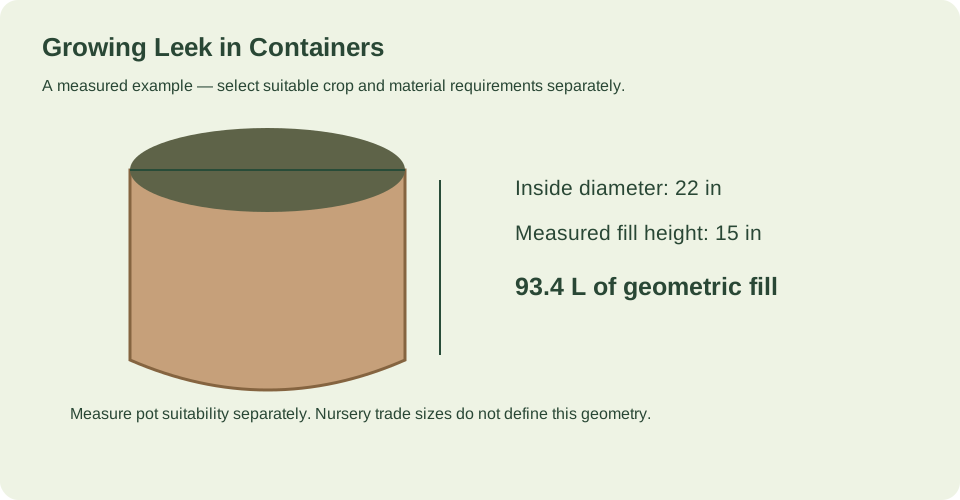
Measure actual fill volume rather than trusting a nursery trade-gallon label. Use inside diameter and the fill height you will really use, leaving a rim gap for watering. The supplied example is a straight-sided pot with a 22-inch inside diameter, 16-inch inside height and a 1-inch rim gap, giving a 15-inch fill height. Its computed fill capacity is about 3.30 cubic feet, 93.4 liters or 24.7 US liquid gallons. That is a volume-only illustration; it is not a minimum pot size for leek, and you must confirm a suitable container separately.
For the growing medium, the container source lists commercial soilless mix and an equal-volume soilless-mix and compost blend among options for container vegetables. Dense garden soil behaves differently from a container mix. If reusing medium, remove plant residue and do not save medium associated with root disease; the guide describes blending old and fresh material rather than assuming old mix is unchanged. Stones or gravel under the mix do not improve drainage, and saucers should be emptied so roots are not left saturated.
- Measure inside diameter and the fill height, subtracting any rim gap.
- Calculate fill volume and compare it with the container you actually have.
- Choose a soilless mix or an equal-volume soilless-mix and compost blend.
- Keep drainage holes open and empty saucers after watering.
Source context: University of Maryland Extension · University of Maryland Extension
Set up planting, watering and blanching access
The source gives in-ground seed depth of ¼-½ inch and row spacings of 3-4 inches within the row and 8-16 inches between rows. Those are row figures for garden planting, not a container spacing rule, and they should not be converted into an unsupported pot minimum. For containers, keep access for transplanting and for whatever blanching method you choose, without expecting a particular shank size. Blanching methods that hill soil or add mulch around stems need room to work and a pot deep enough for the method you select.
Water to maintain steady moisture, since the source says leeks require regular watering and water stress reduces plant size. Organic mulch can help conserve water, supply extra nutrients and reduce weeding. The source also describes nitrogen side dressing in May and June for garden plantings, at a rate given per 100 square feet; that rate is an in-ground figure and is not a container dose. Control weeds, insects and diseases throughout the season, and monitor the medium for drying and drainage problems.
- Leave working space around each plant for transplanting and blanching.
- Water regularly and check moisture before it drops sharply.
- Apply organic mulch if it suits your setup and keep it clear of stems as needed.
- Inspect for weeds, pests, disease and blocked drainage through the season.
Source context: Utah State University Extension · University of Maryland Extension · University of Maryland Extension
Plan harvest and storage expectations
Leek varieties vary in maturity. The source says leeks may be harvested as early as 60 days after seeding but generally require 100-120 days to mature, and are ready to eat when stalks are about 1 inch in diameter. Use those as crop timing facts, not a promise for your container. In mild areas the source describes storing leeks in the garden by hilling soil around plants and covering with mulch; in very cold areas it describes harvesting and storing in cold, humid conditions. A container limits in-garden overwintering options, so decide early how you will handle cold weather.
The source lists Large American Flag, Comanche and King Richard as varieties, and notes that local garden centers and catalogs may list others. Variety choice is separate from pot size, and no container performance is claimed here.
- Record the sowing date and check stalks against the 1-inch diameter readiness guide.
- Decide before cold weather whether plants will be harvested or protected.
- Note the variety you planted for your own records.
Source context: Utah State University Extension
Check your measured example
Volume-only illustration: one straight-sided pot with inside diameter 22 in, inside height 16 in and 1 in rim gap. The resulting fill capacity is not a minimum pot size for leek; confirm a suitable container separately.
| Quantity | Calculated result |
|---|---|
| inside diameter in | 22 |
| fill height in | 15 |
| volume cuft | 3.2998 |
| volume liters | 93.4389 |
| US liquid gallons | 24.6839 |
The example is a volume-only calculation for a straight-sided pot with a 22-inch inside diameter, 16-inch inside height and 1-inch rim gap, giving a 15-inch fill height and about 3.30 cubic feet, 93.4 liters or 24.7 US liquid gallons. It does not establish a minimum pot size for leek; confirm a suitable container separately using drainage, shape and root space.
Example inputs explain the method. Review the source context, chosen cultivar and actual site before planting or ordering.
Your before-you-plant checklist
- Full-sun position confirmed and regular watering possible.
- Pot has open drainage holes and a shape that fits mature plants.
- Inside diameter and fill height measured, with rim gap subtracted.
- Soilless mix or equal-volume soilless-mix and compost blend chosen.
- Access left for transplanting and the chosen blanching method.
- Sowing date and variety recorded for harvest timing.
Questions that come up while planning
What pot size do leeks need in containers?
The supplied sources do not give a leek container volume. Use the general container guidance: adequate drainage, a root-supporting medium and a pot matched to mature top growth and root space. The 22-inch by 15-inch fill example is geometry only, not a leek minimum.
Can I use the in-ground row spacing for a container?
No. The 3-4 inch within-row and 8-16 inch between-row figures are garden row spacings. They are not a container spacing rule and should not be converted into a pot minimum.
How often should container leeks be watered?
The source says leeks require regular watering and that water stress reduces yield and plant size. Check the medium often and water before it dries sharply; drainage holes must stay open and saucers should be emptied.
Sources & method
Horticultural guidance is linked to its original source and regional context. Geometry and unit conversions are calculated separately. Read how we prepare and check a page.
- How to Grow Leeks in Your GardenUtah State University Extension
- Growing Vegetables in Containers and Salad TablesUniversity of Maryland Extension
- Growing Media (Potting Soil) for ContainersUniversity of Maryland Extension