
Choose the pea type and support first
Garden peas are harvested when pods are full but before seeds mature, snap peas when pods are plump, and dry peas when pods yellow and seeds dry. Snap peas generally produce pods over a longer period, so the source describes one planting, while garden and dry peas are sown every 14 to 21 days until the regional cutoff. Those Utah dates are examples for that location, not a universal calendar.
Peas are cool, frost-tolerant crops that do poorly above 80 degrees Fahrenheit. Most varieties are self-supporting, but taller types are more productive and easier to harvest with a cage, trellis or fence. Decide whether you want bush or climbing growth, then size the support footprint and check that you can reach the pods without stepping into the pot.
- Pick garden, snap or dry peas and note the expected harvest stage.
- Choose bush or climbing habit and sketch the finished trellis footprint.
- Confirm the pot and support fit your reach and available space.
Source context: Utah State University Extension · University of Maryland Extension
Measure the pot and prepare the medium
Match both mature top growth and root space; volume alone does not define a suitable shape. Measure actual fill volume rather than trusting nursery trade-gallon labels. Drainage holes must stay open, and stones or gravel under the mix do not improve drainage. Empty saucers so roots are not left saturated.
Use a commercial soilless mix or an equal-volume soilless-mix and compost blend. Dense garden soil behaves differently from container mix. If reusing medium, remove plant residue and do not save medium associated with root disease; blend old and fresh material rather than assuming old mix is unchanged.
- Measure inside diameter and usable fill height, allowing a rim gap.
- Check that drainage holes are open and the saucer can be emptied.
- Fill with soilless mix or an equal-volume mix and compost blend.
Source context: University of Maryland Extension · University of Maryland Extension
Sow, water and monitor
The source spacing of seeds 1 to 2 inches apart in rows 12 to 24 inches apart is an in-ground row figure, not a converted pot minimum. For a container, use the label or packet guidance for sowing depth and interval, and treat the finished trellis footprint as separate from sowing interval. Peas need regular watering, particularly at flowering, and hot temperatures plus water stress reduce yield and pod quality.
Peas fix nitrogen through soil bacteria, and extra nitrogen can over-stimulate leaves, delay flowering and reduce pod set. Do not add fertilizer beyond what was applied at planting. Organic mulch can conserve water and reduce weeding. Watch for insects and disease, and harvest at the stage for your chosen pea type.
- Sow at the depth and interval given on your seed packet.
- Water regularly, especially at flowering, without leaving the saucer full.
- Monitor for pests, disease and heat stress, then harvest at the correct stage.
Source context: Utah State University Extension · University of Maryland Extension · University of Maryland Extension
Check your measured example
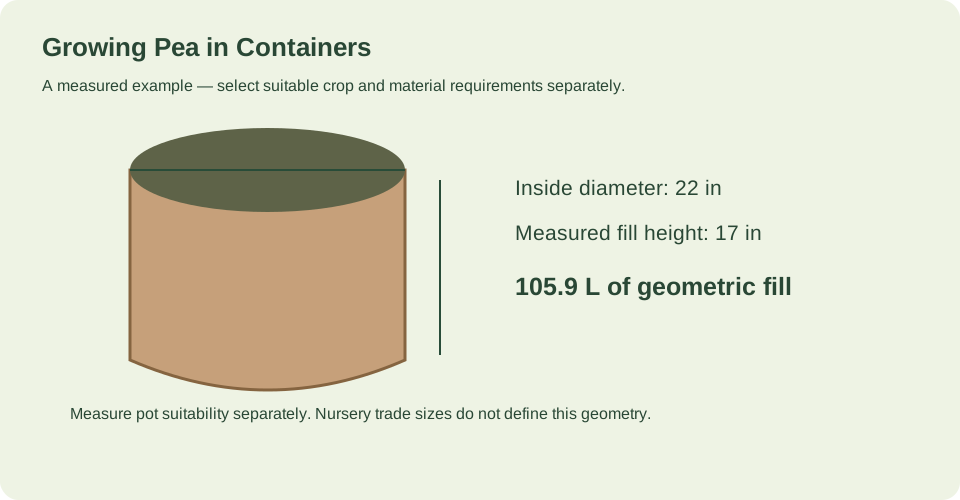
Volume-only illustration: one straight-sided pot with inside diameter 22 in, inside height 18 in and 1 in rim gap. The resulting fill capacity is not a minimum pot size for pea; confirm a suitable container separately.
| Quantity | Calculated result |
|---|---|
| inside diameter in | 22 |
| fill height in | 17 |
| volume cuft | 3.7397 |
| volume liters | 105.8974 |
| US liquid gallons | 27.9751 |
The worked example is a geometrical volume calculation for one straight-sided pot with a 22-inch inside diameter, 18-inch inside height and 1-inch rim gap, giving a 17-inch fill height. Its calculated volume is not a minimum pot size for peas and does not establish crop spacing, support size or yield.
Example inputs explain the method. Review the source context, chosen cultivar and actual site before planting or ordering.
Your before-you-plant checklist
- Pea type chosen: garden, snap or dry.
- Bush or climbing habit and support footprint decided.
- Pot measured by actual fill volume, not trade-gallon label.
- Drainage holes open and saucer emptyable.
- Soilless mix or equal-volume mix and compost blend ready.
Questions that come up while planning
Does the 22-inch pot example give a minimum pot size for peas?
No. It is a volume-only illustration of one straight-sided pot with a 1-inch rim gap. Confirm a suitable container separately by matching root space, top growth and support.
Can I convert the in-ground row spacing into a pot spacing?
No. The 1-to-2-inch seed spacing and 12-to-24-inch row spacing are in-ground row figures. Use seed packet guidance for container sowing and keep the trellis footprint separate.
Should I add nitrogen fertilizer to container peas?
The source says peas do not need additional fertilizer if fertilizer or compost was applied at planting, and extra nitrogen can delay flowering and reduce pod set.
Sources & method
Horticultural guidance is linked to its original source and regional context. Geometry and unit conversions are calculated separately. Read how we prepare and check a page.
- How to Grow Peas in Your GardenUtah State University Extension
- Growing Vegetables in Containers and Salad TablesUniversity of Maryland Extension
- Growing Media (Potting Soil) for ContainersUniversity of Maryland Extension