
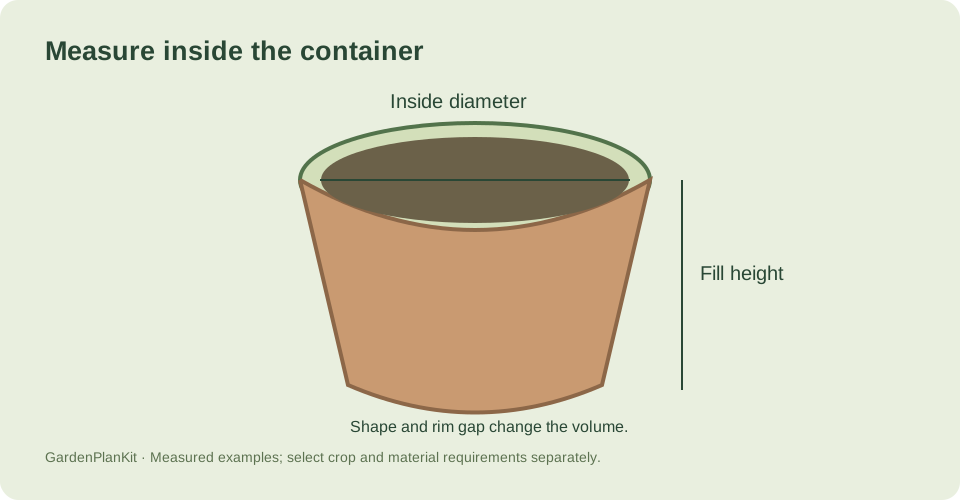
Measure the fill capacity you will actually use
Container labels and trade names can describe a pot differently from the volume you will fill. Measure the inside of the container and the depth of growing medium you intend to use, then calculate the volume of that fill space. A straight-sided cylinder is a simple geometrical example, not a recommendation for a particular crop layout or pot shape.
The supplied example is one straight-sided cylinder with an internal diameter of 16 inches and a fill depth of 12 inches. Using pi geometry, that space is about 1.396 cubic feet, or about 39.54 liters. This is a geometry result, not a nursery trade-size capacity. If your pot is tapered, has internal ridges, or will be filled to a different depth, measure and calculate your own fill space rather than copying the example.
- Measure the internal diameter and the fill depth you plan to use.
- Calculate the volume of that fill space and record it with the units you measured.
- Check that the container is opaque, food-safe and has drainage before filling.
Source context: Penn State Extension · University of Maryland Extension
Choose a growing medium for the container
The growing medium must support roots while holding appropriate water and air. Dense garden soil behaves differently from a container mix, so do not assume field soil will perform the same way in a pot. For container vegetables, the supplied guide lists commercial soilless mix and an equal-volume soilless-mix and compost blend among its options.
If you reuse medium, remove plant residue and do not save medium associated with root disease. The guide describes blending old and fresh material rather than assuming old mix is unchanged. Package label units govern any volume conversion, so check the label on the mix you buy before matching it to your calculated fill volume.
- Select a medium from the listed container options and read its package label.
- Convert the label volume using the units printed on the package.
- If reusing medium, remove plant residue and discard medium associated with root disease.
Source context: University of Maryland Extension
Plan watering around the actual pot and system
Container watering needs vary with weather, plant growth and growing medium. Plan for the actual container and growing system you are using. Self-watering designs have different water-reservoir arrangements, so their watering routine will not match a simple drained pot.
Do not fill an entire deep pot immediately as a universal method. The depth you fill should follow your own plan for the container, the planting material and continued care. A large container can be filled in stages if that suits your setup, but the supplied facts do not make staged filling a required rule.
- Identify whether your container is a simple drained pot or a self-watering design.
- Match your watering plan to that system, the weather and the growing medium.
- Decide your fill depth before planting rather than assuming a deep pot must be filled all at once.
Source context: Penn State Extension · University of Maryland Extension
Check your measured example
One straight-sided cylinder with internal diameter 16 in and fill depth 12 in; pi geometry, not a nursery trade-size capacity.
| Quantity | Calculated result |
|---|---|
| volume cuft | 1.3963 |
| volume liters | 39.5378 |
The example uses one straight-sided cylinder with a 16-inch internal diameter and 12-inch fill depth. Pi geometry gives about 1.396 cubic feet, or about 39.54 liters. This is a geometrical calculation, not a nursery trade-size capacity and not crop advice; measure your own pot's internal dimensions and intended fill depth.
Example inputs explain the method. Review the source context, chosen cultivar and actual site before planting or ordering.
Your before-you-plant checklist
- Container is opaque, food-safe and has drainage.
- Internal diameter and planned fill depth are measured.
- Fill volume is calculated and recorded with units.
- Growing medium is chosen from the listed container options.
- Watering plan matches the actual container and growing system.
Questions that come up while planning
Is a 10–15 gallon container required for potatoes?
No. Penn State's guide describes large opaque, food-safe containers with drainage, including 10–15 US gallon containers. That range is a planning example, not a requirement or a yield promise.
Can I use garden soil in a potato container?
Dense garden soil behaves differently from a container mix. The supplied guide lists commercial soilless mix and an equal-volume soilless-mix and compost blend among container vegetable options.
Does a taller pot mean more potatoes?
The supplied facts do not support promising yield from container height. Capacity is only one planning input; container shape, access, planting material and continued care also matter.
Sources & method
Horticultural guidance is linked to its original source and regional context. Geometry and unit conversions are calculated separately. Read how we prepare and check a page.
- Potatoes in the Garden and the KitchenPenn State Extension
- Growing Vegetables in Containers and Salad TablesUniversity of Maryland Extension
- Growing Media (Potting Soil) for ContainersUniversity of Maryland Extension