
Match the support to the crop habit
Vining and bush cultivars need different supports, so confirm which habit your seed packet describes before choosing hardware. Climbing peas and beans can use netting or twine. Tomatoes may use cages or stakes. Smaller-fruited vines may use trellises. Large squash and pumpkins are grown on the ground rather than assumed suitable for a light trellis, because mature fruit weight and the support's rated capacity are separate questions from span.
Mesh opening matters as much as mesh height. Choose an opening that suits the stems and tendrils you will guide and that lets you reach through for harvest. Twine is flexible for light climbing crops but must be tied to something rated for the job. A cage or stake suits a tomato's growth habit better than netting designed for peas.
- Read the seed packet to confirm vining or bush habit.
- List the crop's mature fruit weight and harvest method.
- Pick a support type suited to that habit: netting or twine, cage or stake, or trellis for smaller-fruited vines.
Source context: University of Minnesota Extension
Measure the span and check light and access
Measure the actual bed span where the trellis will sit, not the bed's nominal size. Note whether that span is in full sun or shade, since light affects where you place the trellis and which side of the bed you plant. Keep pathways, access and nearby beds visible in the garden layout so you can still water, weed and harvest.
A span measurement is not a structural load rating. The manufacturer's rated anchoring system, wind exposure and the components you select govern whether a support is appropriate. Choose rated components and anchoring separately from the crop decision.
- Measure the real span between the points where the trellis will attach.
- Mark sun and shade across the bed and note pathway widths.
- Confirm the anchoring system is rated by its manufacturer for your setup.
Source context: University of Minnesota Extension
Use the 0, 4 and 8 ft example as a counting exercise
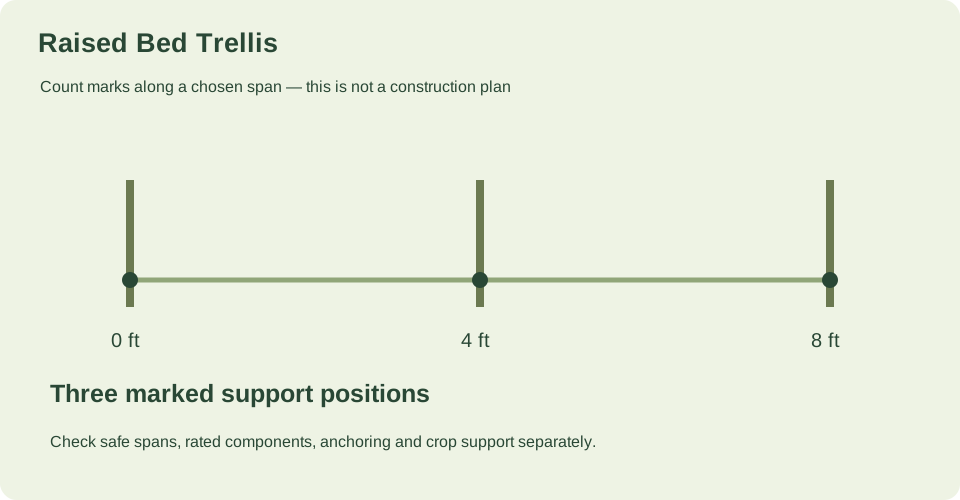
The worked example selects an 8 ft span and marks stations at 0, 4 and 8 ft, producing three counted support positions. That is a geometry exercise only: it counts selected marks along a chosen span. It is not a safe post spacing, hardware prescription, load capacity or construction drawing.
Use the example to practice counting stations on your own measured span, then verify rated components, anchoring, wind exposure and crop suitability separately. The count tells you how many positions you marked, not how much weight they can hold.
- Mark your chosen span at your selected interval.
- Count the marked positions.
- Verify hardware and anchoring against manufacturer ratings before building.
Source context: University of Minnesota Extension
Buy and place with the whole bed in view
When buying, match the support type to the crop habit, check mesh opening against the stems you will guide, and confirm the anchoring system is rated. Keep the trellis placement consistent with pathways and nearby beds so access stays open. A trellis does not automatically justify closer crop spacing, so keep the crop's recommended planting distance.
Place the trellis where the crop's light needs are met and where you can reach fruit without stepping into the bed. If a crop's mature fruit is heavy, treat light trellis options as unsuitable unless a rated system is specified for that load.
- Compare support type, mesh opening and rated anchoring before purchase.
- Keep recommended planting distances rather than tightening them for the trellis.
- Check that pathways and nearby beds remain reachable after placement.
Source context: University of Minnesota Extension
Check your measured example
Counted layout marks only, not structural design. The selected 8 ft span is marked at 0, 4 and 8 ft; hardware and safe spans require separate verification.
| Quantity | Calculated result |
|---|---|
| selected span ft | 8 |
| selected interval ft | 4 |
| marked positions | 0 ft; 4 ft; 8 ft |
| support positions counted | 3 |
| load capacity | Not calculated |
The supplied example selects an 8 ft span and marks stations at 0, 4 and 8 ft, counting three support positions. It is a selected geometry exercise only, not a safe post spacing, hardware prescription, load capacity or construction drawing; rated components, anchoring, wind exposure and crop suitability must be chosen separately.
Example inputs explain the method. Review the source context, chosen cultivar and actual site before planting or ordering.
Your before-you-plant checklist
- Seed packet confirms vining or bush habit.
- Support type matches the crop: netting or twine, cage or stake, or trellis for smaller-fruited vines.
- Actual bed span measured and light and shade noted.
- Mesh opening suits the stems and harvest access.
- Anchoring system is rated by its manufacturer and pathways stay open.
Questions that come up while planning
Can I use a light trellis for pumpkins or large squash?
Large squash and pumpkins are grown on the ground rather than assumed suitable for a light trellis. Mature fruit weight and the support's rated capacity are separate from span, so a light trellis is not a default choice for heavy fruit.
Does adding a trellis let me plant closer together?
No. Trellising does not automatically justify closer crop spacing. Keep the crop's recommended planting distance and treat the trellis as a support choice.
What does the 0, 4 and 8 ft example prove?
It counts three marked support positions along a selected 8 ft span. It is a geometry exercise, not a safe post spacing, load rating or construction drawing.
Sources & method
Horticultural guidance is linked to its original source and regional context. Geometry and unit conversions are calculated separately. Read how we prepare and check a page.
- Trellises and cages to support garden vegetablesUniversity of Minnesota Extension