
What the 18–24 inch range covers
The range applies to initial rooted plants set within a row. It does not describe the final number of canes, the width of the maintained strip, or the distance between separate rows. Because suckers fill in over time, the number you plant at the start is a planting count, not a harvest or mature-plant count.
Choose a center interval inside the range and label it clearly. The worked example below uses 24 inches, the upper end of the range, for one measured row. That choice is a labeled scenario, not a claim that 24 inches suits every garden or every raspberry type.
- Confirm the source range of 18–24 inches applies to initial rooted plants within a row.
- Pick one center interval within that range and write it down with the row it belongs to.
- Record that the count is initial plants, not a permanent cane total.
Source context: Utah State University Extension
Worked example: one 144-inch row
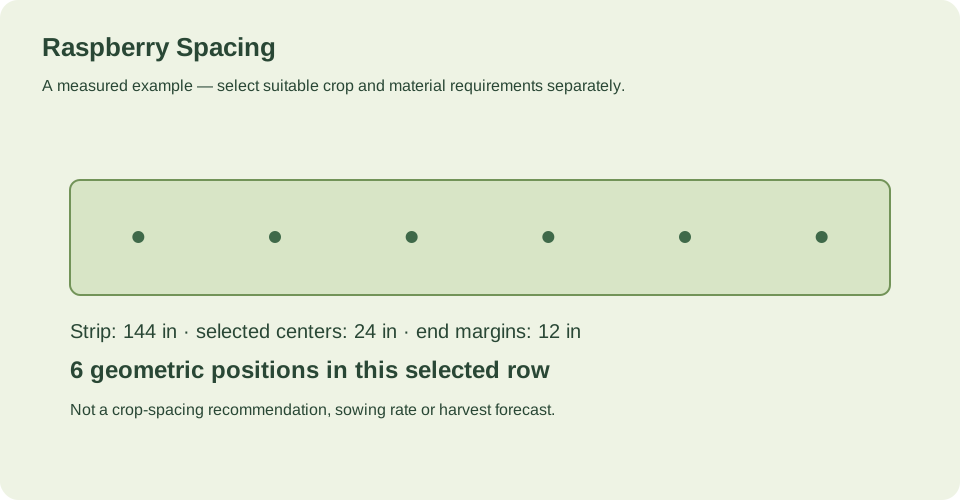
Take a measured row 144 inches long, a selected center spacing of 24 inches, and 12-inch margins at both ends. The first plant center sits 12 inches from the start, the last sits 132 inches from the start, and the row holds 6 initial rooted plants. The count refers to initial rooted plants only.
This is a geometrical example, not crop advice for a particular cultivar or site. It shows how length, center interval, and end margins combine to produce a plant count. The linked row calculator can count this exact length, center interval, and both end margins in inches or centimeters.
- Measure the row length in inches or centimeters.
- Enter the selected center interval and both end margins into the row calculator.
- Check that the first and last centers fall inside the row and that the count matches your marked positions.
Source context: Utah State University Extension
Choices the row count does not make
One row is not an entire garden layout. Between-row access is typically not less than 96 inches according to the linked guide, but that figure covers access between rows, not the full arrangement of a garden. Supports, adjacent rows, paths, and the mature habit of the plants must be chosen separately.
Do not invent distances for those elements. Decide them from your own site measurements, the support system you plan to use, and the space the mature strip will occupy. Keep the in-row planting interval and the between-row access figure as separate decisions so neither is mistaken for the other.
- Mark the between-row access separately from the in-row plant centers.
- Choose support and adjacent-row placement using your own measured site, not the in-row interval.
- Keep the initial plant count distinct from the eventual maintained strip.
Source context: Utah State University Extension
Marking and checking the plan
Mark each initial rooted plant center at the chosen interval, starting after the first end margin. Check that the last center leaves the second end margin intact. Then review the row against the rest of the layout before planting.
If the marked count and the calculator count differ, recheck the measured length, the center interval, and both margins. The example values are fixed; changing any one of them changes the count.
- Mark centers from the first margin to the last margin.
- Compare the marked positions with the calculator result.
- Review access, supports, and adjacent rows before finalizing the layout.
Source context: Utah State University Extension
Check your measured example
One measured 144-inch row, with selected 24-inch centers and 12-inch margins at both ends. Count 6 initial rooted plants.
Reference and growing system: USU’s Raspberry Management for Utah gives initial rooted plants 18–24 inches apart within a row. Between-row access is typically not less than 96 inches. Suckers later fill the maintained strip, so this is not a permanent cane count.
| Quantity | Calculated result |
|---|---|
| Usable row length (in) | 144 |
| Selected center spacing (in) | 24 |
| Margin at each row end (in) | 12 |
| Positions in this row | 6 |
| First center from row start (in) | 12 |
| Last center from row start (in) | 132 |
| What is being counted | initial rooted plants |
The example uses a 144-inch row, 24-inch centers, and 12-inch margins at both ends. It yields 6 initial rooted plants, with the first center at 12 inches and the last at 132 inches. This is a geometrical illustration of the range, not crop advice, and the count is not a permanent cane total.
Count this row in the spacing calculator ↗Example inputs explain the method. Review the source context, chosen cultivar and actual site before planting or ordering.
Your before-you-plant checklist
- Row length measured in inches or centimeters.
- Center interval chosen within the 18–24 inch range and labeled.
- Both end margins recorded.
- First and last plant centers checked against the row ends.
- Between-row access, supports, and adjacent rows decided separately from the in-row interval.
Questions that come up while planning
How far apart should initial raspberry plants go within a row?
USU's Raspberry Management for Utah gives 18–24 inches apart within a row for initial rooted plants. Choose one interval in that range and label it for your row.
Does the plant count equal the final number of canes?
No. Suckers later fill the maintained strip, so the initial rooted plant count is a planting count, not a permanent cane count.
Is 96 inches the full garden layout spacing?
No. The linked guide says between-row access is typically not less than 96 inches. That covers access between rows, not supports, adjacent rows, or the whole garden layout, which you must choose separately.
Sources & method
Horticultural guidance is linked to its original source and regional context. Geometry and unit conversions are calculated separately. Read how we prepare and check a page.
- Raspberry Management for Utah Utah State University Extension