
Decide whether a container raspberry row fits your site
Raspberry plants have a perennial root system, but individual canes are biennial: first-year primocanes emerge from the roots, and second-year floricanes grow lateral branches and fruit before dying. While floricanes fruit, primocanes are developing for the next year, so a planting can fruit each year. In a container, that cycle means you need space not only for the plants you set now but for the new canes that will emerge later.
Container growing suits a site where you can provide adequate drainage, a root-supporting growing medium and a pot suited to the crop and cultivar. Match both mature top growth and root space; a tall, narrow pot and a wide, shallow pot of the same volume are not interchangeable. Choose disease-resistant cultivars and confirm that the cultivar is appropriate for your area, since some cultivars cannot survive severe freezes. Obtain certified virus-free plants from reputable nurseries rather than sharing plants with neighbors, which can spread viruses and soil-borne diseases.
Climate matters too. Fruit plants need a dormant cold period, and chilling hours affect fruit bud development. In mild regions, a low-chill cultivar may come out of dormancy during a late-winter warm spell and then be injured by a late freeze. Regional planting dates in any source are examples for that source location, not a schedule for your garden.
- Confirm the site receives the conditions the chosen cultivar needs and that the container can stay in place permanently.
- Select a disease-resistant cultivar suited to your area and order certified virus-free plants early.
- Check that the intended pot has open drainage holes and a shape that can support both top growth and root space.
Source context: Utah State University Extension · University of Maryland Extension · University of Maryland Extension
Measure the pot and check the growing medium
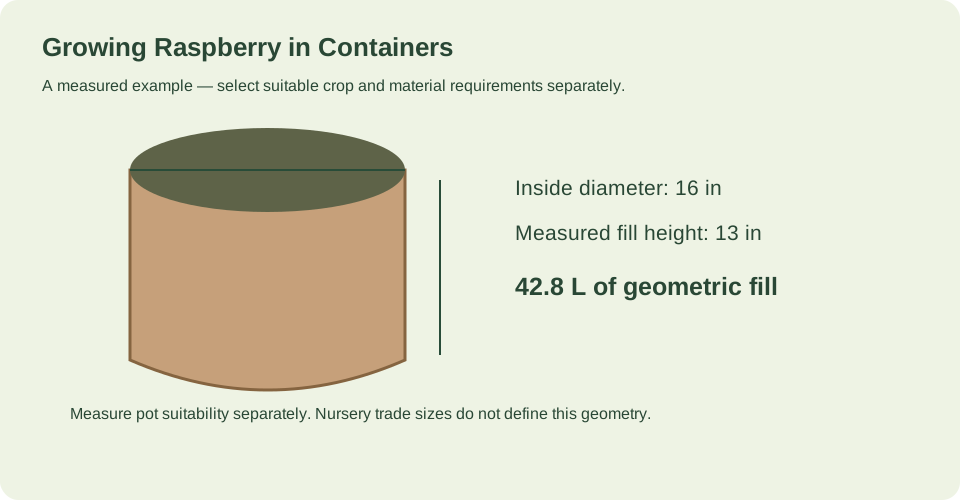
Measure actual fill volume rather than relying on nursery trade-gallon labels. For a straight-sided pot, use the inside diameter and the fill height after allowing a rim gap for watering. The supplied example uses a pot with a 16-inch inside diameter, a 14-inch inside height and a 1-inch rim gap, giving a 13-inch fill height. That geometry produces about 1.51 cubic feet, 42.83 liters or 11.32 US liquid gallons of fill capacity. This is a volume-only illustration; it is not a minimum pot size for raspberry, and you must confirm a suitable container separately.
Container roots rely on the material inside the pot for physical support and a workable balance of moisture and air. Ordinary garden soil does not behave like a purpose-made container medium. Maryland includes ready-made soilless media among its container-vegetable options, as well as a blend using the same volume of soilless material and compost. If you reuse medium, remove plant residue and do not save medium associated with root disease; blend old and fresh material rather than assuming old mix is unchanged.
Drainage holes must remain open. Stones or gravel under the mix do not improve drainage, and empty saucers so roots are not left saturated.
- Measure inside diameter and usable fill height, then calculate fill volume and compare it with the container you actually have.
- Fill with a commercial soilless mix or an equal-volume soilless-mix/compost blend.
- Keep drainage holes clear, skip gravel layers and empty saucers after watering.
Source context: University of Maryland Extension · University of Maryland Extension
Lay out the cane row, suckering strip and harvest aisle
Plan the container planting as a permanent cane row rather than a set of isolated plants. Set the initial rooted plants along the row, but treat that initial spacing as a starting layout only: it does not fix the eventual number of canes. New primocanes will emerge from the roots over time, so reserve a suckering strip where those canes can grow and be managed.
Leave a harvest aisle alongside the row so you can reach the fruit and tend the canes without stepping into the growing area. Because the cane growth cycle is biennial, plan pruning and cane removal as part of the layout: floricanes die after fruiting, and fall-bearing types may also produce a summer crop on retained lower cane portions the following season. The height at which fruiting begins depends on cultivar and plant vigor.
Support is a practical check, not an optional extra. Decide how you will hold canes upright within the container and how that support will be anchored, then confirm the pot and support arrangement leave the harvest aisle usable.
- Mark the cane row, the suckering strip and the harvest aisle before planting.
- Set initial rooted plants along the row, noting that this spacing does not determine the final cane count.
- Install a support arrangement that keeps canes upright and leaves the aisle clear.
- Record a pruning plan for dead floricanes and any retained lower cane portions.
Source context: Utah State University Extension · University of Maryland Extension
Set up and monitor the planting
Dormant bare-root plants can be planted as soon as the ground can be tilled in early spring, and spring bare-root planting is preferred over later potted starts, which are more expensive and often of inferior quality. Specify a shipping date that allows planting at the right time for your area.
After planting, monitor the things you can actually check: drainage, medium moisture, cane emergence, support stability and the condition of new growth. Fall-bearing primocanes stop terminal growth and begin flowering in mid-summer, with harvest beginning in late summer or early fall and continuing until the first fall freeze. In areas with fewer than 125 freeze-free days, primocane yields may not justify planting these cultivars.
Keep the plan reviewable. Note which canes are primocanes and which are floricanes, when you remove dead canes, and whether the suckering strip is filling the space you reserved. Adjust the layout only after checking the actual growth against your plan.
- Plant dormant bare-root stock in early spring when the ground can be worked, or set a shipping date that matches your planting window.
- Check drainage, moisture and support stability regularly through the first season.
- Track primocane and floricane growth and record cane removal dates.
- Review whether the suckering strip and harvest aisle still match the actual planting.
Source context: Utah State University Extension · University of Maryland Extension · University of Maryland Extension
Check your measured example
Volume-only illustration: one straight-sided pot with inside diameter 16 in, inside height 14 in and 1 in rim gap. The resulting fill capacity is not a minimum pot size for raspberry; confirm a suitable container separately.
| Quantity | Calculated result |
|---|---|
| inside diameter in | 16 |
| fill height in | 13 |
| volume cuft | 1.5126 |
| volume liters | 42.8326 |
| US liquid gallons | 11.3152 |
The worked example is a volume-only illustration of one straight-sided pot: 16-inch inside diameter, 14-inch inside height and a 1-inch rim gap, giving a 13-inch fill height and about 1.51 cubic feet, 42.83 liters or 11.32 US liquid gallons. It does not establish a minimum pot size for raspberry, and no additional numerical results are implied.
Example inputs explain the method. Review the source context, chosen cultivar and actual site before planting or ordering.
Your before-you-plant checklist
- Pot has open drainage holes and a shape that matches both top growth and root space.
- Fill volume measured from inside diameter and usable fill height, not a trade-gallon label.
- Growing medium is a soilless mix or equal-volume soilless-mix/compost blend.
- Cane row, suckering strip and harvest aisle are marked before planting.
- Support is installed and stable, and the harvest aisle stays clear.
Questions that come up while planning
Can I use the 11.32-gallon example as the minimum pot size for raspberries?
No. The example is a volume-only geometry illustration for a straight-sided pot with a 16-inch inside diameter and a 13-inch fill height. It is not a minimum pot size for raspberry, and you must confirm a suitable container separately, matching both top growth and root space.
Does the initial plant spacing set how many canes I will have?
No. Initial rooted plants are a starting layout. New primocanes emerge from the roots over time, so the eventual number of canes is not fixed by the initial spacing. Reserve a suckering strip for that growth.
Should I share raspberry plants with neighbors to save money?
The source advises against it. Sharing plants can spread plant viruses and soil-borne diseases, and the money saved is not worth the problems of trying to rid your planting of disease. Obtain certified virus-free plants from reputable nurseries instead.
Sources & method
Horticultural guidance is linked to its original source and regional context. Geometry and unit conversions are calculated separately. Read how we prepare and check a page.
- Raspberry Management for Utah Utah State University Extension
- Growing Vegetables in Containers and Salad TablesUniversity of Maryland Extension
- Growing Media (Potting Soil) for ContainersUniversity of Maryland Extension
- Starting a Home Fruit GardenUniversity of Maryland Extension