
Decide whether a container suits rhubarb
Start with the plant's eventual scale. USU describes mature garden rhubarb exceeding 3 feet in both height and width, which shows why a small pot is a poor fit even if its volume sounds generous. The RHS figure of at least 50 cm (20 in) deep and wide is the named container guidance to compare against; it is not derived from an in-ground row spacing.
A compact variety is preferable according to the RHS. Also plan access around the pot for watering, checking drainage and managing leaves. A pot that meets the depth and width guidance but is wedged into a corner will be harder to monitor through the season.
- Measure the pot's inside depth and inside width, not its outside profile.
- Compare both measurements with the RHS 50 cm (20 in) depth and width guidance.
- Confirm the chosen variety is described as compact before buying.
- Check there is working space around the pot for watering and leaf management.
Source context: Royal Horticultural Society · Utah State University Extension · University of Maryland Extension
Prepare the growing medium and drainage
Use a peat-free soil-based potting compost, as named in the RHS container guidance. In that UK terminology, potting compost means a formulated container growing medium, not pure garden compost used as a soil amendment. A container medium must support roots while holding suitable water and air; dense garden soil behaves differently in a pot.
Drainage holes must stay open. Stones or gravel beneath the mix do not improve drainage, so do not add a drainage layer as a substitute for open holes. If you reuse medium, remove plant residue and do not save medium associated with root disease; the general container guidance describes blending old and fresh material rather than assuming old mix is unchanged.
- Check that drainage holes are clear before filling.
- Buy a peat-free soil-based potting compost rather than garden soil.
- Measure the actual fill volume you need instead of trusting a nursery trade-gallon label.
- If reusing medium, remove residue and discard any medium linked to root disease.
Source context: Royal Horticultural Society · University of Maryland Extension · University of Maryland Extension
Set the crown and plan monitoring
The RHS general planting instructions place the tip of the crown, where leaves emerge, just above the soil surface. That is the crown-position check for this pot setup. Do not carry over a nursery root-ball covering depth from garden planting instructions; it is not a container-culture depth rule.
After planting, empty any saucer so roots are not left saturated, and keep checking that holes remain open. Monitor the crown position and the medium's moisture and air balance through the season. Because rhubarb is a perennial clump, plan for the pot to remain in a position where you can reach it and inspect it regularly.
- Set the crown tip just above the medium surface.
- Empty the saucer after watering so roots are not left saturated.
- Recheck drainage holes and crown position during the growing season.
- Keep the pot accessible for routine watering and inspection.
Source context: Royal Horticultural Society · University of Maryland Extension · University of Maryland Extension
Use the volume example correctly
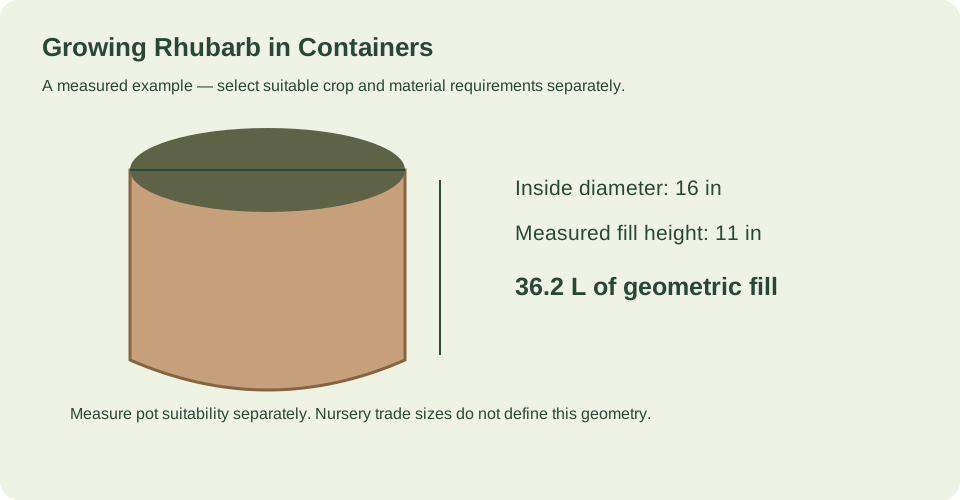
The supplied example is a geometry check only: a straight-sided pot with a 16 in inside diameter, 12 in inside height and a 1 in rim gap gives a fill height of 11 in and about 1.28 cubic feet, 36.24 liters or 9.57 US liquid gallons. Those figures describe how much medium that shape holds. They do not establish a minimum pot size for rhubarb.
Use the example to check fill quantity after you have separately confirmed that the pot meets the RHS depth and width guidance. A volume figure cannot show that a pot is wide or deep enough for a large crown, so compare dimensions before buying medium.
- Confirm depth and width against the RHS guidance first.
- Then use the example's fill volume only to estimate medium for that measured shape.
- Do not treat the example volume as a rhubarb pot minimum.
Source context: Royal Horticultural Society · University of Maryland Extension
Check your measured example
Volume-only illustration: one straight-sided pot with inside diameter 16 in, inside height 12 in and 1 in rim gap. The resulting fill capacity is not a minimum pot size for rhubarb; confirm a suitable container separately.
| Quantity | Calculated result |
|---|---|
| inside diameter in | 16 |
| fill height in | 11 |
| volume cuft | 1.2799 |
| volume liters | 36.243 |
| US liquid gallons | 9.5744 |
The example is a volume-only illustration for a straight-sided pot with a 16 in inside diameter, 12 in inside height and 1 in rim gap, giving an 11 in fill height and about 1.28 cubic feet, 36.24 liters or 9.57 US liquid gallons. It shows fill capacity for that shape, not a rhubarb pot minimum; confirm the RHS depth and width guidance separately before buying medium.
Example inputs explain the method. Review the source context, chosen cultivar and actual site before planting or ordering.
Your before-you-plant checklist
- Pot measures at least 50 cm (20 in) deep and wide inside.
- Variety is described as compact.
- Drainage holes are open and no gravel layer is used to replace them.
- Medium is a peat-free soil-based potting compost.
- Crown tip sits just above the medium surface.
- Saucer is emptied and the pot is accessible for monitoring.
Questions that come up while planning
What pot size does the RHS give for rhubarb in a container?
The RHS describes a container at least 50 cm (20 in) deep and wide, preferably with a compact variety. Compare both inside dimensions, not volume alone.
What growing medium should I use?
The RHS container guidance calls for a peat-free soil-based potting compost. That means a formulated container medium, not pure garden compost used as a soil amendment.
Where should the crown sit in the pot?
The RHS general planting instructions place the crown tip, where leaves emerge, just above the soil surface. The separate Utah passage about covering a nursery root ball in a garden is not a container depth instruction.
Sources & method
Horticultural guidance is linked to its original source and regional context. Geometry and unit conversions are calculated separately. Read how we prepare and check a page.
- How to grow rhubarbRoyal Horticultural Society
- How to Grow Rhubarb in Your Garden Utah State University Extension
- Growing Vegetables in Containers and Salad TablesUniversity of Maryland Extension
- Growing Media (Potting Soil) for ContainersUniversity of Maryland Extension