
What the spacing source does and does not set
The provided guidance gives a minimum between rosemary plants: at least 45 cm, approximately 18 inches. Treat that as the plant-to-plant interval for initial planting, not as a sowing or thinning rate and not as a universal between-row distance. The source also notes that mature cultivar habit matters, so a compact cultivar and a spreading one may need different access and adjacent-row decisions.
One measured row is a placement example, not an entire garden layout. It does not tell you how far apart parallel rows should be, where paths go, or how much room a mature plant needs beyond its center. Those choices must be made separately for the site.
- Record the source minimum as at least 45 cm, approximately 18 inches, between rosemary plants.
- Label any chosen interval as a scenario value, not a universal recommendation.
- Note mature cultivar habit as a separate check before fixing adjacent rows or access space.
Source context: Royal Horticultural Society
Worked example: one 144-inch row at 18-inch centers
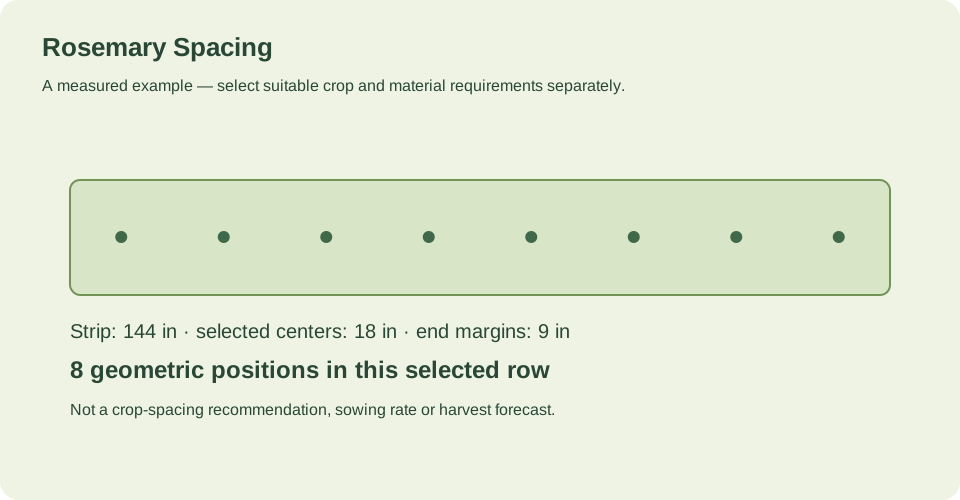
The verified example uses a 144-inch row, a selected 18-inch center interval, and 9-inch margins at both ends. The first center is at 9 inches and the last at 135 inches. The counted item is plants: 8 plant positions fit in that measured row under those selected values.
This is a geometrical example, not crop advice. The 18-inch interval sits within the provided RHS context of at least 45 cm, approximately 18 inches, but the example does not establish a between-row distance or a bed width. The 9-inch end margins are selected example values, not a spacing rule from the source.
- Measure the actual row length before counting.
- Subtract both end margins from the row length.
- Divide the remaining length by the center interval, then add one to count positions when the layout fits exactly as in the example.
- Check that the first and last centers match the chosen margins.
Source context: Royal Horticultural Society
Marking plants and checking the rest of the plan
Mark plant centers rather than leaf spread. In the example, place marks at 9 inches and 135 inches for the end centers, with the selected 18-inch interval between them. Keep the counted item precise: the result is 8 plants, not 8 gaps, seeds, or rows.
After marking one row, decide separately how much access space you need, whether supports or adjacent rows affect the plan, and how the mature habit of your rosemary cultivar fits the site. The linked guide does not provide those distances, so do not copy the 18-inch interval into a between-row setting without a separate basis.
- Mark the first and last centers at the chosen end margins.
- Mark intermediate centers at the selected interval and count plants, not intervals.
- Check access, adjacent rows, supports, and mature habit as separate planning items.
- Use the linked row calculator to count this exact length, center interval, and both end margins in inches or centimeters.
Source context: Royal Horticultural Society
Check your measured example
One measured 144-inch row, with selected 18-inch centers and 9-inch margins at both ends. Count 8 plants.
Reference and growing system: RHS garden-planting guidance allows at least 45 cm, approximately 18 inches, between rosemary plants. Mature cultivar habit still matters. This is not a universal separate between-row distance.
| Quantity | Calculated result |
|---|---|
| Usable row length (in) | 144 |
| Selected center spacing (in) | 18 |
| Margin at each row end (in) | 9 |
| Positions in this row | 8 |
| First center from row start (in) | 9 |
| Last center from row start (in) | 135 |
| What is being counted | plants |
The worked example is a single 144-inch row with 18-inch centers and 9-inch margins at both ends. It yields 8 plant positions, with the first center at 9 inches and the last at 135 inches. The 18-inch interval is within the RHS context of at least 45 cm, approximately 18 inches, between plants; the example does not set a between-row distance, bed width, or mature-plant access space.
Count this row in the spacing calculator ↗Example inputs explain the method. Review the source context, chosen cultivar and actual site before planting or ordering.
Your before-you-plant checklist
- Confirm the measured row length in inches or centimeters.
- Label the chosen center interval and both end margins as scenario values.
- Mark plant centers and count plants, not gaps.
- Check mature cultivar habit before fixing adjacent rows or access space.
- Keep the row example separate from the full garden layout.
Questions that come up while planning
Is 18 inches the rosemary between-row spacing?
No. The provided RHS context gives at least 45 cm, approximately 18 inches, between rosemary plants. It does not provide a universal separate between-row distance.
Does the 144-inch example prove that 8 rosemary plants fit every garden?
No. It shows 8 plant positions for one measured 144-inch row with selected 18-inch centers and 9-inch end margins. It is a geometrical example, not a whole-garden layout or crop recommendation.
What does the example count?
It counts plants. The first center is at 9 inches, the last at 135 inches, and the selected interval is 18 inches, giving 8 plant positions.
Sources & method
Horticultural guidance is linked to its original source and regional context. Geometry and unit conversions are calculated separately. Read how we prepare and check a page.
- How to grow RosemaryRoyal Horticultural Society