
Decide whether a container suits this rosemary
Rosemary is a reasonable container herb when you can give it a warm, sunny position and a free-draining growing medium. Its evergreen, aromatic leaves and small flowers make it useful as a container centrepiece, and it can sit alongside other shrubby, sun-loving herbs such as sage, thyme and hyssop.
Variety matters. Rosemary varieties differ in size, flower colour and growth style: some are tall and upright, such as Miss Jessopp's Upright, while others are low and trailing, such as Capri. Match the pot to the cultivar you actually have, because a trailing plant and an upright plant make different demands on shape and top space. Volume alone does not define a suitable pot shape.
Rosemary is hardy through most of the UK but may need winter protection in colder locations. That is a local and cultivar-dependent judgement, not a promise that a container plant will survive winter. If winter survival matters to you, plan protection and accept that the outcome is not guaranteed.
- Identify your rosemary cultivar or growth style before choosing a pot.
- Confirm you have a warm, sunny position for the container.
- Decide how you will protect the pot in cold weather, or accept the risk.
Source context: Royal Horticultural Society · University of Maryland Extension
Choose and measure the pot
Maryland describes 5-gallon-or-larger pots for large herbs including rosemary, sage, parsley, dill and fennel. Use that named group as the reference rather than assigning an unsupported crop-specific capacity, and remember these are guide examples, not guarantees for every variety.
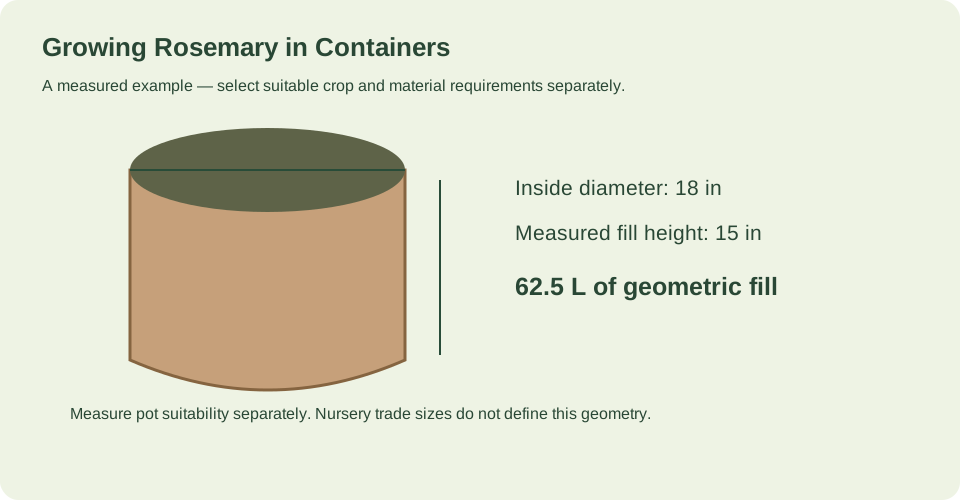
Measure actual fill volume rather than relying on nursery trade-gallon labels. A pot's usable fill depends on its inside dimensions and on how far below the rim you leave the growing medium. The worked example in the table is a volume-only illustration: one straight-sided pot with an inside diameter of 18 inches, an inside height of 16 inches and a 1-inch rim gap, giving a fill height of 15 inches. That calculation is geometry, not a minimum pot size for rosemary. Confirm a suitable container separately.
Drainage holes must remain open. Stones or gravel under the mix do not improve drainage, and empty saucers so roots are not left saturated.
- Measure inside diameter and inside height, then subtract the rim gap to get fill height.
- Calculate fill volume from those inside dimensions and compare it with the named large-herb reference.
- Check that drainage holes are open and that any saucer can be emptied.
Source context: University of Maryland Extension
Prepare the growing medium and support
The growing medium must support roots while holding appropriate water and air. Dense garden soil behaves differently from a container mix, so do not treat them as interchangeable. For container vegetables, the guide lists commercial soilless mix and an equal-volume soilless-mix and compost blend among its options.
If you reuse medium, remove plant residue and do not save medium associated with root disease. Blend old and fresh material rather than assuming old mix is unchanged.
Because rosemary is woody and can become straggly and bare at the base if left unpruned, plan for annual clipping to keep it compact and bushy. Even with regular trimming, it is often best to replace rosemary every seven or eight years with a new young plant, and rosemary is easy to grow from cuttings.
- Choose a commercial soilless mix or an equal-volume soilless-mix and compost blend.
- Remove plant residue before reusing any medium, and discard medium linked to root disease.
- Plan an annual trim after flowering to keep the plant compact.
Source context: University of Maryland Extension · Royal Horticultural Society
Set up and monitor the container
Once established, rosemary is drought tolerant and needs little maintenance apart from annual clipping. That does not mean ignoring the pot: check that drainage stays open, that the saucer is emptied, and that the plant has room for its mature top growth.
Rosemary is considered a high-risk host plant for the bacterial disease Xylella fastidiosa. Buying British-grown rosemary helps reduce the risk of importing the disease, and growing new plants from cuttings is another option if you already have a plant.
Seeds are available, but plants grown from seed may take several years before they are large enough to harvest leaves from. Keep monitoring simple: watch drainage, top growth and winter protection rather than expecting a set yield.
- Check drainage holes and empty the saucer regularly.
- Trim annually after flowering to keep the plant bushy.
- Review winter protection as cold weather approaches.
- Note when the plant outgrows its pot or grid cell and plan replacement or propagation.
Source context: Royal Horticultural Society · University of Maryland Extension · University of Maryland Extension
Check your measured example
Volume-only illustration: one straight-sided pot with inside diameter 18 in, inside height 16 in and 1 in rim gap. The resulting fill capacity is not a minimum pot size for rosemary; confirm a suitable container separately.
| Quantity | Calculated result |
|---|---|
| inside diameter in | 18 |
| fill height in | 15 |
| volume cuft | 2.2089 |
| volume liters | 62.55 |
| US liquid gallons | 16.524 |
The worked example is a volume-only illustration: a straight-sided pot with an 18-inch inside diameter, 16-inch inside height and 1-inch rim gap, giving a 15-inch fill height and the listed fill capacity. It is geometry, not a rosemary minimum pot size; confirm a suitable container separately using the named large-herb reference and the plant's mature top growth and root space.
Example inputs explain the method. Review the source context, chosen cultivar and actual site before planting or ordering.
Your before-you-plant checklist
- Cultivar or growth style identified before choosing a pot.
- Pot compared with the named 5-gallon-or-larger large-herb reference.
- Fill volume measured from inside dimensions and rim gap, not trade-gallon labels.
- Drainage holes open and saucer emptied.
- Growing medium is soilless mix or an equal-volume soilless-mix and compost blend.
- Annual trim after flowering planned.
Questions that come up while planning
What pot size does rosemary need in a container?
Maryland describes 5-gallon-or-larger pots for large herbs including rosemary. That is a named guide example, not a guarantee for every variety. Match the pot to the cultivar's mature top growth and root space, and measure actual fill volume rather than relying on trade-gallon labels.
Is the 18-inch example pot a minimum size for rosemary?
No. The example is a volume-only geometry illustration for one straight-sided pot with an 18-inch inside diameter, 16-inch inside height and 1-inch rim gap. It shows how fill capacity is calculated, not a minimum pot size for rosemary.
Will rosemary survive winter in a container?
Rosemary is hardy through most of the UK but may need winter protection in colder locations. Survival depends on cultivar and local conditions, and no winter-survival guarantee applies to a container plant.
Sources & method
Horticultural guidance is linked to its original source and regional context. Geometry and unit conversions are calculated separately. Read how we prepare and check a page.
- How to grow RosemaryRoyal Horticultural Society
- Growing Vegetables in Containers and Salad TablesUniversity of Maryland Extension
- Growing Media (Potting Soil) for ContainersUniversity of Maryland Extension