
Set the frost anchor and the transplant window
Start with a local last-frost reference for your area. An average frost date is a historical midpoint, not a forecast for the coming season, and hardiness zones describe general climate patterns rather than a precise frost date for your garden. Record the source and date you used so the plan can be checked later.
Next, choose the transplant window you intend to use. Seed packets and plant tags supply variety information, and planting schedules depend on local frost dates and the crop's maturity period. Historical frost probabilities do not guarantee a particular season, so treat the chosen window as a plan to verify locally rather than a fixed appointment.
- Write down your local last-frost reference and where it came from.
- Choose the transplant window you intend to use for the crop.
- Note the crop and variety details from the packet or tag.
Source context: University of New Hampshire Extension · University of Illinois Extension
Subtract the indoor growing period
Once the transplant window is chosen, subtract the indoor growing weeks to find the sowing date. The New Hampshire reference gives tomato seedlings 6 to 8 weeks indoors and transplanting 1 to 2 weeks after last frost. That range is a crop example, not a rule for every plant.
A range produces two dates: an earlier sowing date from the longer indoor period and a later sowing date from the shorter one. Both are planning boundaries. Outdoor readiness still depends on actual local conditions at transplant time.
- Convert the indoor weeks to days.
- Subtract the longer period to get the earliest sowing date.
- Subtract the shorter period to get the latest sowing date.
- Mark both dates in your journal with the chosen transplant date.
Source context: University of New Hampshire Extension · University of Illinois Extension
Worked tomato example
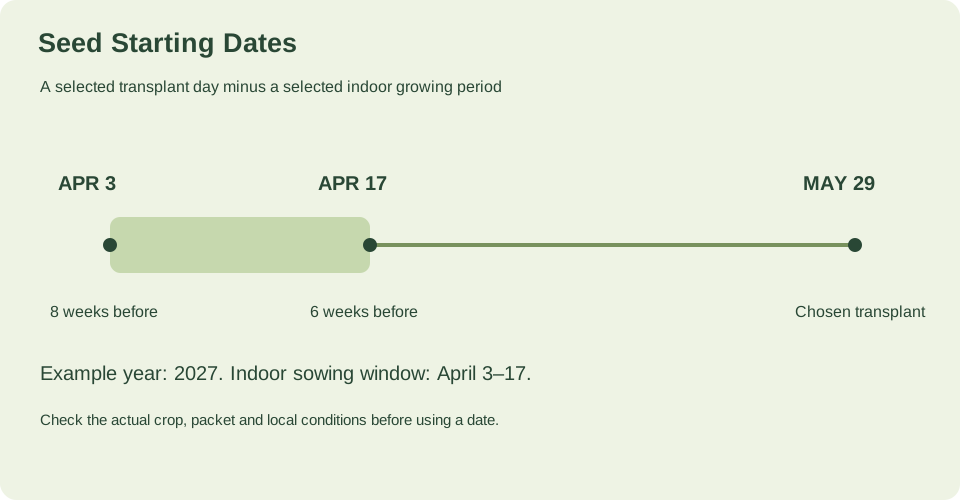
The supplied example is arithmetic only. A chosen transplant date of May 29, 2027, minus a selected 6 to 8 week indoor period, gives an earliest sowing date of April 3, 2027, and a latest sowing date of April 17, 2027. The earlier end is 56 days before transplant; the later end is 42 days before transplant.
This example shows how the subtraction works. It does not confirm that May 29 suits your garden, and it does not turn the tomato range into advice for other crops. Keep the local crop and weather checks separate from the calculation.
- Check that the chosen transplant date is recorded separately from the calculated sowing dates.
- Confirm the indoor weeks came from the crop or packet context you selected.
Source context: University of New Hampshire Extension · University of Illinois Extension
Document the plan and check it
Record the frost anchor, the intended transplant date, the indoor period and both sowing boundaries in one place. The date tool can run the subtraction, the quantity calculator can size the sowing, and the succession guide can help you think through timing across the season. A second sowing is not automatically feasible; decide it from your own space, crop context and local conditions.
When the sowing date arrives, compare the plan with actual local conditions rather than treating the calculated date as a guarantee. Update the journal with what you chose and why.
- Log the anchor, transplant date and sowing boundaries together.
- Use the date tool for the subtraction and the quantity calculator for sowing size.
- Review the succession guide before adding another sowing.
- Update the journal when local conditions change the plan.
Source context: University of New Hampshire Extension · University of Illinois Extension
Check your measured example
Arithmetic example only: a chosen transplant date of May 29, 2027, minus a selected 6–8 week indoor period. Local crop and weather checks remain separate.
| Quantity | Calculated result |
|---|---|
| chosen transplant date | 2027-05-29 |
| earliest sowing date | 2027-04-03 |
| latest sowing date | 2027-04-17 |
| earlier end days before transplant | 56 |
| later end days before transplant | 42 |
The example is arithmetic only: a chosen transplant date of May 29, 2027, minus a selected 6 to 8 week indoor period, yields April 3 and April 17, 2027, as the earlier and later sowing boundaries, 56 and 42 days before transplant. It does not add crop advice or confirm local suitability.
Example inputs explain the method. Review the source context, chosen cultivar and actual site before planting or ordering.
Your before-you-plant checklist
- Local last-frost reference recorded with its source.
- Intended transplant window chosen and written down.
- Indoor growing period taken from the crop or packet context.
- Earliest and latest sowing dates calculated and logged.
- Plan checked against actual local conditions before transplanting.
Questions that come up while planning
Is an average frost date a forecast?
No. It is a historical reference. Historical frost probabilities do not guarantee a particular season, so verify the intended transplant date against actual local conditions.
Can I use the tomato example for every crop?
No. The 6 to 8 week indoor period and the 1 to 2 week post-frost transplant window are the supplied tomato example. Other crops need their own packet or crop context.
Does a hardiness zone give me a precise frost date?
No. A hardiness zone is different from an actual local frost date. Use a local frost reference and record where it came from.
Sources & method
Horticultural guidance is linked to its original source and regional context. Geometry and unit conversions are calculated separately. Read how we prepare and check a page.
- Growing Vegetables: When to Plant Your Vegetable GardenUniversity of New Hampshire Extension
- When to PlantUniversity of Illinois Extension