
Essentials organized by the job each item does
A practical seed starting setup separates supplies by function. Viable packet information tells you what the crop needs and when to start it; read the packet before buying anything else, because it governs timing and sowing depth. Containers need drainage, and a support tray underneath catches water and keeps cells steady. A suitable seed-starting medium fills the cells, while adequate light serves the seedlings after germination. Labels identify what is in each cell, and a simple way to check moisture keeps you from guessing.
Keep the count of cells separate from the count of seeds and from any promise of seedlings. Sowing more seeds than your target cells is a choice about expected germination, not a guarantee. The seed quantity tool handles your expected rates separately, so you can enter your own assumptions and see the arithmetic without mixing them into the cell count.
- Read the crop packet for timing, sowing depth and light needs before purchasing.
- List containers with drainage, a support tray, medium, light, labels and a moisture-checking method as separate lines.
- Decide your target cell count first, then note expected germination rates separately using the seed quantity tool.
Source context: University of Minnesota Extension
Measured two-tray example
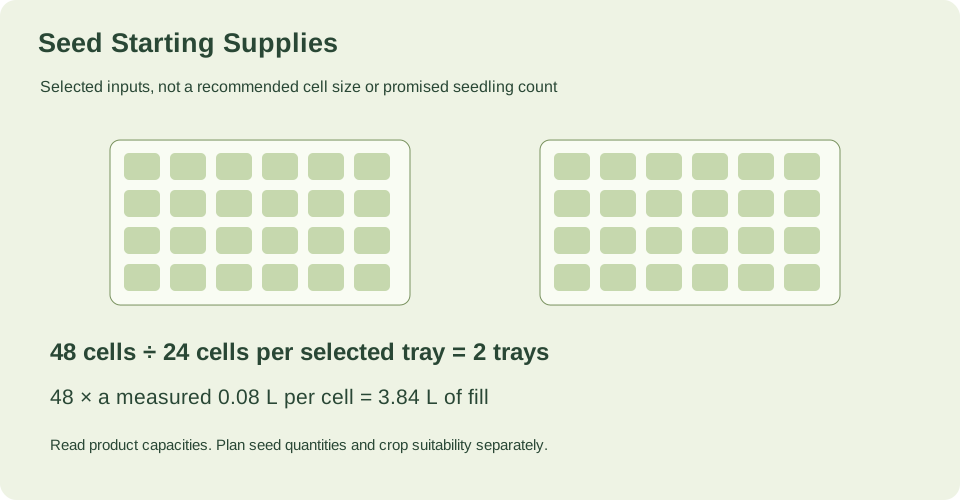
The example starts with 48 target cells and selects 24-cell trays, which rounds to two trays. A measured fill of 0.08 L per cell gives 3.84 L of total fill. These are explicit arithmetic inputs chosen for the example, not a recommended cell size or a tray capacity that suits every crop. Your own cells and measured fill will produce different numbers.
For medium, a selected 8 L bag rounds to one bag before any separately chosen reserve. That rounding is purchasing arithmetic only. Check the actual bag label for its stated volume, and compare product capacity and tray compatibility against the labels rather than assuming a fit. A material limitation: package label units govern volume conversions, so a bag listed in quarts or cubic feet must be converted from its own label before you compare it with your fill total.
- Multiply target cells by measured fill per cell to get total fill volume.
- Divide target cells by cells per selected tray and round up to whole trays.
- Divide total fill by the bag volume on the label and round up, then add any reserve you choose separately.
Source context: University of Minnesota Extension
Check capacity and compatibility on labels
Before buying, compare the numbers on the products themselves. Confirm that your chosen cells fit the support tray, that the tray fits where the light will sit, and that the medium volume on the bag meets your fill total. If you plan to pot seedlings on later, account for that pot space as a separate line so it does not get folded into the cell count. The pot-volume tool helps you size later pots from your own measurements.
Use the medium-comparison guide to weigh medium options by what each is suited to, and use the date calendar to set start dates from packet information. Record what you bought, the label volumes and your target cell count in the journal so the next planning round starts from real figures.
- Check that cells fit the support tray and that the tray fits under the light.
- Confirm the medium volume on the bag label against your total fill.
- Note later pot space as its own line, and log purchases and label volumes in the journal.
Source context: University of Minnesota Extension
Check your measured example
User-selected purchasing arithmetic, not a crop-specific cell-size recommendation or seedling survival forecast. Fill volume comes from the actual chosen cells.
| Quantity | Calculated result |
|---|---|
| target cells | 48 |
| cells per selected tray | 24 |
| trays rounded | 2 |
| measured fill per cell liters | 0.08 |
| total fill liters | 3.84 |
| selected bag liters | 8 |
| bags rounded without reserve | 1 |
The example is purchasing arithmetic from user-chosen inputs: 48 target cells in 24-cell trays rounds to two trays, and 0.08 L per cell gives 3.84 L of fill. An 8 L bag rounds to one bag before any separately chosen reserve. It is not a crop-specific cell-size recommendation, a tray capacity claim or a seedling survival forecast.
Example inputs explain the method. Review the source context, chosen cultivar and actual site before planting or ordering.
Your before-you-plant checklist
- Packet read for timing, sowing depth and light before buying
- Containers with drainage and a support tray that fits
- Medium volume checked against total fill on the bag label
- Labels ready for every cell
- Moisture-checking method chosen
- Later pot space listed separately from cell count
Questions that come up while planning
How many trays do I need for 48 cells?
If you select 24-cell trays, 48 target cells divide into two trays. That is arithmetic from your chosen tray size, not a tray recommendation for any crop.
How much medium does the example use?
At a measured 0.08 L per cell, 48 cells need 3.84 L of fill. An 8 L bag rounds to one bag before any reserve you choose separately. Check the bag label for its stated volume.
Should I buy one seed per target cell?
No. Keep target cells separate from seeds and from expected seedlings. Use the seed quantity tool to apply your own expected germination rates rather than assuming every seed becomes a plant.
Sources & method
Horticultural guidance is linked to its original source and regional context. Geometry and unit conversions are calculated separately. Read how we prepare and check a page.
- Starting seeds indoorsUniversity of Minnesota Extension